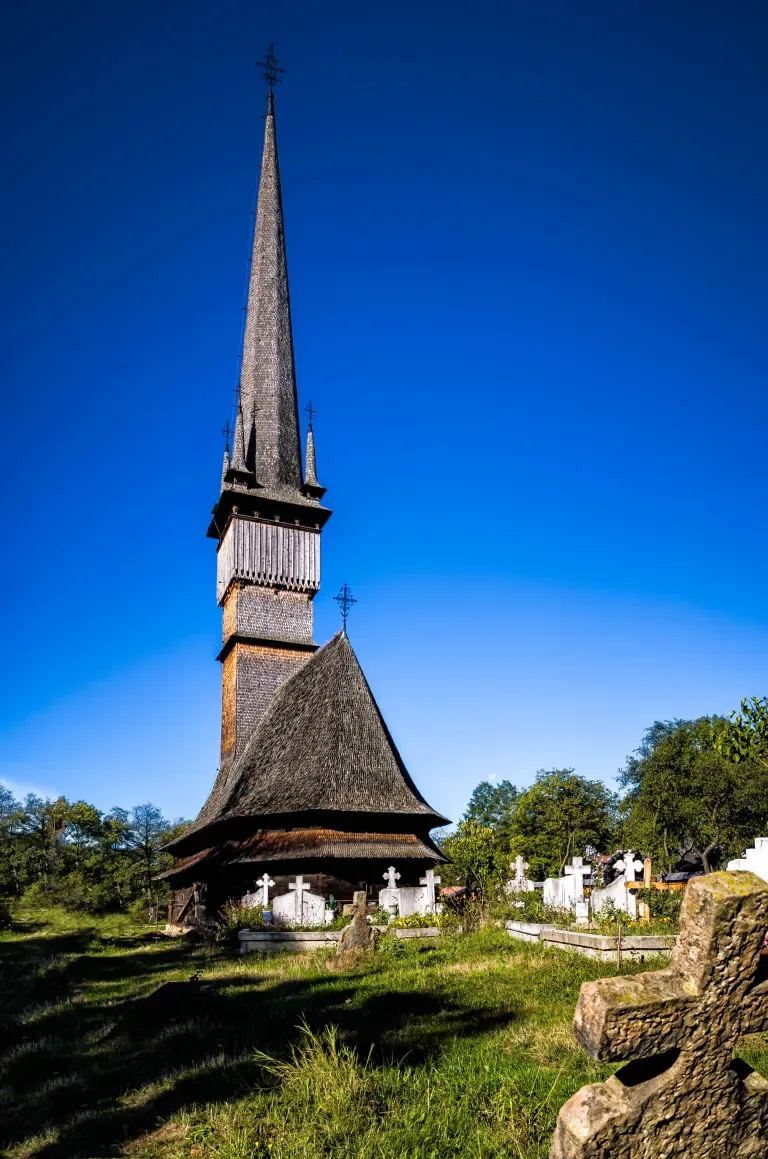
Two massive elm trees provided the entire timber frame for this 17th-century sanctuary, a building held together by wooden pegs and the collective faith of a village that refused to disappear.
About Church of the Holy Archangels
The Church of the Holy Archangels reflects the specific 'Lăpuș style' of Maramureș architecture, which is slightly more robust and less vertical than its counterparts in the Iza Valley. Its construction in 1663 was a defiant act of cultural survival in a period of frequent Ottoman and Tatar raids. The 1785 frescoes are particularly notable for their folk-art aesthetic; the painters didn't aim for Byzantine perfection but for storytelling that the illiterate peasantry could understand. Over the years, the elm wood has hardened into something resembling stone, and the grey-silver patina of the roof shingles is the result of centuries of exposure to the harsh northern winters. It remains an active church, though its primary role now is as a cultural anchor for the region.
In the village of Rogoz, tucked into
In the village of Rogoz, tucked into the Lăpuș Valley of Maramureș, stands a wooden structure that feels more like a living organism than a building. The Church of the Holy Archangels Michael and Gabriel is a masterpiece of vernacular architecture, built entirely of elm without the use of a single metal nail. Its distinctive feature is an asymmetrical roof, with one side longer than the other to protect the small porch where the village elders once held council. Part of the UNESCO World Heritage list, this church is proof of the spiritual ingenuity of the Romanian peasantry, who, forbidden by their Hungarian rulers from building in stone, reached for the heavens using the only material they had: the ancient forests of the north.
church was erected, 1663
The church was erected in 1663, following a devastating Tatar invasion that leveled the previous place of worship. The villagers of Rogoz, determined to rebuild, used two massive elm trees from the nearby hills to create the foundation and the walls. The structure is famous for its 'horse head' console endings, a pre-Christian motif intended to ward off evil spirits. Across centuries, the church was the social and religious heart of the village. Inside, the walls are covered in frescoes painted in 1785 by the local masters Radu Munteanu and Nicolae Man, who used vegetable dyes to depict biblical scenes with a distinctly local, rural flavor. The church survived the world wars and the industrialization of the region, preserved by its remote location and the devotion of its small parish.
Approaching the church requires ducking through a low doorway, an architectural choice designed to force a bow of humility. The interior is cramped, dim, and smelling of dried herbs and old wood. The light is scarce, coming from tiny windows that look like arrow slits, which keeps the 18th-century frescoes remarkably vivid. Leading with the depictions of the Last Judgment, where the 'sinners' are often dressed in the costumes of the village's historical enemies. The floor is made of wide, uneven planks that groan underfoot, and the low ceiling in the narthex creates an intimate, almost womb-like atmosphere. Outside, the churchyard is filled with simple stone and wooden crosses, and the silence is only broken by the distant sound of a tractor or the call of a crow. Rogoz is located about 45 kilometers southeast of Baia Mare. There are no direct trains, so a car is essential for the journey. The drive takes you through the rolling hills of the Lăpuș region, a landscape defined by haystacks and horse-drawn carts. The church is located on a small hill in the center of the village. It is often kept locked to protect the delicate interior, but a sign on the gate usually directs you to the house of the caretaker, who lives just a few doors down and is happy to open the doors for visitors for a small donation. This interaction with the local keeper is as much a part of the experience as the church itself.
The Experience
What comes through is how the church feels rooted to the spot, its low-slung roof mimicking the surrounding hills. Inside, the darkness is absolute for the first few seconds until your eyes adjust to the flicker of a single candle. You find yourself tracing the 'horse head' carvings with your fingers, feeling the rough grain of wood that was growing before the Enlightenment. The surroundings are remarkably still, and the paintings on the walls, vibrant yellows and deep ochres, feel almost like they are emerging from the wood itself. You find no pomp here; the altar is small, the pews are simple benches, and the connection to the earth is visceral. Inside the graveyard afterward, the modern world feels incredibly distant and strangely thin.
Why It Matters
Rogoz is one of the most authentic examples of the Northern Romanian wooden church tradition. It represents a peak of technical skill in joinery and a unique synthesis of Christian iconography and pre-Christian pagan symbols. As a UNESCO site, it provides a crucial link to a medieval way of life that has largely vanished from the rest of Europe but persists in the daily rhythms of Maramureș.
Why Visit
Visit Rogoz for the intimacy. While the taller wooden churches of Bârsana or Șurdești are more 'famous,' Rogoz feels personal and untouched. It is the best place to understand the raw, unpolished spirit of the Romanian north, where the line between the forest and the chapel is almost non-existent.
✦ Photo Gallery
Best Season
🌤 Late June is spectacular, as the surrounding hay meadows are in full bloom and the village celebrates the feast of the Archangels with traditional local customs.
Quick Facts
Best time to visit
Late June is spectacular, as the surrounding hay meadows are in full bloom and the village celebrates the feast of the Archangels with traditional local customs.
Getting there
In Maramureș, Romania; reach Maramureș first, then continue to the site.
Location
Maramureș, Romania
Type
attraction
Insider Tips
- 1
Don't be shy about knocking on the caretaker's door; they are the gatekeepers of the church's history and usually live within sight of the gate.
- 2
Look for the 'Table of the Elders' in the porch, where the names of the village's noble families are still visible on the wooden beams.
- 3
Walk to the back of the church to see the asymmetrical roof line, which is best viewed from the lower cemetery path.
- 4
The road to Rogoz can be bumpy; ensure your car has decent ground clearance if you're taking the back routes from Cavnic.