“Cross a bridge spanning a dizzying gorge to enter a fortress so quintessentially Gothic that it has been used as the definitive backdrop for Hollywood’s darkest legends.”
About Corvin Castle
John Hunyadi built this fortress not just for defense, but to announce the arrival of his dynasty. The castle’s architecture is a rare blend of functional military engineering and high-status residential design. The 'Nebojša' tower, meaning 'Don't be afraid' in Serbian, was the final redoubt, designed to be independent of the rest of the castle in case of a breach. After the Corvinus line died out, the castle passed through several noble families, including the Bethlens and the Zapoilyas, each adding a layer of Baroque or Renaissance style before the 19th-century fire nearly reduced it to a ruin. The subsequent reconstruction was led by architects who were perhaps more inspired by romantic novels than historical accuracy, giving us the dramatic silhouette we see today.
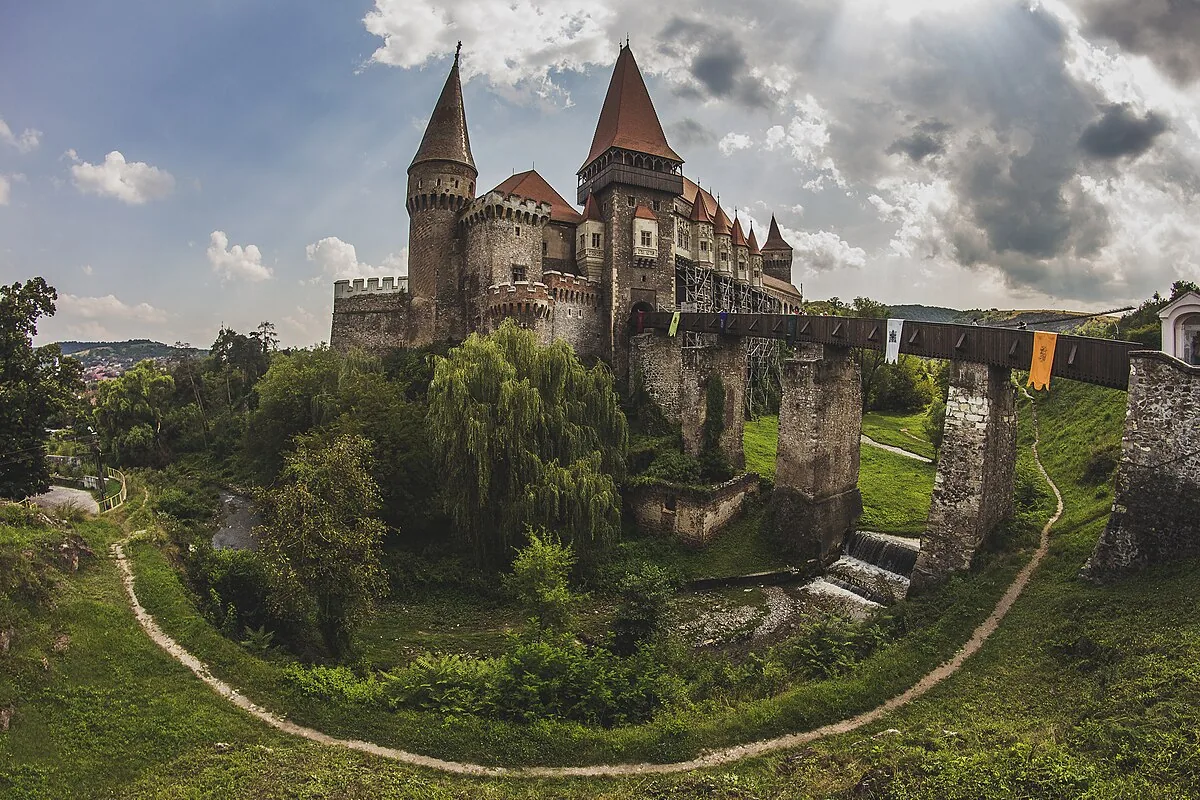
Corvin Castle in Romania
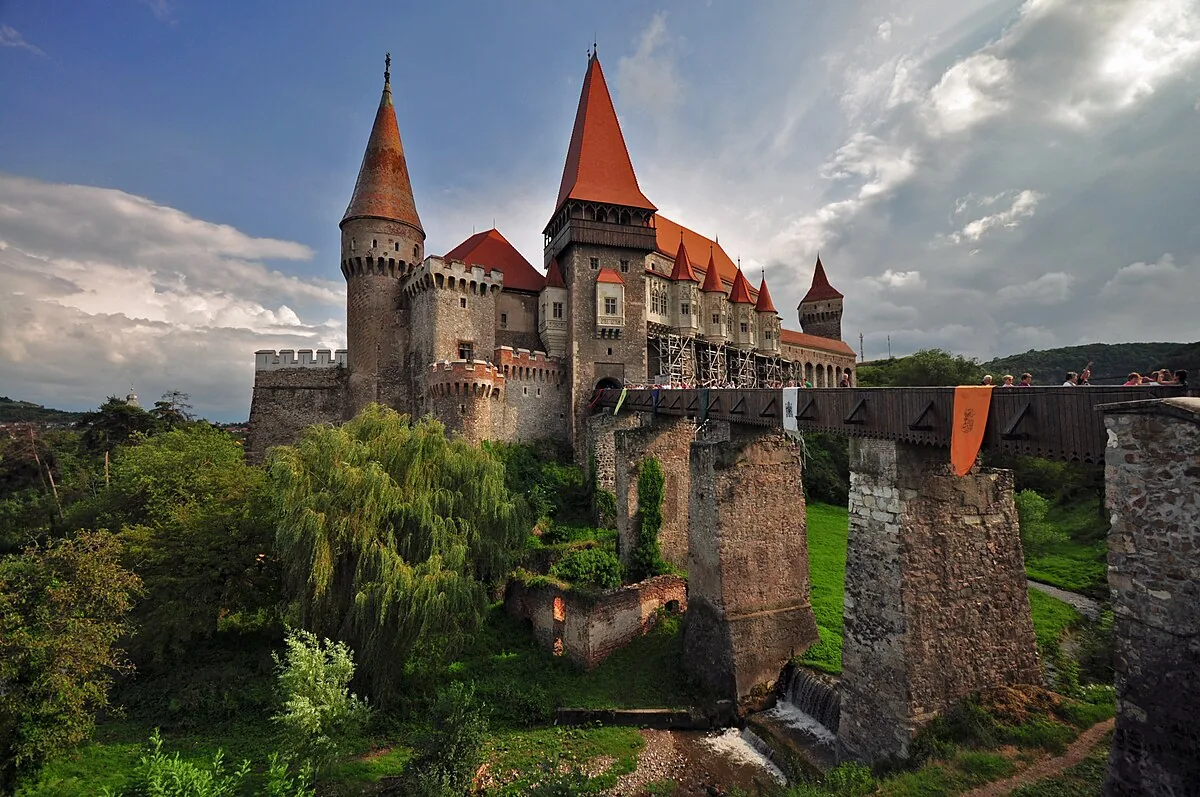
A massive stone bridge spans a deep moat, leading toward the jagged, fairy-tale silhouette of Corvin Castle. This Gothic-Renaissance fortress in Hunedoara is the stuff of cinematic legend, featuring tall, circular towers, multicolored roof tiles, and an interior of echoing halls and dark dungeons. Known also as Hunyadi Castle, it is one of the largest and most impressive fortresses in Europe. The space here is often heavy smelling of wet limestone and the metallic tang of old iron. It is a building designed for intimidation, a vertical fortress that seems to grow directly out of the rock. While Bran Castle has the myth of Dracula, Corvin Castle has the actual architecture of a medieval warlord, standing as a formidable monument to the military power of the Transylvanian nobility.
A massive stone bridge spans a deep moat, leading toward the jagged, fairy-tale silhouette of Corvin Castle.
building the castle, 1440
John Hunyadi, a brilliant military commander who stopped the Ottoman advance at Belgrade, began building the castle in 1440 on the site of an earlier fortification. He transformed it into a masterpiece of Gothic design, with the Diet Hall and the Knight's Hall serving as symbols of his rising status. His son, Matthias Corvinus, who became one of Hungary’s greatest kings, continued the work, adding Renaissance flourishes and the famous 'Loggia Matia.' The castle’s history is peppered with dark legends, including the story of a deep well supposedly dug by three Turkish prisoners who were promised freedom but were executed after fifteen years of labor. After centuries of neglect and a devastating fire in 1854, the castle underwent a massive restoration that gave it the dramatic, slightly romanticized appearance it has today.
Crossing the long wooden bridge,
Crossing the long wooden bridge, The height of the Zlaști River gorge beneath you, a dizzying drop that emphasizes the castle's defensive intent. Inside, the space the Knight’s Hall is cool and silent, carrying a trace of cold hearths and damp stone. First you see the way the rib-vaulted ceilings create complex shadows on the floor, lit by narrow slits in the masonry. The standout is the intricate coat of arms of the Corvin family, a raven holding a gold ring in its beak, carved into every available surface. There is a claustrophobia of the dungeons, where the stone walls seem to press inward, and The scratches on the walls of the torture chamber. You catch the vibrant geometric patterns on the roof tiles of the towers, which provide a splash of color against the grey stone. People generally stick to the main halls, but you should notice the 'Capistrano' tower, where the famous monk once lived, its tiny fireplace still soot-stained. The way the light filters through the stained glass in the chapel, casting pools of red and blue on the stone floor. The sound of your own breathing becomes noticeable in the stillness of the armory, where suits of plate mail stand like hollow ghosts.
Hunedoara is best reached by car
Hunedoara is best reached by car or bus from Deva, which is on the main train line between Bucharest and Arad. The castle sits on the edge of the modern industrial town, and the contrast between the 15th-century stone and the surrounding steel mills is one of the most striking sights in the region.
Hunedoara is best reached by car or bus from Deva, which is on the main train line between Bucharest and Arad.
The Experience
The wind howls through the arrow-slits of the Deserted Tower, a sound that makes the stone walls feel even more ancient. What hits is the way the cold penetrates your clothes in the lower galleries, even in the height of summer. Something like a sense of grandeur in the Diet Hall, imagining the boisterous feasts and political scheming that took place under its vaulted roof. Immediately, the small, iron-bound doors that lead to secret spiral staircases, a reminder that this was a place of secrets. The moment that anchors the visit is standing in the courtyard at twilight, as the towers turn black against a violet sky and the castle’s true, imposing character is revealed.
Why It Matters
Corvin Castle is the most significant Gothic secular building in Transylvania. It represents the peak of 15th-century military architecture and serves as a monument to the Hunyadi family, who were instrumental in defending Central Europe from the Ottoman Empire. It is a physical manifestation of the transition from medieval warfare to the early modern state.
Why Visit
Check out this castle for the sheer scale and architectural drama that Bran Castle lacks. It feels like a 'real' castle, with its deep moats, towering walls, and authentic Knight’s Hall. It is the best place in Romania to lose yourself in a medieval fantasy that is actually backed by solid stone and blood-soaked history.
✦ Insider Tips
- 1
Arrive at the gate ten minutes before it opens to cross the bridge without a dozen other people in your photographs.
- 2
Look for the inscription on the wall of the well; it allegedly says 'You have water, but you have no heart,' a message from the executed prisoners.
- 3
Wear sturdy shoes; the stone floors and spiral stairs are uneven and can be very slippery from the constant humidity.
- 4
The Knight’s Hall is often used for events; check the schedule beforehand to ensure the main room isn't closed for a private function.
- 5
Take a moment to explore the exterior path that runs along the riverbed for the most imposing angle of the castle's massive foundations.