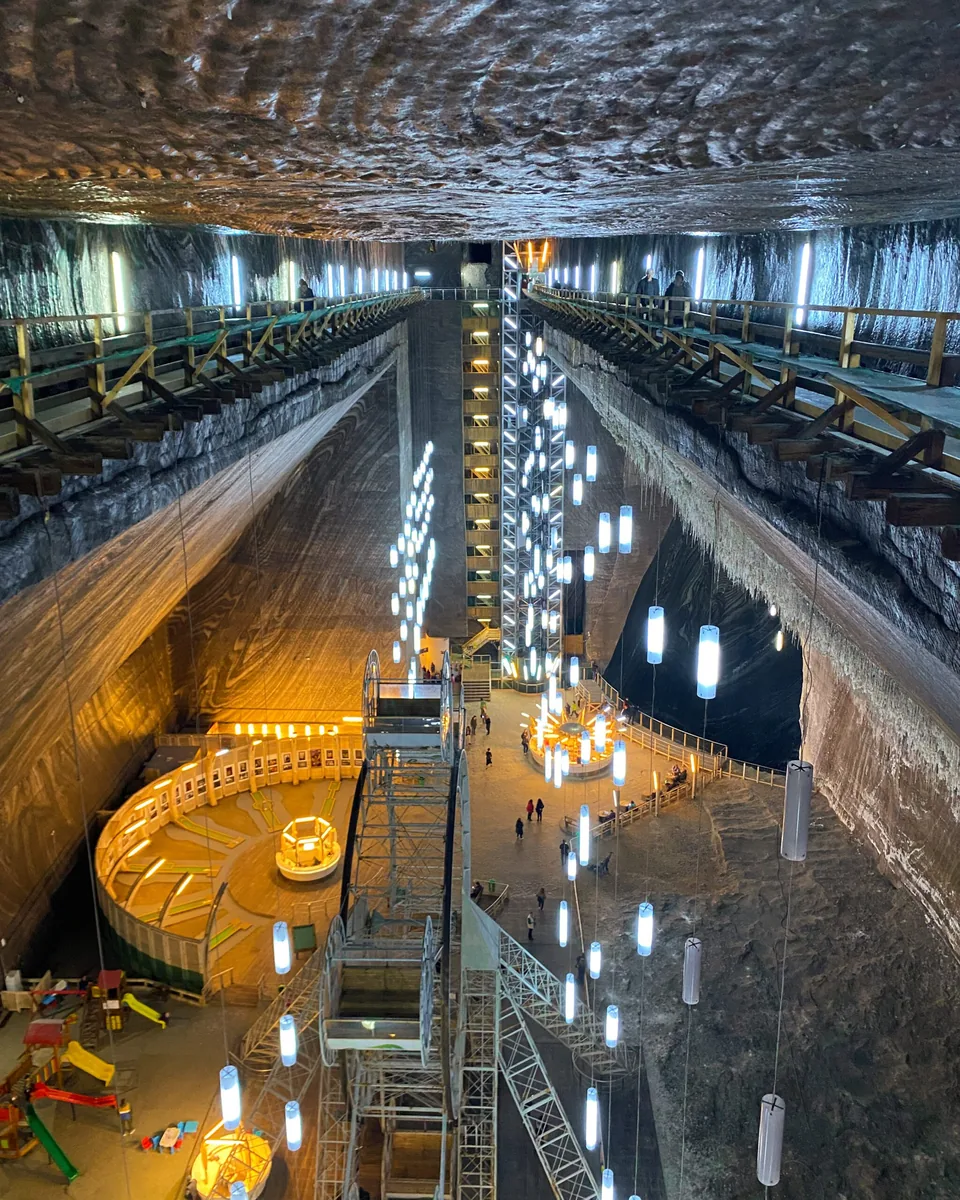
Twelve hundred feet below the surface, a subterranean lake and a neon-lit ferris wheel turn a former salt mine into a scene from a science-fiction epic.
About Salina Turda
The mine was once the economic engine of Transylvania, with the salt being transported by river to the far reaches of the empire. The Rudolf Mine was the last to be exploited in Turda, which explains its more modern, rectangular shape compared to the older, bell-like Terezia chamber. Throughout the 19th century, the mine was a marvel of engineering, using horse-powered pulleys to lift massive salt blocks to the surface. After its closure, the mine was nearly forgotten until it was renovated in 2010 with a multi-million dollar investment that introduced the futuristic lighting and leisure facilities. Today, it is recognized not only for its tourism but as a significant site for speleotherapy, where the unique microclimate helps treat respiratory conditions.
Deep beneath the Transylvanian soil, a hollowed-out salt mountain holds a subterranean world that feels more like a space station than a medieval mine. Salina Turda is a vertical void of staggering proportions, where hundreds of feet of darkness are punctuated by glowing neon halos and the slow rotation of a panoramic wheel. Here, the air is cold and exceptionally pure, tasting of ancient minerals and a heavy, life-giving salinity that clears the senses instantly. You stand on the edge of the Rudolf Mine. Notice how the salt walls are etched with the rhythmic scars of centuries of manual pickaxes. In your ears is a surreal mix of echoing voices from the depths and the rhythmic creak of the wooden elevator shafts. It feels like standing in the belly of an alien cathedral, where the silence of the earth has been replaced by a playful, neon-lit energy.
Salt was first extracted here
Salt was first extracted here by the Romans, but the mine as it exists today was largely shaped during the 17th and 18th centuries under the administration of the Austro-Hungarian Empire. Miners labored in these bell-shaped chambers for generations, carving out millions of tons of salt without the use of explosives to prevent structural collapse. This careful, manual extraction left the walls with the marbled, wavy patterns that define the mine's aesthetic today. Salt production ceased in 1932, and the tunnels briefly was a bomb shelter during World War II and later as a cheese storage facility. In 1992, the mine was reimagined as a halotherapy center and a theme park, transforming a site of grueling labor into a sanctuary of health and leisure that attracts travelers from across the globe.
Descending the 13 flights of wooden stairs into the Rudolf Mine, the temperature drop to a constant 11 degrees Celsius, a cool embrace that never leaves the mine. You catch the way the light from the modern fixtures catches the salt crystals, making the walls shimmer like a million tiny diamonds. The smell is incredibly crisp, a dry, metallic scent that makes every breath feel deeper and more efficient than the last. An echo of the vibration of the subterranean bowling alley and the distant splashing of oars in the Terezia Mine lake. First, the 'salt stalactites' that grow from the ceiling at a rate of only a few centimeters per year before they eventually break under their own weight. The most evocative moment is taking a boat across the jet-black salt lake at the very bottom, looking up at a ceiling so high that the people at the top appear as tiny, moving specks.
The mine is located on the outskirts of Turda, a short drive from the city of Cluj-Napoca. Travelers usually arrive via bus or taxi from Cluj, though parking is ample for those with a rental car. There are two entrances; the modern Durgău entrance features a futuristic glass structure, while the older Franz Josef gallery offers a longer walk through history. Once inside, you can choose between the vintage-style wooden elevators or the stairs to descend into the main chambers. Arriving early in the morning is essential to avoid the long elevator queues and to experience the vast Rudolf Mine in its quietest state. Because of the consistent underground climate, no special timing is needed for the weather, but warm clothing is a requirement even in the height of summer.
The Experience
The energy at Salina Turda is one of cool, echoing immensity. The first thing you register is the sound of your own breath, which sounds amplified in the dry, mineral-rich air. The smoothness of the salt walls, polished by decades of air currents until they feel like cold marble. The light is the key to the experience; the designers used cold, blue and white LEDs to emphasize the alien quality of the salt, making the dark corners feel infinitely deep. The slow, heavy movement of the wooden elevator, a mechanical heartbeat that connects the surface world to the abyss. The most striking detail is the black lake at the bottom of the Terezia mine, where the water is so dense that the rowboats seem to glide on glass rather than liquid.
Why It Matters
Salina Turda is one of the oldest and most important salt mines in Transylvania and a unique example of industrial heritage repurposed for the modern world. It represents the transition from the grueling labor of the 18th century to the wellness-focused tourism of the 21st. Humanly, it is a result of the sheer scale of what people can carve out of the earth with little more than hand tools and persistence.
Why Visit
The reason to come: you want to see the most beautiful place underground. While other mines are damp and claustrophobic, Turda is vast, dry, and glowing with a strange, technological beauty. You come here to play mini-golf in a salt cathedral and to breathe air that hasn't seen the surface in millions of years. It is the only place where the end of the world feels like a playground.
✦ Photo Gallery
Best Season
🌤 Any month is perfect because the mine maintains a constant 11°C (52°F) year-round, though visiting in the winter provides a strange, warm contrast to the snowy Transylvanian landscape above.
Quick Facts
Best time to visit
Any month is perfect because the mine maintains a constant 11°C (52°F) year-round, though visiting in the winter provides a strange, warm contrast to the snowy Transylvanian landscape above.
Getting there
In Turda, Romania; reach Turda first, then continue to the site.
What's nearby
St. Michael's Church, Piața Mare and Sarmizegetusa Regia are also in the area.
Location
Turda, Romania
Type
attraction
Coordinates
46.5877°, 23.7874°
Insider Tips
- 1
Wear a warm jacket and closed-toe shoes; the temperature is a constant, biting 11°C regardless of how hot it is outside.
- 2
Take the stairs down to see the historical markings on the walls, but wait for the elevator to go back up unless you want a serious cardio workout.
- 3
The Echoes Room (Crivac Room) contains a horse-powered pulley system from 1881 that is the only one of its kind preserved in its original location.
- 4
If you have asthma or allergies, spend at least two hours inside; the saline aerosol is a natural treatment that has been used for centuries.
- 5
Bring a snack and water, as the options inside the mine are limited and you will likely want to spend several hours exploring the different levels.