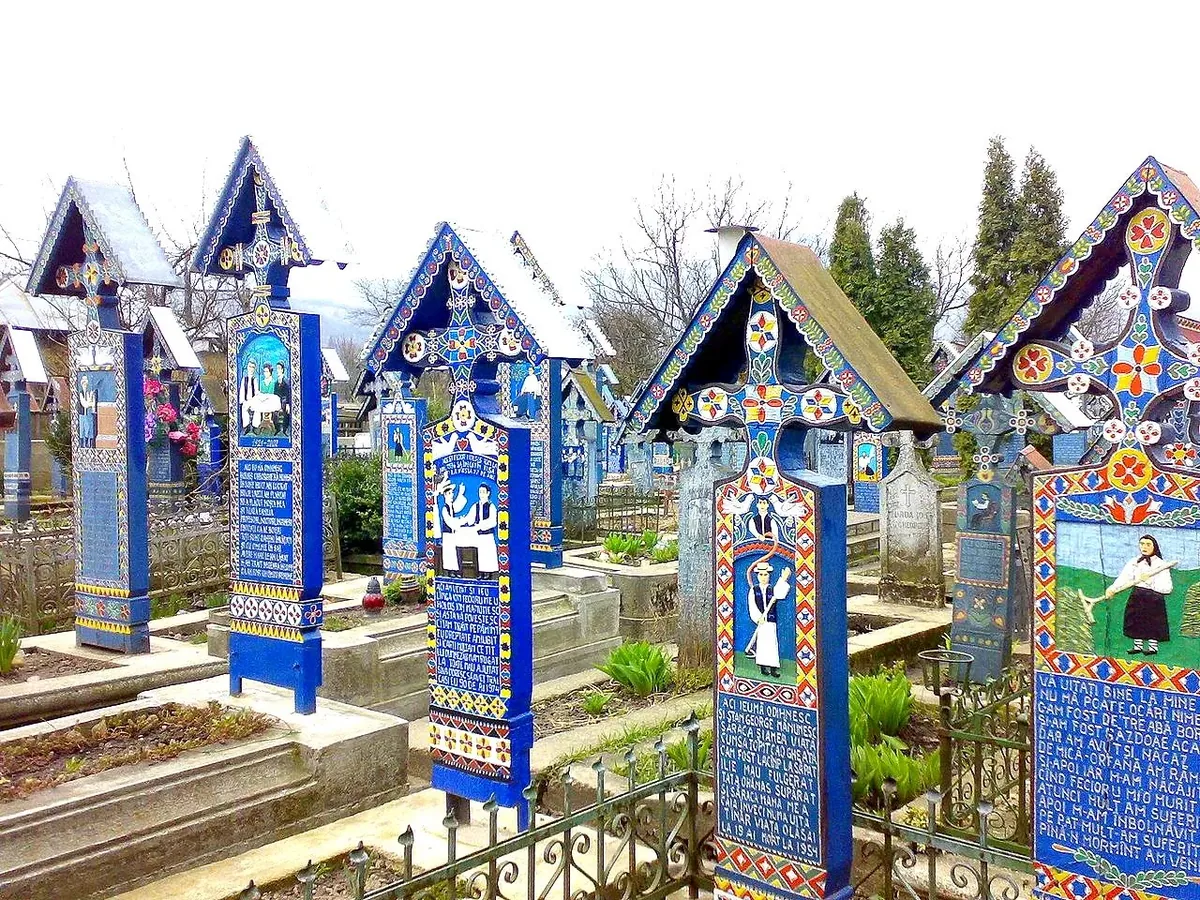
Eight hundred oak crosses painted in a defiant, luminous blue prove that in this corner of Maramureș, the final word on a person’s life is usually a punchline.
About Săpânța Merry Cemetery
The Merry Cemetery grew from the vision of a single craftsman who rejected the austerity of traditional Orthodox funerals. Stan Ioan Pătraș spent over forty years observing his neighbors and distilling their essence into short, rhyming stanzas. His work survived the pressures of the communist era, which generally discouraged religious expression, largely because the folk art style was seen as a pure representation of the Romanian peasantry. Today, the cemetery is a UNESCO-recognized site and the second most visited funeral site in the world after the Valley of the Kings. Each new cross added to the collection must follow the strict aesthetic guidelines established by Pătraș, ensuring the visual continuity of the 'Săpânța Blue' landscape.
What Săpânța Merry Cemetery actually is
In the far northern reaches of Maramureș, death is not a subject for whispers or black veils. The Merry Cemetery of Săpânța is a vibrant, blue-hued rebellion against the typical somberness of the grave. Here, rows of carved oak crosses stand in the shadow of a towering church, each painted in a specific, electric shade known as Săpânța Blue. These markers do not just name the dead; they illustrate their lives with naive paintings and provide brutally honest, often humorous epitaphs in the local dialect. Here a man’s love for plum brandy or a woman’s skill at the loom is immortalized in primary colors, turning a graveyard into a living archive of a village’s collective memory.
The tradition began, 1935
The tradition began in 1935 with a local woodcarver named Stan Ioan Pătraș. A man of deep faith and a sharp wit, Pătraș decided that the story of a person’s life shouldn't be buried with them. He began carving crosses from oak, painting them with floral borders and scenes of the deceased’s daily work or the manner of their death. He believed that according to Dacian culture, death was merely a transition to a better life, and therefore a cause for celebration rather than mourning. Pătraș continued his work until his death in 1977, leaving his workshop and the continuation of the tradition to his apprentice, Dumitru Pop Tincu, who carries on the craft to this day using the same ancestral tools and pigments.
Walking through the cemetery feels more like browsing a comic book of history than visiting a necropolis. The sun catches the gold and red details of the carvings, making the blue backgrounds pop against the green grass. Audible here is the rhythmic tap-tap-tap of woodcarving from the nearby workshops and the occasional burst of laughter from visitors reading the poems. One cross might show a shepherd tending his sheep, while another depicts a man being struck by a car, a startlingly blunt representation of tragedy. The epitaphs are the soul of the place; they speak in the first person, often teasing the deceased for their flaws or mourning a life cut short with a wink. Here, the smells of freshly cut wood and the wild roses that grow between the plots.
Săpânța is located a few kilometers
Săpânța is located a few kilometers from the Ukrainian border. Reaching it requires a dedicated journey, as it is far from the main tourist hubs of Transylvania. Travelers usually arrive via Sighetu Marmației, which is connected by bus and train. The drive through the Maramureș countryside is a destination in itself, featuring the famous tall wooden churches and elaborate carved gates that define the region. The cemetery is the central landmark of the village, located on the main road, and is best explored on foot to allow for the slow reading of the markers and a visit to the Stan Ioan Pătraș memorial house nearby.
The Experience
Leading is the weight of the silence here is different; it isn't heavy with grief but light with curiosity. The vividness of the paintings, vibrant greens for the fields, bright yellows for the sun, contrasts sharply with the grey stone walls of the village houses. You find yourself leaning in close to decipher the Cyrillic-influenced script, even if you don't speak Romanian, because the images tell the story so clearly. You get a strange intimacy in knowing that the woman buried here was famous for her spinning wheel, or that the man next to her was a bit too fond of the local tavern. By the time you reach the back of the lot, the fear of mortality feels just a bit more manageable, replaced by a deep appreciation for the mundane details of a life well-lived.
Why It Matters
The cemetery is a rare surviving example of the ancient Dacian belief in the immortality of the soul. It represents a unique intersection of folk art, woodcarving, and oral literature that is found nowhere else on the planet. Culturally, it anchors the identity of the Maramureș region, preserving a way of life that is rapidly modernizing while keeping the ancestors as active participants in the community's daily rhythm.
Why Visit
You visit because it is perhaps the only place on earth where a graveyard can make you smile without being disrespectful. It offers a profound lesson in how to remember the people we lose, not as names on a list, but as characters in a grand, colorful story. It is the most human landmark in Romania.
✦ Photo Gallery
Best Season
🌤 Late May brings the blooming of the wildflowers in the cemetery, which perfectly complement the floral motifs carved into the oak crosses.
Quick Facts
Best time to visit
Late May brings the blooming of the wildflowers in the cemetery, which perfectly complement the floral motifs carved into the oak crosses.
Getting there
In Maramureș, Romania; reach Maramureș first, then continue to the site.
Location
Maramureș, Romania
Type
attraction
Insider Tips
- 1
Use a translation app with OCR capability to read the epitaphs; the humor and pathos are lost without the words.
- 2
Visit the Stan Ioan Pătraș House-Museum just down the street to see the original carver’s personal quarters and workshop.
- 3
The cemetery gets very crowded at midday; arrive at 8:00 AM to have the rows to yourself and catch the soft morning light.
- 4
Dress respectfully, as this is still an active parish cemetery where funerals regularly take place.
- 5
Look for the cross of the founder, Stan Ioan Pătraș, which features a self-portrait and a poem about his own life's work.