“A stone calendar designed to track the movements of the sun sits abandoned in a cloud forest, the last remnant of a kingdom that the Romans tried to erase from the map.”
About Sarmizegetusa Regia
The Dacians were known for their bravery and their belief in the immortality of the soul, led by their god Zalmoxis. Sarmizegetusa Regia was not just a fort; it was a cosmic center where the kings were also priests. The Roman conquest was so thorough that they even diverted a river to find the hidden treasure of Decebalus. After the fall of the kingdom, the site remained a place of legend among the local mountain people, who spoke of hidden gold and 'white giants' who built the walls. Modern archaeology has only uncovered a fraction of the site, revealing a city that relied on massive terracing and iron tools that were far ahead of their time in Eastern Europe.
What Sarmizegetusa Regia actually is
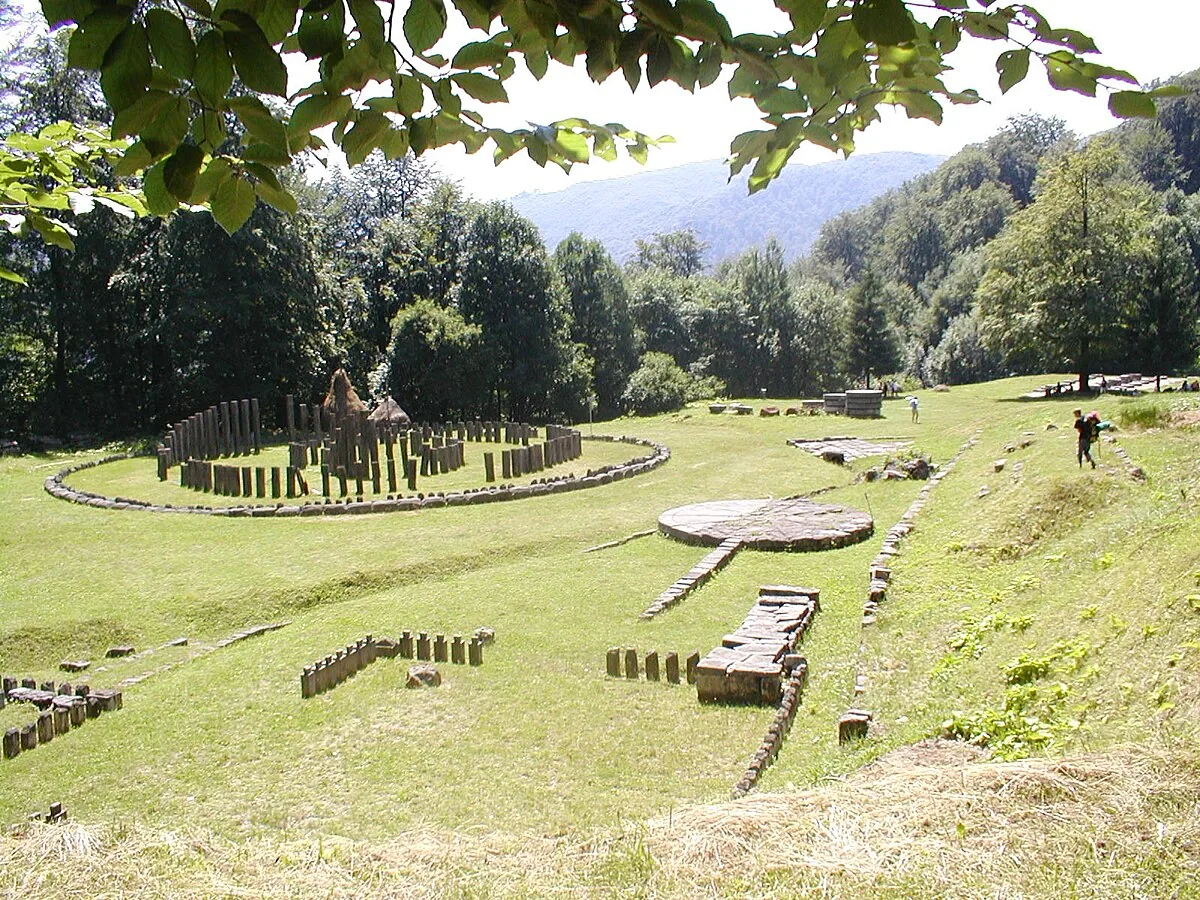
Circular stone calendars and massive andesite altars lie silent in the deep, primeval forests of the Orăștie Mountains. Sarmizegetusa Regia was the sacred capital of the Dacian Kingdom, a mountain fortress that once stood as the spiritual and political heart of a civilization that challenged the Roman Empire. Located at 1,200 meters, the site is a series of man-made terraces carved into the steep slopes, surrounded by ancient beech trees that seem to guard the ruins. The air is thin and carries the scent of damp moss and mountain pine, with a persistent mist that often clings to the stones. It is a place of profound cosmic geometry, where the alignment of the sanctuaries suggests a deep understanding of astronomy and the cycles of the sun. Unlike the marble ruins of Rome, these are stones of the earth, weathered and mossy, feeling like an organic extension of the mountain itself.
Circular stone calendars and massive andesite altars lie silent in the deep, primeval forests of the Orăștie Mountains.
The past
Built in the 1st century BC, Sarmizegetusa Regia was the crown jewel of King Burebista and later King Decebalus. It was part of a sophisticated defensive system of six fortresses designed to protect the Dacian gold mines. The capital was a center of ironworking and high-level stone masonry, featuring an advanced water purification system using ceramic pipes. The end came in 106 AD, after a brutal siege by Emperor Trajan’s legions. The Romans dismantled the fortress stone by stone to prevent it from ever being used again as a symbol of resistance, and they built a new administrative capital, Ulpia Traiana Sarmizegetusa, forty kilometers away on the plains. The original mountain site was forgotten for centuries, swallowed by the forest until it was rediscovered and eventually granted UNESCO status for its unique 'Murus Dacicus' defensive walls and monumental sanctuaries.
Walking along the 'Sacred Road' of flat limestone slabs, the ancient stones beneath your boots, still fitting perfectly together after two thousand years. The area is incredibly quiet, with only the rustle of the beech leaves and the distant sound of a mountain stream. The Great Circular Sanctuary, a ring of timber posts on stone bases that functioned as a sophisticated sun calendar. The 'Andesite Sun,' a massive circular altar with a carved ray pattern that suggests the ritual importance of solar worship. Something of the temperature drop entering the shadow of the massive defensive walls, noticing the scale of the stone blocks that had to be hauled up these steep ridges without the use of mortar. You register the way the moss has claimed the edges of the ritual well, turning the dark water into a reflective mirror of the forest canopy. Almost all visitors just see the ruins, but you should notice the ceramic pipes and drainage channels, evidence of a city that was as functionally advanced as it was spiritually focused. First, the way the trees have grown around and even through the stones, their roots acting like living fingers that hold the ruins in place. The feeling of being 'watched' by the surrounding peaks adds to the site's intense, spiritual energy.
The site is remote, located
The site is remote, located at the end of a long, winding road from the village of Costești. The final stretch is a narrow paved road that climbs steeply into the national park. People typically stay in the town of Orăștie or the village of Grădiștea de Munte and hire a local driver or use a sturdy vehicle to reach the parking area, followed by a one-kilometer walk to the main sanctuaries.
The site is remote, located at the end of a long, winding road from the village of Costești.
The Experience
The damp, earthy smell of the forest is at its strongest near the large andesite altar, where the stones are cold to the touch. You register the way the light filters through the high beech canopy, creating moving patterns that dance across the sacred circle. A sense of mystery in the silence, wondering about the rituals that took place here before the Roman fires. Opening with the incredible precision of the stone joints in the 'Murus Dacicus' walls, proof of a lost engineering tradition. What anchors you is standing in the center of the Great Sanctuary at noon, realizing that the shadows still align with the stone markers just as they did two millennia ago.
Why It Matters
Sarmizegetusa Regia is the most important archaeological site in Romania. It is the only place that offers a direct window into the pre-Roman Dacian civilization, its social hierarchy, and its advanced astronomical knowledge. It remains a potent symbol of Romanian origins and the enduring spirit of the Carpathian people.
Why Visit
This place for its raw, mystical atmosphere that you won't find in the restored castles of Transylvania. It is a site for the pilgrim and the adventurer, requiring a journey into the deep forest to stand among stones that feel heavy with the weight of a lost world. It is the 'Machu Picchu of Romania,' minus the crowds.
✦ Insider Tips
- 1
Wear sturdy hiking boots; the site is located on steep terraces and the limestone slabs can be extremely slippery when the mountain fog rolls in.
- 2
Bring your own water and food, as there are no facilities once you leave the village of Costești at the base of the mountain.
- 3
Visit in the early morning to experience the 'Sacred Area' while it is still shrouded in mist, which significantly enhances the mystical atmosphere.
- 4
Look for the ceramic water pipes near the entrance to the sacred area; they are some of the best-preserved examples of ancient plumbing in Europe.
- 5
The site is within a National Park; stay on the designated paths to protect the delicate moss and the rare alpine flora that grows among the ruins.