A single lightning strike in 1763 brought down the original tower of St. Michael's, yet the medieval vaults beneath didn't crack, holding firm against the weight of falling stone.
About St. Michael's Church
The site likely held an earlier Roman settlement before the first stones of the Gothic structure were laid in the 14th century. Funding came primarily from the city’s guilds, who vied for influence by decorating the lateral chapels with their own symbols. In 1451, the church hosted the christening of Matthias Corvinus, the legendary King of Hungary, whose massive equestrian statue now guards the church’s southern flank. Throughout the 16th century, the building became a flashpoint for the Reformation, briefly becoming the center of Unitarianism in Transylvania. This period saw the removal of many ornate Catholic decorations, resulting in the austere, powerful interior space that defines the church's character today.
What St. Michael's Church actually is
Cluj-Napoca pivots around a single point of gravity: the towering Gothic spire of St. Michael’s Church. Rising from the center of Unirii Square, this hall-church is the second largest of its kind in Romania, a limestone behemoth that has witnessed the coronation of kings and the fiery debates of the Reformation. The architecture is a rigorous exercise in Transylvanian Gothic, characterized by soaring vaults and a facade that feels more like a fortress than a sanctuary. Inside, the air remains ten degrees cooler than the noisy plaza outside, smelling faintly of ancient dust and beeswax. Across centuries, this building has functioned as the heartbeat of the city, surviving fires, sieges, and political upheavals that reshaped the map of Eastern Europe.
“Cluj-Napoca pivots around a single point of gravity: the towering Gothic spire of St.”
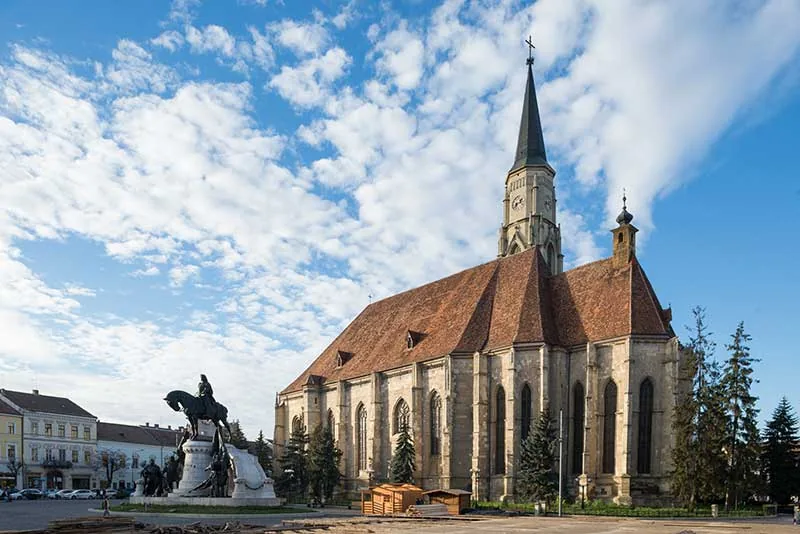
St. Michael's Church, Romania
History
Construction began in 1316, shortly after King Charles Robert of Anjou granted Cluj the status of a free royal city. The process spanned over a century, reflecting the growing wealth of the local Saxon and Hungarian merchants. By the mid-15th century, the main structure was complete, but the iconic tower we see today is a 19th-century Neo-Gothic addition, built after the original Baroque tower collapsed following a lightning strike. The church has a complicated religious soul; it was a Catholic bastion, transitioned into a Unitarian center during the Transylvanian Reformation, and eventually returned to the Catholic fold. Each era left its mark, from 14th-century frescoes discovered behind layers of plaster to the coat of arms of Holy Roman Emperor Sigismund of Luxembourg over the western portal.
The scale of the interior creates an immediate sense of insignificance. Slender stone columns shoot upward like petrified trees, branching into intricate rib vaulting that disappears into the shadows of the ceiling. Sound behaves differently here; the heavy oak doors muffle the screech of the city's trams, replacing them with the rhythmic echo of footsteps on stone. Daylight filters through stained glass, casting deep violets and crimsons across the nave. If you time your visit during an organ recital, the vibration of the pipes can be felt in the floorboards. The climb up the tower provides the best reward, a panoramic view of Cluj’s red-tiled roofs, the hills of the Apuseni Mountains in the distance, and the chaotic geometry of the modern city expanding outward. Locating the church is impossible to fail, as every major road in Cluj-Napoca eventually leads to Unirii Square. The city is well-connected by air through its international airport, and the train station is a short fifteen-minute walk from the center. A large share of visitors arrive via the pedestrian streets that fan out from the square, making the church a natural starting point for any exploration of the old town. Parking nearby is notoriously difficult, so arriving by foot or local bus is the standard approach for those staying within the city limits.
The Experience
Entering the nave on a Sunday morning feels like stepping into a different century. The scent of incense lingers in the cold drafts that swirl around the massive stone pillars. The opening note is the way the light catches the dust motes in the high windows, creating ladders of light that reach the floor. The acoustics are so sharp that even a whispered prayer at the altar can be heard clearly from the back of the church. Outside, the square is a riot of cafe culture and student energy, but inside, the silence is thick and heavy. Climbing the narrow wooden stairs of the tower, you feel the age of the wood through your palms, emerging onto the balcony to find the wind whipping off the Someș River.
Why It Matters
St. Michael's remains the definitive symbol of the multi-ethnic and multi-confessional history of Cluj-Napoca. Its Gothic architecture is a rare example of the style's easternmost reach in Europe. The building serves as a physical record of the city's transition from a medieval trade hub to a modern intellectual capital, anchoring the identity of Transylvania in stone.
Why Visit
While many European cathedrals feel like museums, St. Michael's maintains a raw, unpolished spirituality. The contrast between its grim, fortress-like exterior and the elegant, soaring interior geometry provides a masterclass in Gothic design. It offers the most honest view of the Transylvanian soul, resilient, layered, and deeply grounded in history.
Insider Tips
- 1
Look for the medieval sun dial on the southern wall, which still accurately marks the passing hours of the afternoon.
- 2
Check the schedule for the weekly organ concerts, usually held on Tuesday evenings in the summer months.
- 3
Small 14th-century frescoes are hidden in the Schleunig Chapel; they are easy to miss if you don't look behind the main altar area.
- 4
The tower climb requires a separate ticket and involves very narrow stairs, so avoid bringing large backpacks.
- 5
The best photography angle for the whole facade is from the corner of Eroilor Street just as the sun begins to set.