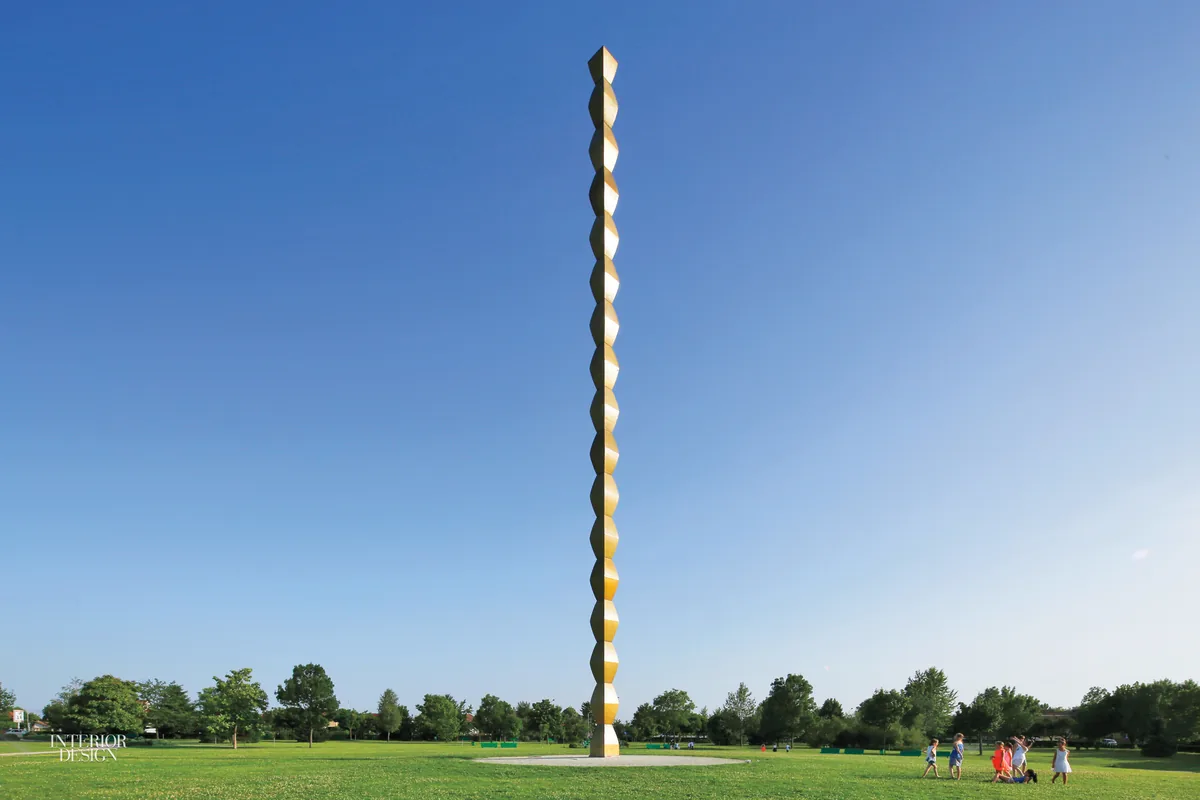
Ninety-six half-rhomboids of cast iron rise thirty meters into the Oltenian sky, standing as a mathematical prayer for soldiers who never came home from the banks of the Jiu River.
About The Sculptural Ensemble of Constantin Brâncuși
Commissioned in 1934 by Arethia Tătărescu, the project sought to honor the bravery of the inhabitants of Târgu Jiu during World War I. Brâncuși, then at the height of his international fame, spent several years refining the spiritual geometry of the site. He chose materials that reflected the ruggedness of the region: local limestone and heavy iron. The installation was completed just as Europe descended into the darkness of the Second World War, nearly disappearing into obscurity during the post-war decades. When the 1950s communist government deemed it 'decadent bourgeois art,' the monuments survived only because the sheer weight of the column proved impossible to topple with the technology available at the time.
The short version
Târgu Jiu does not immediately look like the cradle of modernism. This industrial town in the foothills of the Southern Carpathians holds a singular, silent power along a mile-long axis that honors the fallen of the First World War. Here, Constantin Brâncuși, the shepherd-turned-visionary who redefined 20th-century art in a Paris studio, returned to his home soil to leave a legacy that breathes with the earth itself. The ensemble consists of three primary works: The Table of Silence, The Gate of the Kiss, and The Endless Column. Unlike museum pieces trapped behind glass, these monuments exist in the open air, subject to the shifting Romanian sun and the touch of local hands.
Returning from France in the late 1930s, Brâncuși
Returning from France in the late 1930s, Brâncuși accepted a commission from the National League of Gorj Women to create a memorial for the local soldiers who defended the town against German forces. He refused any payment for the work, viewing it as a spiritual debt to his ancestors. Brâncuși drew from the deep well of Oltenian folk art, specifically the carved wooden pillars that supported peasant porches. The Endless Column, a stack of cast-iron rhomboids coated in yellow brass, was erected in 1938. Despite later attempts by the communist regime to pull it down with tractors, failing because the spine of the column was too resilient, it remains a vertical bridge between the heavy soil and the infinite sky.
Walking the path between the Calea Eroilor and the riverside park requires a contemplative pace. At the Table of Silence, twelve hourglass-shaped stone stools surround a massive circular slab. The limestone feels cool even in August, and the circular arrangement forces a communal, hushed focus. Moving toward the Gate of the Kiss, the texture of the Banpotoc stone reveals subtle carvings of eyes merging into one, a motif of unity that feels protective rather than decorative. The journey culminates at the Endless Column. At its base, the repetition of shapes creates an optical illusion of movement, as if the stack is actively boring into the clouds. The sound here is mostly the wind whistling through the brass edges, a lonely but triumphant metallic hum.
Târgu Jiu sits roughly 300 kilometers west of Bucharest
Târgu Jiu sits roughly 300 kilometers west of Bucharest. At the town involves a drive through the Olt River Valley, a route defined by limestone cliffs and ancient monasteries. While trains run from the capital, they are slow and rhythmic, matching the meditative energy of the sculptures. Just about everyone arrive by car from Sibiu or Craiova, finding the ensemble spread across the town's central parks, easily accessible on foot for anyone willing to walk the symbolic line of the heroes.
The Experience
Standing beneath the Endless Column at midday produces a strange sensation of vertigo. The golden-hued modules seem to vibrate against the blue backdrop, losing their metallic heaviness. The element that hits is how locals treat the site with a casual reverence, often resting on the stone stools of the Table of Silence as if they were simple park benches. The environment often carries the scent of roasted sunflower seeds and the damp earth of the nearby riverbank. As the light shifts toward golden hour, the Gate of the Kiss glows with an amber warmth, making the hard stone appear almost soft, like skin. You realize the entire ensemble is a clock, marking time through shadow and light across the park floor.
Why It Matters
Brâncuși effectively moved the center of the art world from the galleries of Paris to a provincial Romanian park. This ensemble represents the transition from representational sculpture to pure abstraction, rooted in peasant mysticism. It serves as a philosophical bridge, turning the tragedy of war into a meditation on the continuity of life and the soul’s ascent. Culturally, it remains the most profound expression of Romanian identity in the modern era.
Why Visit
Forget the crowded galleries of the Met or the Pompidou. To see these works in their intended environment, surrounded by the trees and the people that inspired Brâncuși, changes the scale of the art entirely. You gain a visceral understanding of 'the infinite' that a photograph can never convey. It is a rare chance to sit inside a masterpiece rather than just looking at it.
✦ Photo Gallery
Best Season
🌤 September offers a crisp, clear light that emphasizes the sharp geometry of the column and avoids the hazy humidity of the Romanian summer.
Quick Facts
Best time to visit
September offers a crisp, clear light that emphasizes the sharp geometry of the column and avoids the hazy humidity of the Romanian summer.
Getting there
In Târgu Jiu, Romania; reach Târgu Jiu first, then continue to the site.
Location
Târgu Jiu, Romania
Type
attraction
Insider Tips
- 1
Visit the Endless Column at dawn to see the first light turn the brass modules into a pillar of fire.
- 2
Walk the full length of Calea Eroilor on foot to understand the intended physical rhythm of the memorial.
- 3
Check the local museum nearby to see Brâncuși’s early sketches and original tools used during the construction.
- 4
Carry a small bottle of water as the walk between the two main park sites offers very little shade in mid-afternoon.
- 5
Look closely at the surface of the Gate of the Kiss to see the microscopic patterns in the Banpotoc limestone.