“A city built of mud and straw survived a six-month siege by one of the world's great empires, only to rise again as the spiritual heart of a modern kingdom.”
About At-Turaif District in ad-Dir'iyah
The rise of At-Turaif in the 18th century marked the first time the interior of Arabia was unified under a single political and religious vision. The district was an architectural innovator, using local tamarisk wood and sun-dried bricks to create multi-story palaces that remained cool in the 45-degree heat. The 1818 siege was a turning point; the destruction was so thorough that the capital was eventually moved to nearby Riyadh. The ruins of At-Turaif became a symbol of the 'First State,' and their restoration today is part of a broader movement to celebrate Saudi heritage beyond the era of oil. Every brick replaced in the recent restoration was made using the original traditional methods to ensure historical accuracy.
Ad-Dir'iyah is the cradle of the Saudi state
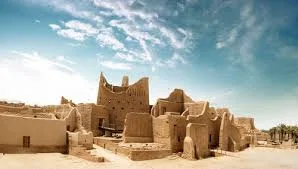
Ad-Dir'iyah is the cradle of the Saudi state, a labyrinth of sun-baked mud and straw that rises from the verdant Wadi Hanifa. At its heart lies the At-Turaif District, a UNESCO World Heritage site that was the first capital of the Saudi Dynasty. This is Najdi architecture at its most regal: thick-walled palaces, geometric crenellations, and triangular ventilation holes designed to catch the desert breeze. The buildings seem to grow directly out of the earth, their ochre surfaces changing color from dusty gold to deep amber as the day progresses. The history of a kingdom is etched into the very grain of the mud-brick, recently restored to its former glory as a centerpiece of national pride.
Ad-Dir'iyah is the cradle of the Saudi state, a labyrinth of sun-baked mud and straw that rises from the verdant Wadi Hanifa.
a power center, 1744
Founded in the 15th century, Dir'iyah became a power center in 1744 when Imam Muhammad bin Saud and the scholar Muhammad ibn Abd al-Wahhab formed an alliance. At-Turaif was the seat of government, a citadel that commanded the trade and pilgrimage routes. Its prominence ended in 1818 following a brutal six-month siege by Ottoman-Egyptian forces under Ibrahim Pasha, which left much of the city in ruins. For nearly two centuries, the site remained a ghostly reminder of the First Saudi State. Recent years have seen a massive, meticulous reconstruction project, turning the ruins into a living museum that honors the resilience of the Najdi people.
Walking through the narrow, high-walled alleys
Walking through the narrow, high-walled alleys of At-Turaif feels like moving through a life-sized sculpture. The setting is dry and carries the faint, earthy scent of clay and limestone. First, the intricate patterns carved into the heavy wooden doors, many of which are painted in the vibrant colors of the central desert. The Salwa Palace, the largest structure in the district, tells the story of the royal family through immersive displays that use the crumbling walls as a backdrop. At night, the district is transformed by a sophisticated lighting system that makes the mud-brick appear to glow from within, while the sound of traditional Ardah drums often echoes from the nearby plazas. At-Turaif is located on the northwestern outskirts of Riyadh, roughly a thirty-minute drive from the city center. It is connected to the Bujairi Terrace, a modern dining and retail hub that offers the best views of the historic district. Visitors must typically purchase a ticket for Dir'iyah which includes access to the At-Turaif district via a scenic bridge crossing the Wadi Hanifa. The site is fully pedestrianized, and golf carts are available for those who need assistance navigating the slopes of the citadel.
The Experience
It becomes clear how the thick walls of the palaces muffle the sounds of the modern city nearby, creating a pocket of profound quiet. The geometric shadows cast by the triangular windows move slowly across the floor as the sun passes overhead. The rough, straw-flecked texture of the walls, realizing that this entire city was built by hand from the very ground you are standing on. The view from the top of the citadel overlooks the palm groves of the Wadi, an echo of why this spot was chosen centuries ago. It is a sensory bridge between the harshness of the desert and the ingenuity of human settlement.
It becomes clear how the thick walls of the palaces muffle the sounds of the modern city nearby, creating a pocket of profound quiet.
Why It Matters
At-Turaif is the most important historical site in the central Arabian Peninsula. It represents the birth of the Saudi identity and the unique Najdi architectural style. Its UNESCO status recognizes it as a globally significant example of a traditional human settlement that successfully adapted to an extreme desert environment.
Why Visit
Visit At-Turaif to see where the Saudi story truly began. While Riyadh is a city of glass and steel, Dir'iyah is a city of soul and earth. It offers a depth of historical context that explains the values and origins of the modern Kingdom in a way that no museum in a skyscraper ever could.
✦ Insider Tips
- 1
The site is open to all visitors, and no religious restrictions apply.
- 2
Arrive at the Bujairi Terrace for an early dinner, then cross the bridge into At-Turaif just as the evening lights come on.
- 3
Wear flat, comfortable shoes; the cobblestones and mud paths can be uneven and taxing on the feet.
- 4
Look for the museum of traditional life inside the palace complex to see how the desert people managed water and food storage.
- 5
Check the schedule for the nightly light and sound show projected onto the walls of the Salwa Palace.