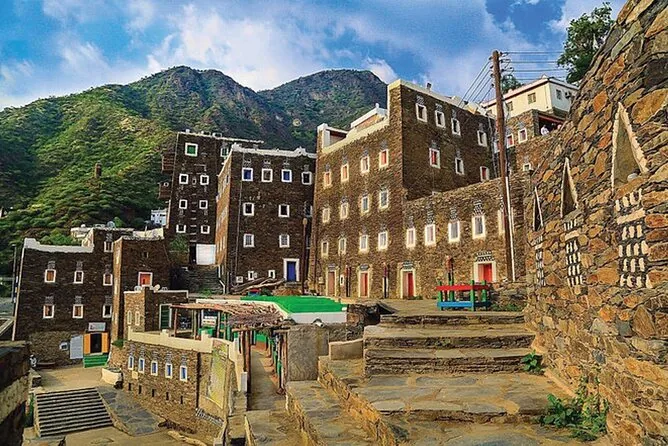
“Seven-story skyscrapers made of dark basalt and white quartz cling to a mountain cliff, a thousand-year-old fortress that looks like a village made of gingerbread.”
About Rijal Almaa
The village was the capital of the independent Principality of Halli for a period, showcasing its historical importance. Its towers, or 'qust,' were designed with storage on the ground floor and living quarters above, reflecting a society that was always prepared for siege. The internal decoration, Al-Qatt Al-Asiri, was recently added to UNESCO’s Intangible Cultural Heritage list. This art form uses bright primary colors and intricate symbols to represent the community's history and the surrounding nature. The survival of Rijal Almaa is born from the pride of the local people, who refused to let their architectural heritage crumble into the valley floor.
What Rijal Almaa actually is
Deep in the green, mist-shrouded mountains of the Asir region, the stone village of Rijal Almaa clings to the side of a valley like a cluster of vertical honeycombs. Known as the 'Gingerbread Village,' its multi-story buildings are constructed from dark basalt stone and accented with brilliant white quartz and colorful wooden shutters. This is a dramatic departure from the sand-colored architecture of northern Arabia. Here, the landscape is lush and rugged, and the village’s towers, some reaching seven stories, were built as fortresses to guard the ancient trade routes between Yemen and the Levant. It is a place of cool air, vibrant folk art, and a culture that feels older and more connected to the earth than the active cities of the plains.
Deep in the green, mist-shrouded mountains of the Asir region, the stone village of Rijal Almaa clings to the side of a valley like a cluster of vertical honeycombs.
Rijal Almaa has been inhabited for over 900 years. Its position made it a vital stop for caravans and pilgrims. The villagers, known for their bravery and independence, successfully resisted Ottoman expansion for decades. The architecture is a marvel of dry-stone engineering; the thick walls provide insulation against both the summer heat and the winter mountain chill. In the 1980s, as residents moved to more modern housing, the village was nearly abandoned. However, a local initiative led by the community saved the site, transforming it into a museum and cultural center. It is now on the tentative list for UNESCO World Heritage status, recognized for its unique 'Al-Qatt Al-Asiri' interior designs, a form of geometric wall painting traditionally done by the women of the village.
Driving down the winding mountain passes, the air turns noticeably cooler and smells of damp cedar and wildflowers. What hits is the striking contrast between the dark stone of the buildings and the white quartz windowsills that look like eyes watching the valley. Walking the narrow, paved paths between the towers, The verticality of the place; you are constantly looking up or down. The village museum, located in one of the largest towers, is filled with silver jewelry, traditional weapons, and old manuscripts. Sound-wise of the wind through the valley is the primary soundtrack, occasionally joined by the call of a mountain eagle. First, the 'Flower Men' of the region, locals who wear intricate crowns of fresh jasmine and herbs, a tradition that adds a splash of color to the stone surroundings.
Rijal Almaa is located about 45
Rijal Almaa is located about 45 kilometers from the city of Abha. The most dramatic way to arrive is via the cable car from the Al Souda mountains, though this is currently undergoing renovation. The drive involves a series of steep switchbacks and tunnels that offer incredible views of the Sarawat Mountains. The bulk of visitors rent a car in Abha or hire a local driver. The village is well-equipped for tourists, with a visitor center and a few small cafes serving traditional Asiri honey and bread, but it remains a quiet, largely residential area that retains its authentic character.
Rijal Almaa is located about 45 kilometers from the city of Abha.
The Experience
What hits is how the light in the mountains is softer than in the desert, often filtered through low-hanging clouds. The stone under your feet is worn smooth by centuries of use. Something like a sense of discovery as you poke your head into the small rooms decorated with vibrant wall paintings that look surprisingly modern in their geometric simplicity. The scent of the herbs worn by the local men, basil, marjoram, and jasmine, lingers in the air as you pass them. You get a tangible sense of community here; it doesn't feel like a staged museum, but a place that is being actively loved back to life. Sitting on a stone ledge as the mist rolls into the valley is one of the most serene experiences in the country.
Why It Matters
Rijal Almaa is the most important cultural landmark in southern Saudi Arabia. It represents a unique mountain civilization that developed entirely different social and architectural norms than the rest of the peninsula. Its preservation is a model for community-led heritage projects and a celebration of the 'Flower Men' culture and Asiri folk art.
Why Visit
A side of Saudi Arabia you didn't know existed, green, cool, and artistically vibrant. It is the perfect antidote to the heat of the Red Sea coast or the bustle of Riyadh. If you love history, hiking, and indigenous art, Rijal Almaa is the most rewarding destination in the Kingdom.
✦ Insider Tips
- 1
The site is open to all visitors and has no religious entry restrictions.
- 2
Try the local honey; the Asir region is famous for producing some of the most expensive and high-quality honey in the world.
- 3
Wear comfortable hiking shoes as the village is built on a steep incline with many stairs.
- 4
Visit in the late afternoon to see the sunset hit the quartz-lined windows, making them glow like lanterns.
- 5
Ask permission before photographing the local men; most are happy to pose, especially if you show interest in their floral crowns.