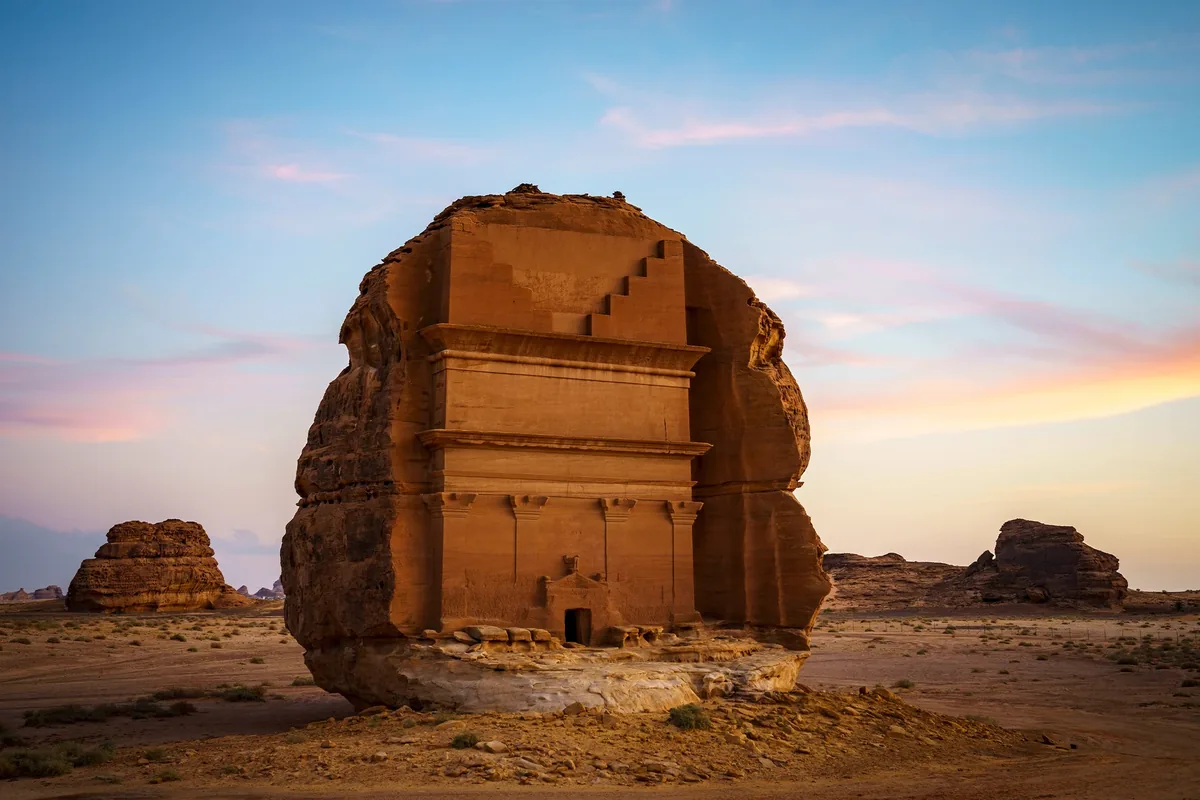
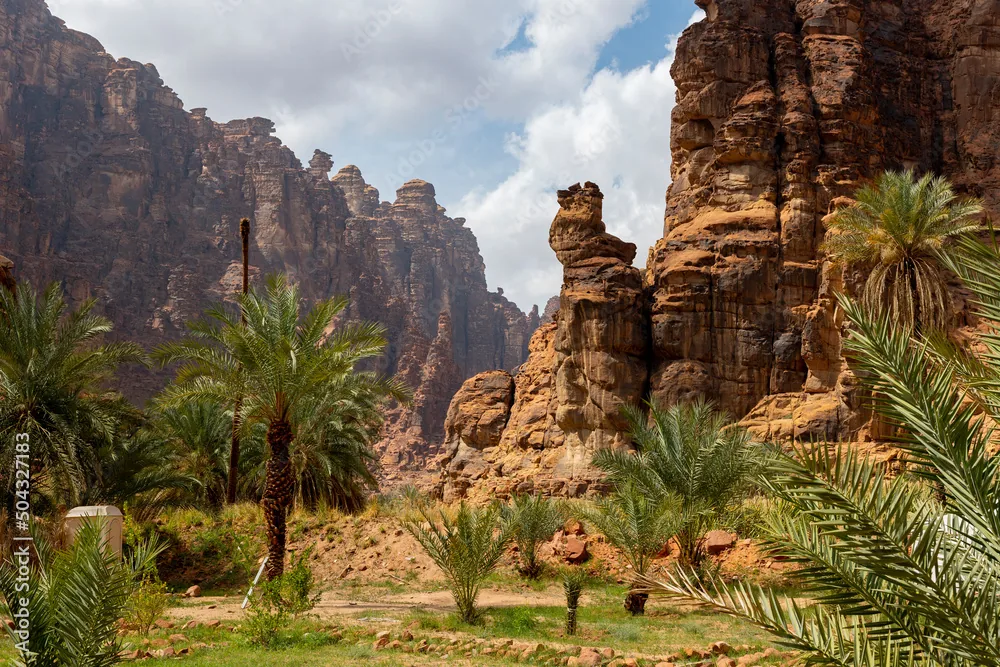
Towering red sandstone pillars rise like the ruins of a Martian cathedral from a hidden valley floor where freshwater springs never run dry.
About Wadi Al-Disah
The history of Al-Disah is etched into its cliffs. Beyond its geological origins, the wadi served as a vital water source on the ancient trade routes connecting the Arabian interior to the Red Sea. The Nabataean inscriptions found here are similar to those in AlUla, suggesting that the wadi was part of their wider network of desert outposts. Local legends speak of the wadi as a place of protection during times of conflict. Today, the area is part of the Prince Mohammed bin Salman Natural Reserve, ensuring that the delicate balance between the water, the flora, and the ancient ruins is preserved for future generations.
In the northwestern Tabuk province, the earth splits
In the northwestern Tabuk province, the earth splits open to reveal a hidden canyon of surreal beauty. Wadi Al-Disah, meaning 'the valley of palm trees,' is a dramatic landscape of towering red sandstone pillars that rise from a floor of lush greenery and bubbling freshwater springs. While the surrounding desert is a monochromatic expanse of sand and rock, the interior of the wadi is a vibrant explosion of life. Giant reeds, tall grasses, and groves of palms create a canopy that provides shade to the narrow passages. The water never stops flowing, carving deep grooves into the canyon walls and creating a microclimate like a prehistoric sanctuary lost in time.
“In the northwestern Tabuk province, the earth splits open to reveal a hidden canyon of surreal beauty.”
Wadi Al-Disah, Saudi Arabia
Wadi Al-Disah is a geological wonder formed
Wadi Al-Disah is a geological wonder formed by water erosion over millions of years. The sandstone formations, some reaching hundreds of meters in height, have been sculpted by the wind and the rare but powerful flash floods of the region. The valley also holds evidence of human history; ancient Nabataean tombs are carved into the cliffs, and petroglyphs scattered throughout the canyon suggest that it has been a refuge for travelers and nomadic tribes for millennia. Until recently, it was one of the Kingdom's best-kept secrets, known mostly to local bedouins and intrepid off-roaders. Now, it is a centerpiece of the Tabuk region's growing eco-tourism profile.
Entering the wadi requires a 4x4 vehicle , as the 'road' is actually the sandy, sometimes muddy bed of the valley. The first thing you register is the temperature drop as the canyon walls close in, casting deep blue shadows across the red rock. The sound of the wind is replaced by the rustle of palm fronds and the gentle trickle of water. You get a sand beneath your feet, which is surprisingly soft and cool in the shaded areas. The space smells of wet earth and wild mint. A highlight is the 'Grand Canyon' section, where the sandstone pillars are so perfectly vertical they look like the ruins of a giant cathedral. The contrast between the fire-red rock and the deep emerald green of the vegetation, a color palette that feels almost alien in the desert.
Wadi Al-Disah is about an 80-minute
Wadi Al-Disah is about an 80-minute drive from the city of Tabuk. While the road to the entrance of the valley is paved, entering the wadi itself is impossible without a high-clearance 4x4. Many visitors hire local guides in the nearby village of Al-Disah who provide specialized vehicles and knowledge of the terrain. There are no hotels or facilities inside the wadi, so most people visit as a day trip from Tabuk or bring their own camping gear to spend the night under the stars. The best way to explore is to drive deep into the canyon and then continue on foot to find the hidden springs and ancient inscriptions.
“Wadi Al-Disah is about an 80-minute drive from the city of Tabuk.”
The Experience
What comes through is how the scale of the canyon makes you feel insignificant; the walls are so high that the strip of sky above looks like a narrow blue ribbon. The water in the springs is crystal clear and surprisingly cold, providing a shock to the system if you decide to wade through the pools. The grain of the sandstone, which is brittle and flakes off in small red grains. The most magical time is the late afternoon, when the sun hits the top of the pillars, making them glow as if they were on fire, while the valley floor remains in cool, dark shadow. The sound is the echoes of your own voice bouncing off the rock, an echo of the canyon’s perfect acoustics. It is a place of absolute, immersive nature.
Why It Matters
Wadi Al-Disah is one of Saudi Arabia’s most important natural landmarks. It represents a unique desert ecosystem and a geological bridge between the Hijaz and the Tabuk mountains. Culturally, it is a symbol of the 'hidden' beauty of the Kingdom, showcasing a landscape that challenges the stereotype of Saudi Arabia as a flat, barren desert.
Why Visit
The sheer visual drama. It is arguably the most beautiful natural site in the country, offering a combination of red rock and green oasis that you won't find anywhere else. It is a dream for photographers, hikers, and anyone who wants to see the raw, unedited power of the Arabian landscape.
Insider Tips
- 1
Do not attempt to enter the wadi in a sedan or a 2WD car; you will get stuck in the deep sand almost immediately.
- 2
Hire a local guide from Al-Disah village; they can show you the specific locations of the ancient Nabataean tombs that are easy to miss.
- 3
Bring all the water and food you need, as there are no shops or facilities once you enter the canyon.
- 4
Check the weather for rain; even a small storm can cause dangerous flash floods in the narrow parts of the wadi.
- 5
The site is open to all visitors and has no religious restrictions.