“Your experience begins with a randomly assigned ticket that dictates which door you are allowed to enter, instantly stripping away your modern identity to mirror a divided past.”
About Apartheid Museum
Apartheid was a formal policy of 'separateness' that categorized every South African into four racial groups, dictating where they could live, work, and love. The museum chronicles this arc from its colonial roots to the 1948 National Party victory and the eventual release of Nelson Mandela. It uses the rise of the 'Tube' (television) and international sanctions as turning points in the narrative. By documenting the Soweto Uprising of 1976 and the subsequent state of emergency, the museum ensures that the complexity of the resistance is never simplified into a single story.
What Apartheid Museum actually is
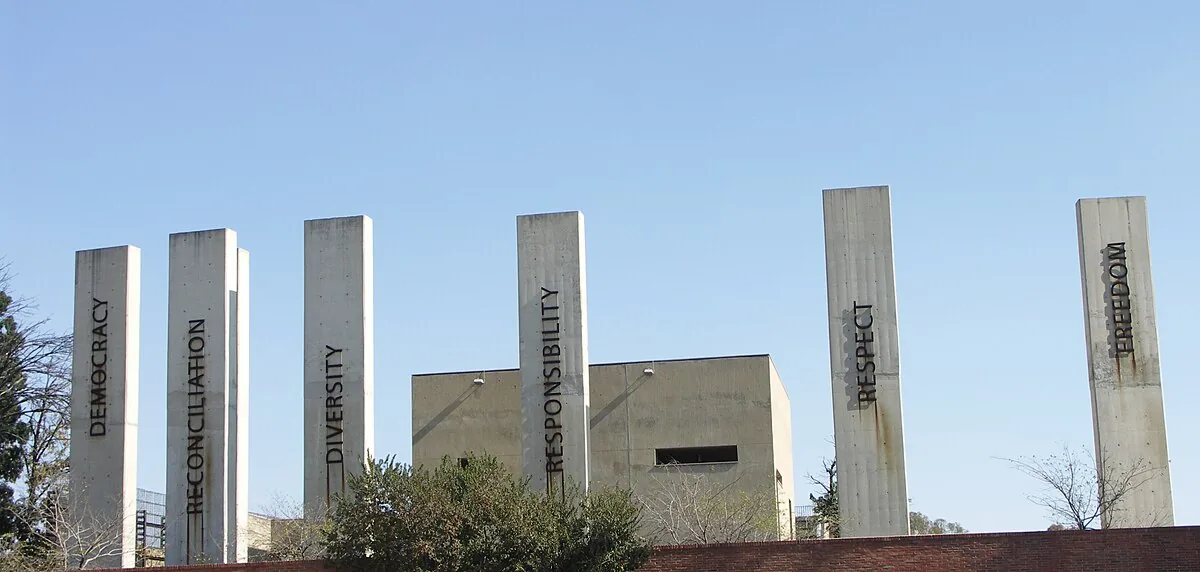
A series of stark, concrete and rusted steel buildings rise from the industrial landscape of southern Johannesburg, designed to mirror the cold, institutionalized cruelty of the system they document. The Apartheid Museum is not a mere collection of artifacts; it is a designed psychological experience. From the moment you enter, your ticket randomly assigns you a race, forcing you through separate entrances based on 'Blankes' (Whites) or 'Nie-Blankes' (Non-Whites). Inside, the narrative follows the rise and fall of the state-sponsored system of racial segregation that gripped South Africa from 1948 to 1994. The architecture uses narrow passages, high walls, and harsh industrial materials to evoke the feeling of being trapped within a machine of social engineering, leading you eventually toward the light of the 1994 democratic elections.
A series of stark, concrete and rusted steel buildings rise from the industrial landscape of southern Johannesburg, designed to mirror the cold, institutionalized cruelty of the system they document.
Opening, 2001
Opening in 2001, the museum was the result of a unique deal between a casino developer and the government; in exchange for a gaming license, the developer had to build a world-class museum that addressed the nation's past. A team of historians, curators, and architects worked together to create a space that avoided the trap of state propaganda, focusing instead on a brutally honest account of the 20th century. The museum is located near Gold Reef City, a site built atop an old gold mine, symbolizing how the wealth of Johannesburg was inextricably linked to the labor and suffering of the people marginalized by apartheid. Over the years, it has become the definitive repository for the photographs, film footage, and personal testimonies that defined the struggle for liberation.
Visiting Apartheid Museum
The air inside the galleries feels heavy and still, often carrying the mechanical hum of old projectors and the muffled sound of revolutionary songs. The sharp, rhythmic barking of police dogs in archival footage and the haunting, melodic voices of a nation in protest. The crossing of the hall of hanging nooses, representing the activists executed by the state, There is a sudden, physical chill and a sense of absolute gravity. First, the weathered textures of the original 'pass books' and the vibrant, defiant colors of the anti-apartheid posters. The light shifts from the oppressive, fluorescent shadows of the prison exhibits to the bright, open sun of the garden of remembrance. From front of the massive posters of the 1994 election lines, the relief and hope of that moment feel as fresh as if it happened yesterday.
Location and access
The museum is located in Ormonde, a short drive from the Johannesburg city center or the township of Soweto. People typically arrive via a guided tour or a ride-share service like Uber, as the surrounding area is industrial and not particularly pedestrian-friendly. It is widely considered a half-day experience, as the sheer volume of information and emotional weight requires time to process. The museum is well-signposted from the main highways, and there is ample secure parking on-site for those driving themselves.
The museum is located in Ormonde, a short drive from the Johannesburg city center or the township of Soweto.
The Experience
A profound, uncomfortable silence as you walk between the high wire fences of the entrance, realizing how easily a society can be partitioned. The sound of the wind rattling the metal plates of the building is the only companion in the outdoor walkways. The tiny, handwritten letters from prisoners to their families, which humanize the statistics of the struggle. Those who come are moved by the large-scale videos, but the real impact is in the small rooms dedicated to the Truth and Reconciliation Commission. The moment you step into the final garden and see the pillars of the constitution is when the weight of the history begins to transform into a sense of responsibility.
Why It Matters
The Apartheid Museum is the most important historical archive in South Africa. it represents a global benchmark for how a nation can confront its darkest chapters with honesty and intellectual rigor. Historically, it is the bridge between the 'Old South Africa' and the 'New,' providing the context necessary to understand the challenges of the country today.
Why Visit
Visit the Apartheid Museum because it is the only way to truly understand the soul of modern South Africa. It is a masterclass in museum design that doesn't just tell you history, it makes you feel it in your bones. You go to learn about a tragedy, but you leave inspired by the capacity for human change.
✦ Insider Tips
- 1
Set aside at least three to four hours; the museum is incredibly dense with text and film, and rushing through it diminishes the emotional impact.
- 2
Follow the numbered path strictly; the museum is designed as a chronological journey, and jumping ahead can make the narrative confusing.
- 3
Bring a light sweater; the air conditioning in the concrete galleries can be surprisingly cold, adding to the somber atmosphere of the exhibits.
- 4
Look for the display on the 1976 Soweto Uprising; it contains some of the most powerful and heartbreaking photographs ever taken in South Africa.
- 5
Take a moment in the courtyard of the seven pillars of the constitution at the end to reflect; it is designed specifically as a space for processing the weight of the experience.