Twenty million years of slow, patient water drips have sculpted a limestone palace so vast it was once used as a secret venue for classical concerts.
About Cango Caves
San paintings near the cave entrance suggest that humans have known of this site for at least 10,000 years, though they never ventured into the pitch-black deeper chambers. Following Van Zyl's discovery, the caves were explored by various colonial figures, including Lord Charles Somerset. The first map of the system was drawn in 1897, revealing a complexity that stunned geologists of the time. In 1938, the caves were proclaimed a National Monument, and modern lighting was installed to showcase the formations without the soot damage caused by early explorers' torches.
About Cango Caves
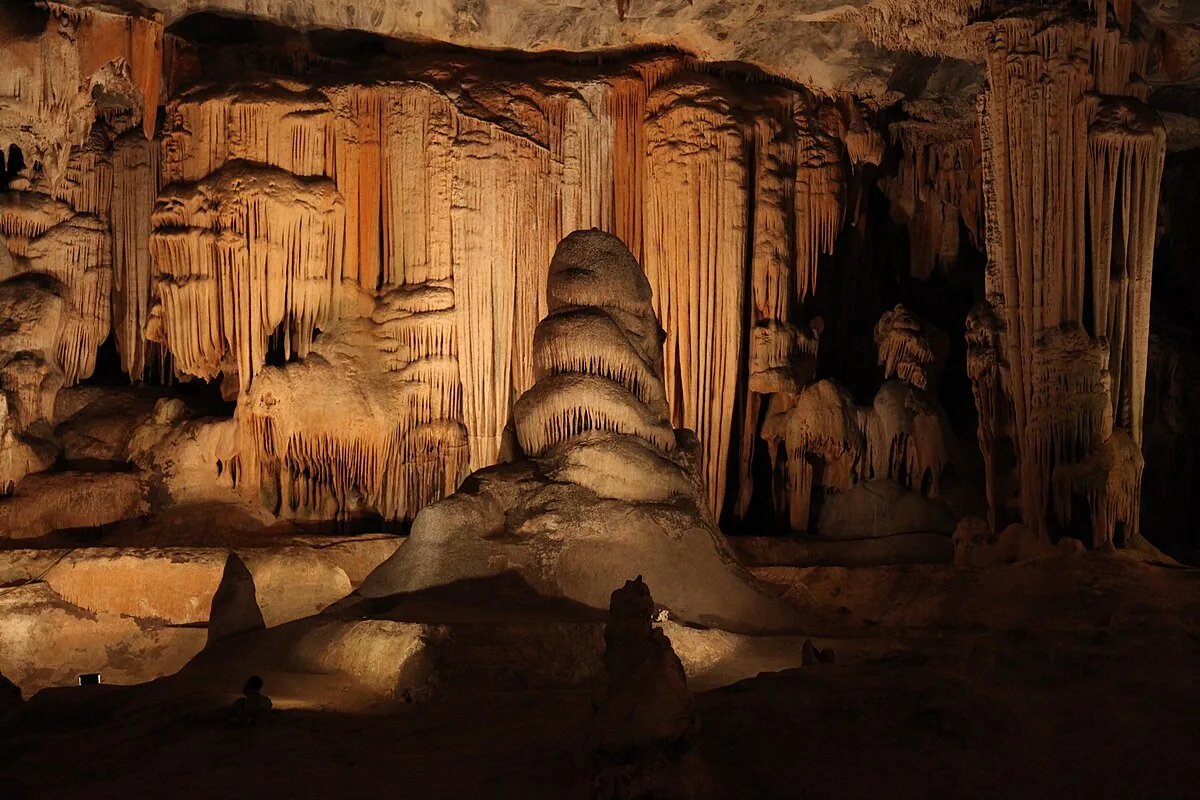
Deep within the Swartberg Mountains lies a subterranean cathedral of limestone that has been forming for twenty million years. Cango Caves represents Africa's largest and most spectacular cave system, a series of vast chambers dripping with stalactites and rising stalagmites. The entrance sits in the lush Cango Valley, leading visitors into a world where time is measured by the slow drip of mineral-rich water. Huge caverns like Van Zyl’s Hall stretch over 90 meters in length, illuminated by subtle lighting that highlights the translucent 'curtains' of stone. The temperature inside remains a constant, humid 18 degrees Celsius regardless of the Karoo sun outside. This underground wilderness offers two paths: a gentle walk through the grand halls or a grueling crawl through the 'Devil’s Chimney' for the adventurous.
of the caves, 1780
Local legend credits a farmer named Jacobus van Zyl with the modern discovery of the caves in 1780, though San people had used the entrance as a shelter for millennia. Van Zyl was allegedly lowered into the first great chamber by rope, clutching a single candle that barely pierced the ancient gloom. By the 19th century, the caves had become a popular, if poorly regulated, attraction for early travelers who often broke off pieces of crystal as souvenirs. This destruction led to the appointment of the first official conservator in 1820, making it South Africa's first protected natural landmark. Exploration continued well into the 1970s, uncovering new chambers like Cango 2 and Cango 3 that remain closed to the general public to preserve their delicate ecosystem.
The air inside feels heavy and damp, smelling faintly of wet stone and ancient earth. From somewhere comes the rhythmic 'plink' of water hitting the cave floor, a sound that has echoed here since before the dawn of humanity. Tracing the designated paths, the smooth, slightly slick texture of the railings and the occasional puff of cool air from deeper passages. What catches you is the 'Botha’s House' formation, which looks like a giant pipe organ carved from white marble. The light is soft and golden, casting long, dramatic shadows that make the stalagmites look like frozen giants. The moment the guide turns off the lights during the 'Heritage Tour,' the absolute, velvet darkness of the deep earth becomes a physical weight on your chest.
Cango Caves is located 29 kilometers
Cango Caves is located 29 kilometers north of Oudtshoorn, at the end of a scenic drive through the foothills of the Swartberg. The road is fully tarred and easily navigable by any standard rental car. Most people include the caves as part of a Garden Route loop or a trip through the Klein Karoo. Because the caves have a strict carrying capacity to manage CO2 levels, booking a tour time in advance is mandatory. The 'Adventure Tour' involves narrow gaps of only 15 centimeters, so it is strictly for those without claustrophobia or physical limitations.
The Experience
Humidity cling to your skin as you descend into the 'Lumbago Alley,' where the ceiling forces you into a respectful bow. You catch of the guide's voice takes on a strange, muffled quality in the larger chambers, as if the stone is absorbing the noise. The 'Cleopatra’s Needle' formation, a slender stalactite that took over 150,000 years to reach its current height. Most people are so busy taking photos that they miss the tiny blind shrimps living in the cave pools. The moment you squeeze through the 'Tunnel of Love,' the primal thrill of being deep underground overrides every other sense.
Why It Matters
Cango Caves is a geological record of the African continent's climatic shifts over millions of years. It is one of the world's finest examples of karst topography. Culturally, it remains a site of immense pride for the Klein Karoo, representing the first successful efforts at nature conservation in South African history.
Why Visit
Visit Cango Caves to see the earth's architecture at its most flamboyant. It is a rare opportunity to walk through a landscape that hasn't seen natural light in eons. You go for the scale of the halls, but you stay for the strange, alien beauty of the stone formations that look like they belong in a dream.
✦ Photo Gallery
Best Season
🌤 September-October offers pleasant weather in the surrounding valley, though the cave interior is perfectly climate-controlled all year round.
Quick Facts
Best time to visit
September-October offers pleasant weather in the surrounding valley, though the cave interior is perfectly climate-controlled all year round.
Getting there
In Oudtshoorn, South Africa; reach Oudtshoorn first, then continue to the site.
Location
Oudtshoorn, South Africa
Type
attraction
Coordinates
-33.3928°, 22.2147°
Insider Tips
- 1
Book the first tour of the morning to experience the chambers with the freshest air and the smallest crowds.
- 2
Avoid the Adventure Tour if you have a waist measurement over 100 centimeters; the 'Leopard Crawl' gap is unforgivingly narrow.
- 3
Wear a shirt with pockets for your phone or keys, as you will need both hands for climbing in the deeper sections.
- 4
Ask your guide to point out the 'ice-cream' formations, which show the translucent beauty of pure calcite.
- 5
Stay in Oudtshoorn the night before to ensure you make your scheduled tour time, as late arrivals are typically not refunded.