In the middle of Durban's loudest market district, behind a pair of heavy wooden doors, lies a marble courtyard so quiet you can hear the wings of pigeons.
About Juma Masjid Mosque
The mosque’s evolution mirrored the rise of Durban as a major port city. Its founder, Aboobaker Amod Jhaveri, was a pioneer of the Indian business community who saw the need for a central spiritual hub. In 1927, the mosque underwent its most significant renovation, adopting the grand Mughal-style domes that define the city's skyline today. During the 1980s, the mosque was a site of quiet resistance, where leaders gathered to discuss the moral implications of the struggle against apartheid. Today, it works as a monument to the resilience of the 1860 settlers and their descendants who built a new home while fiercely preserving their faith.
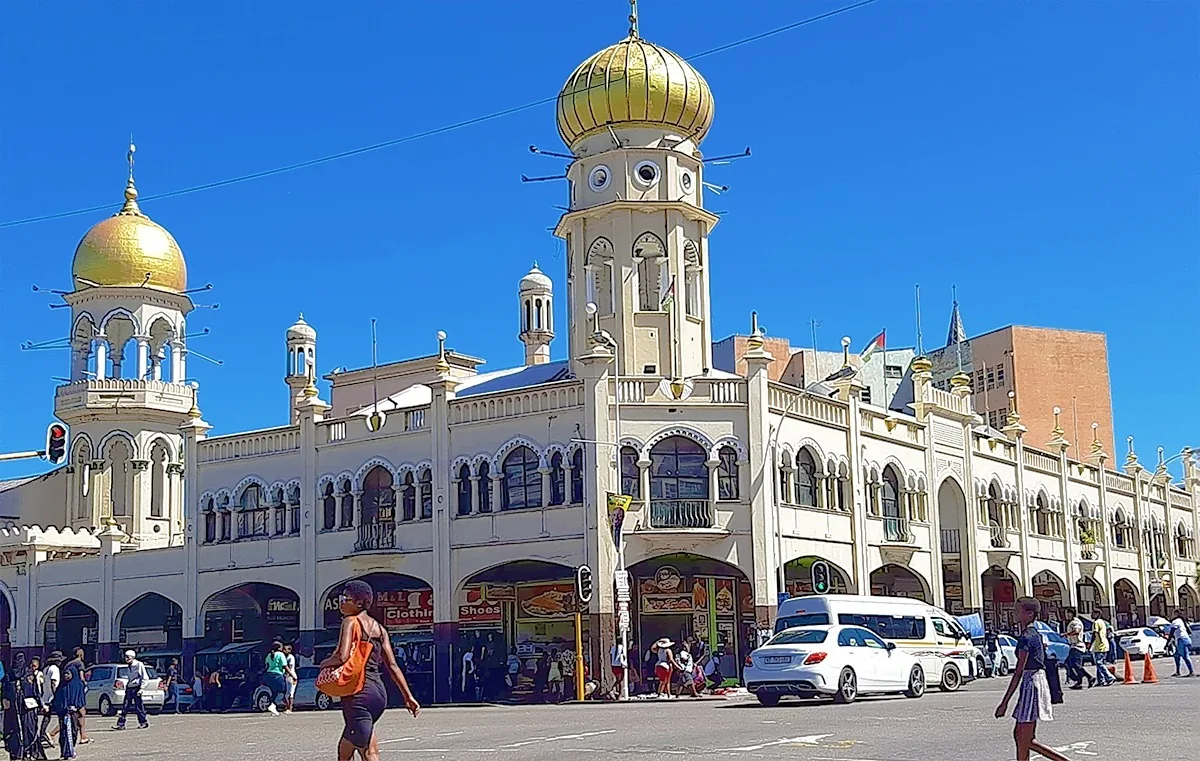
Golden domes and towering minarets rise above
Golden domes and towering minarets rise above the chaotic markets of Durban’s Grey Street Casbah, marking the largest mosque in the Southern Hemisphere. The Juma Masjid, also known as the Grey Street Mosque, is a sprawling architectural landmark that can accommodate up to 6,000 worshippers. Its design is an unusual combination of Mughal and North African styles, featuring elegant arches and a marble-paved courtyard that provides a peaceful escape from the city’s humidity. Surrounded by the scent of roasted spices and the clamor of street vendors, the mosque is the spiritual heart of Durban’s Indian community. Inside, the atmosphere shifts from the urban roar to a cool, reverent stillness where the light filters through ornate windows onto soft, patterned carpets.
In 1881, a group of Indian
In 1881, a group of Indian traders purchased a small plot of land on Grey Street for 115 pounds to build the city's first place of worship. The original structure was a simple brick building, but as the community grew with the arrival of indentured laborers and merchants from Gujarat, so did the mosque. Over several decades, the building was expanded and remodeled, with the iconic minarets added in 1904. The mosque survived several periods of political tension and the restrictive laws of the apartheid era, which sought to limit the growth of non-white religious spaces in city centers. Throughout its history, the Juma Masjid has functioned not just as a prayer hall, but as a center for social justice, education, and community support, cementing its role as a pillar of Durban’s social fabric.
The air outside is a thick cocktail of diesel fumes, frying samoosas, and the salty humidity of the Indian Ocean. The melodic, resonant call to prayer as it cuts through the sound of hooting taxis and market bartering. Inside the courtyard, the immediate drop in temperature as the marble floors cool your feet. The intricate geometric patterns of the tilework and the soft, repetitive rhythm of people performing their ablutions at the central fountain. The light inside the main prayer hall is diffused and ethereal, highlighting the vastness of the space and the delicate calligraphy on the walls. The moment the city noise fades behind the heavy doors, the mosque’s role as a sanctuary becomes a tangible, physical sensation.
Location and access
The Juma Masjid is located in the center of Durban’s busy business district, on what is now Dr. Yusuf Dadoo Street. At the mosque on foot from nearby landmarks like the Victoria Street Market is the best way to soak in the local atmosphere. While the area is safe during the day, it is extremely busy, and parking is nearly impossible to find. Taking a taxi or a ride-share to the entrance is recommended. Non-Muslim visitors are welcome outside of prayer times, but should dress modestly and remove their shoes before entering. Guided tours are often available through the Islamic Information Centre located on-site, providing a deeper look at the architecture and the history of Islam in South Africa.
The Experience
You feel the transition from the frantic energy of the 'Casbah' to the meditative calm of the interior. You catch of the city becomes a distant, low-frequency hum that only emphasizes the silence within. First, the way the afternoon sun casts long, arched shadows across the prayer mats, creating a sense of timelessness. The bulk of visitors are struck by the sheer size of the hall, but the real beauty is in the small details, like the cool touch of the marble columns. The moment you see a group of elders sitting in a circle sharing stories, you realize this is the community’s living room as much as its temple.
Why It Matters
The Juma Masjid is the oldest and largest mosque in South Africa. It represents the cultural and religious heritage of the South African Indian population. Historically, it is a landmark of religious freedom and architectural fusion, standing as a primary point of interest in Durban’s diverse 'Oriental' quarter.
Why Visit
Visit the Juma Masjid to experience the true, multicultural heart of Durban. It offers a sensory contrast unlike any other in the city, from the spice-filled chaos of the street to the marble-clad peace of the sanctuary. You go for the architecture, but you stay for the profound sense of calm.
✦ Photo Gallery
Best Season
🌤 Winter (June to August) is the best time to visit Durban, as the weather is dry and the humidity is low, making walking through the city center much more comfortable.
Quick Facts
Best time to visit
Winter (June to August) is the best time to visit Durban, as the weather is dry and the humidity is low, making walking through the city center much more comfortable.
Getting there
In Durban, South Africa; reach Durban first, then continue to the site.
Location
Durban, South Africa
Type
attraction
Insider Tips
- 1
Visit between 10:00 AM and 11:30 AM to avoid the busy mid-day prayer times and ensure you can enter the main hall.
- 2
Look for the Islamic Information Centre across the street; the staff there are incredibly welcoming and can often arrange a private tour of the interior.
- 3
Combine your visit with a walk through the nearby Victoria Street Market for the best selection of spices and traditional Indian crafts in the country.
- 4
Women should bring a light scarf to cover their heads, although the mosque often provides wraps for visitors who need them.
- 5
Pay attention to the minarets; they are one of the best examples of Edwardian-influenced Islamic architecture in the world.