“Your DNA contains a chemical map that leads directly back to this specific patch of South African grassland, where our ancestors first stood upright millions of years ago.”
About Maropeng
While the world looked to East Africa for the origins of humanity, the limestone quarries near Johannesburg were quietly yielding thousands of hominid fossils. Miners in the late 19th century frequently blasted through prehistoric remains while searching for lime, oblivious to the history they were destroying. It wasn't until Robert Broom and Raymond Dart began their rigorous excavations that the true significance of the Sterkfontein and Swartkrans caves came to light. The site was declared a UNESCO World Heritage Site in 1999, ensuring that the 'missing links' found here would be protected from commercial exploitation forever.
What Maropeng actually is
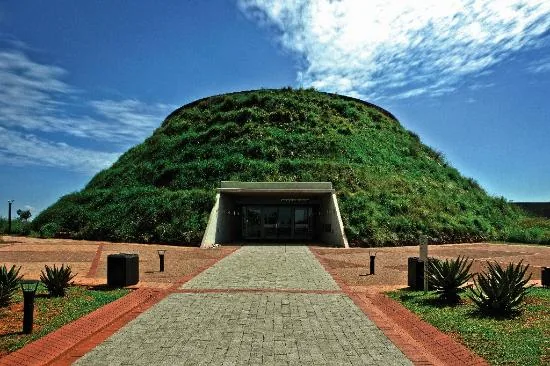
A grassy tumulus rises from the Highveld earth like a giant burial mound, its glass-and-steel facade winking in the Gauteng sun. Maropeng, which means 'returning to the place of origin' in Setswana, is the official visitor center for the Cradle of Humankind. This architectural marvel looks like a prehistoric hill from the front, but reveals a modern, subterranean world entering. The design follows a symbolic path from the ancient past into the digital future, guiding you through the four elements that shaped life on Earth. Inside, the air feels cool and still, a stark contrast to the vast, windswept plains of the Witwatersrand outside. This is a sanctuary for the fossils of our ancestors, providing a space where the profound weight of four billion years of evolution becomes tangible.
A grassy tumulus rises from the Highveld earth like a giant burial mound, its glass-and-steel facade winking in the Gauteng sun.
The limestone caves of Sterkfontein, just a short drive from the main Maropeng building, yielded some of the most significant paleoanthropological discoveries in history. Robert Broom found the first adult Australopithecus africanus skull here in 1936, but the discovery of 'Mrs. Ples' in 1947 captivated the global scientific community. Decades later, Ronald Clarke unearthed 'Little Foot,' a near-complete hominid skeleton that had lain encased in stone for three million years. These finds proved that Africa was the undeniable crucible of humanity. Maropeng was commissioned at the turn of the millennium to translate these complex scientific narratives into a visceral experience for the public. The center opened in 2005, designed to mirror the shape of a burial mound as a nod to our shared lineage and the cyclical nature of life.
The journey begins with a subterranean boat ride that takes you through the cooling mists of the ice age and the roaring heat of volcanic fire. You catch is the rhythmic drip of water in the limestone caves and the low, resonant hum of the earth's tectonic plates shifting in the audio displays. Inside the exhibition halls, the smooth, cold surface of fossil casts and the rough texture of ancient stone tools. Straight away, the evolution of the human brain through a series of interactive displays that illuminate the fragile skull structures of our predecessors. The light transitions from the deep, orange glow of primordial fires to the bright, clinical white of the DNA laboratory. The moment you stand before the original fossils in the vault, the connection between those ancient bones and your own hand feels suddenly, startlingly intimate.
Maropeng sits roughly an hour’s drive
Maropeng sits roughly an hour’s drive from either Johannesburg or Pretoria, positioned in the rolling hills of the Magaliesberg region. The roads are well-maintained, though the final stretch involves winding through rural landscapes where you might spot springbok or zebras in the distance. Most visitors rent a car, as public transport to this remote area is nearly non-existent. A combined ticket including the Sterkfontein Caves is highly recommended, though the caves require a separate drive and a fair amount of physical agility to navigate the narrow passages and steep stairs.
Maropeng sits roughly an hour’s drive from either Johannesburg or Pretoria, positioned in the rolling hills of the Magaliesberg region.
The Experience
An odd sense of homecoming as you descend into the cool, dark heart of the tumulus. The hum of children's laughter echoes off the high walls, mixing with the simulated thunder of the primordial world. The way the architects used light to guide you through the darkness, mimicking the way early humans might have emerged from caves. Most people rush to the interactive games, but the real power lies in the quiet corridor of the hominid skulls. The moment you realize that every human on the planet shares these exact ancestors, the petty divisions of the modern world seem to evaporate in the face of deep time.
Why It Matters
Maropeng preserves the physical evidence of the human origin story. It is one of the few places on the planet where the entire arc of our biological and technological evolution is laid bare. Culturally, it reinforces Africa’s position as the cradle of all humanity, challenging long-held Eurocentric views of history.
Why Visit
Visit Maropeng because it offers a perspective on existence that goes beyond borders or politics. It is a rare chance to stand at the literal beginning of your own story. You go to see fossils, but you leave with a profound understanding of what it means to be human.
✦ Insider Tips
- 1
Check the schedule for 'original fossil' displays; the most famous bones are often kept in a high-security vault and only rotated into public view occasionally.
- 2
Eat lunch at the Tumulus Restaurant; the deck offers an expansive view of the Magaliesberg mountains that helps you visualize the ancient landscape.
- 3
Wear flat, sturdy shoes even if you aren't doing the caves, as the exhibition layout involves significant walking and various floor textures.
- 4
Bring a jacket for the boat ride section, as the temperature drops significantly to simulate the prehistoric climate.
- 5
Visit on a weekday morning to have the interactive displays to yourself and avoid the large school groups that arrive by midday.