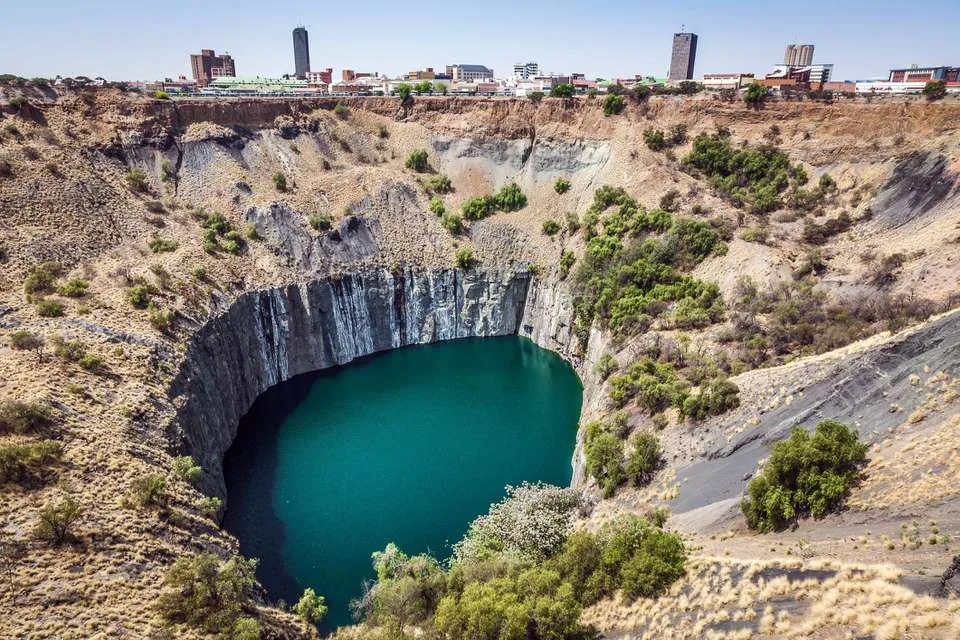
A flat, unremarkable farm was transformed into a 215-meter deep abyss by 30,000 men who dug with nothing but hand tools and the feverish hope of striking it rich.
About The Big Hole
The rush began when a group of prospectors known as the 'Red Cap Party' found diamonds on a small hill in July 1871. Within months, the hill was gone, replaced by a growing depression as thousands of individual claims were excavated simultaneously. This chaotic digging created a labyrinth of rope-walks and precarious ledges before the mine was eventually consolidated into a single pit. Underground mining replaced open-pit work in 1889, continuing until the site was finally decommissioned in 1914. It stands today as the largest hand-dug excavation on the planet, a monument to the era of the 'Diamond Kings.'
What The Big Hole actually is
Roughly 22 million tons of earth were moved by hand to create this sapphire-blue void in the middle of Kimberley. The Big Hole represents a literal scar of ambition, a hand-dug chasm that plunged nearly 800 meters into the crust in search of carbon crystals. Today, the pit is partially filled with turquoise water, looking more like a volcanic crater than an industrial site. A steel viewing platform cantilevered over the edge allows you to peer into the depths where thousands of miners once scrambled like ants. Surrounding the abyss is a preserved town that feels frozen in the 1870s, complete with original corrugated iron buildings and vintage tram tracks. The silence of the hole today contrasts sharply with the frantic, deafening clamor that defined its heyday during the diamond rush.
Johannes and Diederik De Beer never intended to start a global empire when they bought their farm in 1871 for 50 pounds. They simply wanted to graze cattle, but the discovery of diamonds on their land triggered a frantic influx of over 30,000 prospectors. By the time the brothers sold the land for 6,300 pounds, the hill known as Colesberg Kopje had already begun to disappear. Cecil John Rhodes and Barney Barnato eventually fought for control of these claims, a corporate battle that birthed De Beers Consolidated Mines. Between 1871 and 1914, miners unearthed 2,722 kilograms of diamonds using nothing more than picks, shovels, and sheer desperation. The work was brutal, dangerous, and transformed the quiet Karoo landscape into the diamond capital of the world.
The air on the viewing platform carries a dry, metallic scent typical of the Northern Cape. The occasional whistle of the wind as it whips around the jagged rim, punctuated by the distant clatter of a restored tram. Standing over the edge, There is a visceral pull of vertigo as the scale of the excavation finally registers. At once, the different strata of rock on the crater walls, ranging from dusty ochre to the famous 'blue ground' or kimberlite that held the treasure. The light in the late afternoon turns the water at the bottom a deep, opaque teal that looks almost artificial. Inside the 'Old Town' afterward, the texture of the wooden boardwalks and the sight of a Victorian-era bowling alley make the 19th-century boom feel strangely immediate.
Kimberley sits in central
Kimberley sits in central the Northern Cape, easily reached by car from Johannesburg via the N12. The Big Hole complex is centrally situated within the city, with clear signage guiding visitors to the gated entrance. While a car is the most practical way to reach Kimberley, the city is also a stop for the luxurious Blue Train and the Rovos Rail. Once inside the complex, the experience is entirely pedestrian, though a vintage tram offers a short, nostalgic loop around the perimeter of the mine site.
The Experience
You feel the ghost of the 1870s as you walk through the reconstructed streets, where the original De Beers office still stands. Sound-wise of your footsteps on the gravel mimics the noise of thousands of prospectors who once swarmed this site. The way the light catches the ripples on the emerald water far below, a sight far more peaceful than the mine's violent history. People generally focus on the hole, but the underground 'experience' simulation provides the real chills. The moment you enter the high-security diamond vault and see the raw stones in their natural state, the obsession that drove men to dig this hole becomes perfectly clear.
Why It Matters
The Big Hole is the birthplace of the modern diamond industry. It fueled the industrialization of South Africa and shaped the global economy of gemstones. Culturally, it recalls of the immense human cost of extraction and the sheer scale of colonial-era engineering.
Why Visit
Visit the Big Hole to witness the physical evidence of human willpower pushed to its absolute limit. It is one of the few places where you can see the literal impact of a gold (or diamond) rush on the earth's surface. You go for the scale, but you stay for the eerie, quiet beauty of the town that diamonds built.
✦ Photo Gallery
Best Season
🌤 May to August offers clear skies and cool temperatures, avoiding the punishing heat of the Karoo summer which often exceeds 40 degrees.
Quick Facts
Best time to visit
May to August offers clear skies and cool temperatures, avoiding the punishing heat of the Karoo summer which often exceeds 40 degrees.
Getting there
In Kimberley, South Africa; reach Kimberley first, then continue to the site.
Location
Kimberley, South Africa
Type
attraction
Coordinates
-28.7389°, 24.7589°
Insider Tips
- 1
Ask the staff about the 'Kimberley Process' exhibit to understand how this specific mine changed global ethics in gemstone trading.
- 2
Ride the vintage tram; it is the only operational tramway in South Africa and uses original 19th-century tracks.
- 3
Look for the 'Star of South Africa' replica in the museum to see the stone that technically started the entire rush.
- 4
Avoid the midday sun on the viewing platform as the steel structure absorbs heat and can become quite uncomfortable.
- 5
Check the water level of the hole; it changes based on local rainfall and drastically alters the color of the pit.