These mountains contain a hidden outdoor gallery of over 35,000 paintings, some dating back thousands of years, created by a culture that has since vanished from the peaks.
About uKhahlamba Drakensberg Park
The Drakensberg was the final stronghold of the San people, who found sanctuary in its deep ravines as colonial expansion moved inland. Their paintings, found in over 600 sites throughout the park, are more than just art; they are a spiritual map of a people who saw the mountains as a bridge between the physical and spirit worlds. In the early 1900s, the area became a destination for mountaineers and naturalists, leading to the creation of the Royal Natal National Park in 1916. The eventual UNESCO listing in 2000 acknowledged that these peaks are as much a cultural treasure as they are a biological one.
What this is
Basalt buttresses and sandstone ramparts form a 200-kilometer barrier of jagged peaks that the Zulu people call uKhahlamba, 'the barrier of spears.' This massive mountain range, stretching along the border of Lesotho and South Africa, is a landscape of high-altitude grasslands, hidden river valleys, and sheer cliffs that drop into nothingness. The uKhahlamba Drakensberg Park is a UNESCO World Heritage site of dual significance, recognized for its staggering natural beauty and the world's largest collection of San rock art. Above 3,000 meters, the air is thin and cold, while the lower valleys are lush with yellowwood forests and proteas. Whether it is the mist-shrouded 'Amphitheatre' or the lonely spires of the Cathedral Peak area, the Berg, as locals call it, offers a scale of wilderness that feels both ancient and untamed.
“' This massive mountain range, stretching along the border of Lesotho and South Africa, is a landscape of high-altitude grasslands, hidden river valleys, and sheer cliffs that drop into nothingness.”
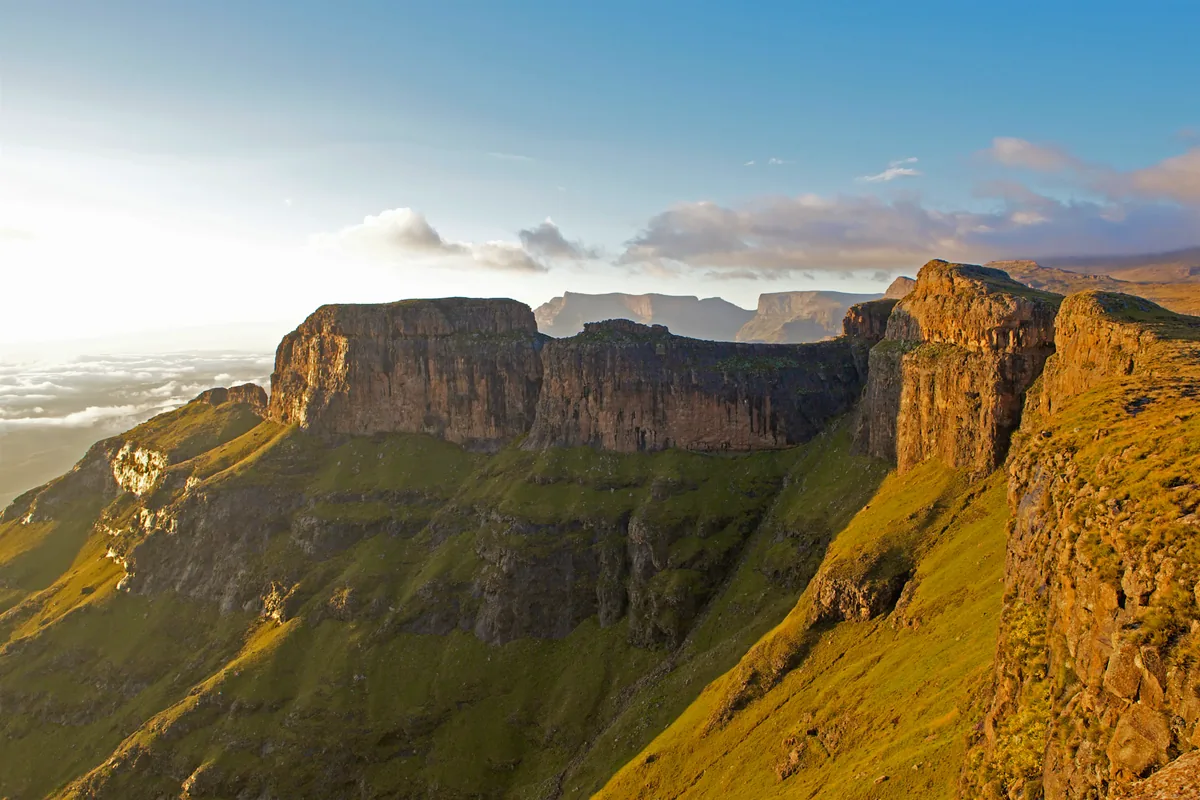
uKhahlamba Drakensberg Park, South Africa
The mountains were formed roughly 180 million years ago when a massive outpouring of lava covered the interior of the Gondwana supercontinent. As the continent drifted apart, erosion carved the basalt layer into the dramatic escarpment we see today. For thousands of years, the San people (Bushmen) lived in these mountains, using the sandstone overhangs as shelters and canvases for their intricate paintings. These artworks, created with mineral pigments and animal fat, depict their spiritual beliefs, hunting practices, and later, their first encounters with European settlers. By the 19th century, the San had been largely driven out or assimilated, but their gallery of 35,000 individual paintings remains. In the 20th century, the park was established to protect this heritage and the vital water catchment area that supplies much of South Africa’s interior.
The air is incredibly crisp and carries the sharp, clean scent of mountain fynbos and damp earth after a summer thunderstorm. Sound-wise is the distant, echoing bark of a baboon and the constant, rushing sound of waterfalls cascading down the basalt faces. Tracing the contour paths, The crunch of dry grass under your boots and the sudden, biting chill when a cloud passes over the sun. The tiny, vibrant flowers hiding in the rock crevices and the massive, soaring shadows of bearded vultures circling the peaks. The light at dawn is otherworldly, painting the peaks in shades of pink and orange before the valleys are even awake. From the edge of the Tugela Falls, the second-highest waterfall in the world, the sheer verticality of the landscape is enough to take the breath from your lungs. The park is divided into several regions, with the Northern and Central Drakensberg being the most accessible from Johannesburg and Durban. Travelers usually base themselves in areas like Royal Natal National Park or Giant’s Castle, which are reached via well-paved but winding secondary roads. A private vehicle is essential for navigating the distances between the different trailheads. While many of the lower walks are manageable for casual hikers, the high-altitude 'Chain Ladders' or the multi-day 'Grand Traverse' require significant preparation, specialized gear, and a deep respect for the mountain's notoriously unpredictable weather.
The Experience
There is a profound sense of solitude as you hike into the 'Little Berg,' where the only sign of humanity is the path beneath your feet. The sound of the wind is a constant companion, whistling through the 'Eye of the Needle' and other strange rock formations. The shimmering transition from the green of summer to the burnt gold of winter when the mountains often wear a cap of snow. Just about everyone stay near the resorts, but the real reward is reaching a remote cave and finding a perfectly preserved painting of an eland. The moment a thick mountain mist rolls in and swallows the landscape, you realize how quickly the 'Barrier of Spears' can turn from beautiful to intimidating.
Why It Matters
uKhahlamba Drakensberg is the most significant mountain range in Southern Africa. It is a vital 'water tower' for the region and a refuge for rare species like the Cape vulture. Historically, it holds the most concentrated collection of San rock art in the world, providing an irreplaceable record of the indigenous history of the subcontinent.
Why Visit
Visit the Drakensberg because it offers a raw, alpine experience that feels completely different from the African savannah. It is a place for true silence and physical challenge. You go for the hiking, but you stay for the ancient art and the humbling scale of the escarpment.
Insider Tips
- 1
Always sign the mountain register before heading out on a hike; the weather here can change from sunny to a life-threatening blizzard in minutes.
- 2
Hire a local guide to see the rock art at Giant’s Castle; they can point out details in the paintings that are invisible to the untrained eye.
- 3
Bring a high-quality rain shell even on cloudless days, as the mountains generate their own localized thunderstorms every afternoon in summer.
- 4
Stay overnight in a hiking cave at least once to experience the silence of the mountains after the sun goes down.