Nelson Mandela's inaugural speech here in 1994 turned a building designed for colonial dominance into a global symbol of reconciliation and the birth of a new nation.
About Union Buildings
Architect Sir Herbert Baker insisted on using only local materials, sourcing the light sandstone from nearby quarries to ensure the building felt rooted in the African soil. It was here in 1956 that 20,000 women marched against the pass laws, famously chanting, 'Now you have touched the women, you have struck a rock.' The site was chosen for its height and visibility, intended to be seen from every corner of the capital. Today, the West Wing houses the office of the President, while the East Wing serves as the administrative heart of the Department of International Relations.
What Union Buildings actually is
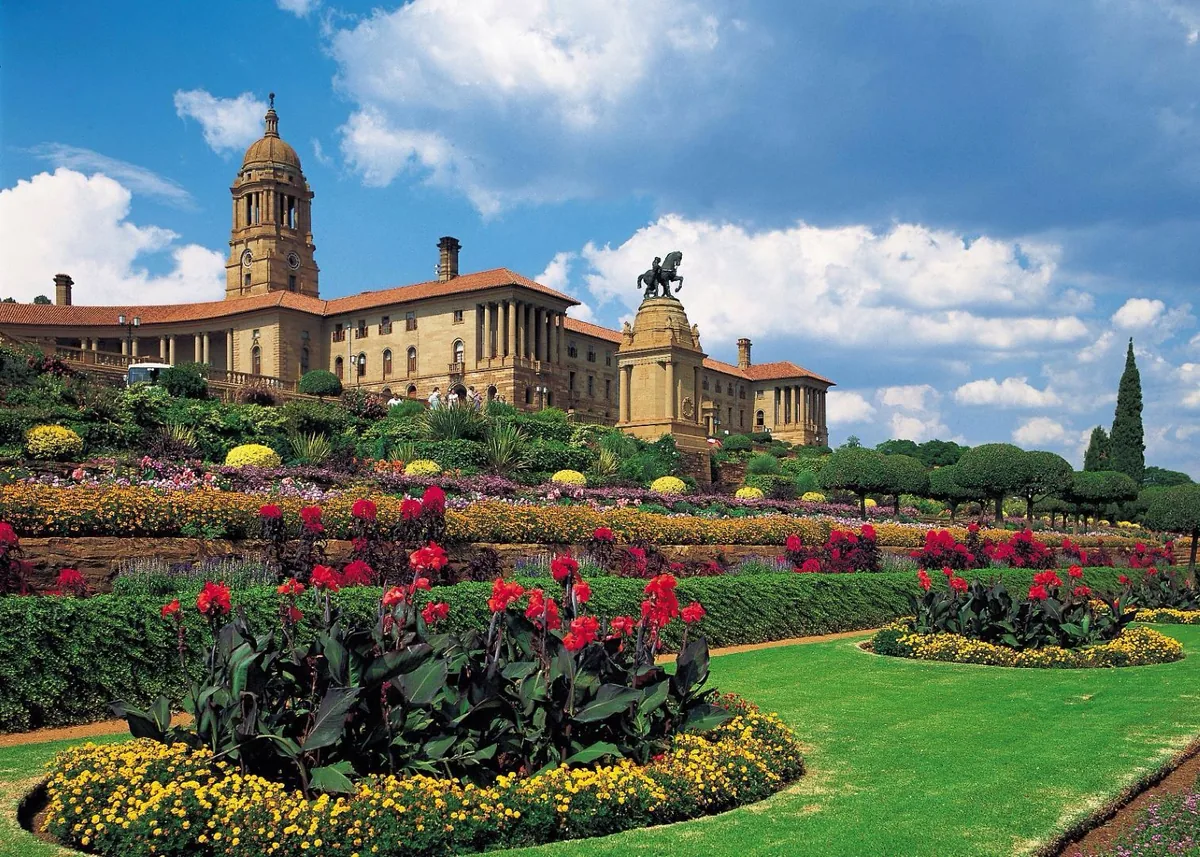
Two massive wings of light-colored sandstone sweep across Meintjieskop, the highest point in Pretoria, forming a semicircular amphitheater that overlooks the administrative capital. Sir Herbert Baker designed this monumental structure to represent the union of a divided country, though its history has often been a story of exclusion and later, spectacular reclamation. The buildings are a masterpiece of Neoclassical and Italian Renaissance styles, characterized by long, shaded colonnades and two identical domed towers representing the English and Afrikaans languages. Lush, terraced gardens fall away from the main facade, filled with indigenous plants and monuments that trace the long, often painful walk toward South African democracy. While the offices inside house the highest levels of government, the lawns outside belong to the people, serving as the site for every presidential inauguration since 1994.
Construction began, 1910
Construction began in 1910 and required nearly 1,300 workmen and three years to complete one of the largest building projects in the southern hemisphere at the time. Sir Herbert Baker envisioned a 'South African Acropolis' that would bring together the warring British and Boer factions following the South African War. For decades, these halls were the nerve center of the apartheid regime, the place where discriminatory laws were signed and enforced. This dark legacy shifted forever on May 10, 1994, when Nelson Mandela stood on these very steps to take the oath of office as the country’s first black president. The buildings transitioned from a symbol of white supremacy to a 'house of the people,' a transformation immortalized by the nine-meter-tall bronze statue of Mandela that now stands with open arms at the center of the gardens.
The air on the hill is crisp and often carries the faint, sweet scent of jacaranda blossoms during the spring months. The distant hum of Pretoria’s traffic far below and the rhythmic footsteps of the guards patrolling the stone corridors. Along the terraced paths, The rough texture of the local sandstone and the cool shade offered by the massive columns. At once, the intricate details of the clock towers and the way the red roof tiles contrast against the deep blue Highveld sky. The light at midday is harsh and bright, catching the bronze sheen of the Mandela statue, while sunset casts long, dramatic shadows across the amphitheater. From the highest terrace, the view of the city stretching toward the horizon makes The immense weight of the decisions made behind those walls.
Pretoria is roughly a 45-minute
Pretoria is roughly a 45-minute drive from Johannesburg, or a quick trip on the Gautrain, which connects the two cities. The Union Buildings are situated on Government Avenue, and while the interior offices are generally closed to the public, the gardens are open daily. Visitors generally arrive via tour bus or private car, parking along the lower terraces to walk up the steep central path. Security is present but the atmosphere on the lawns is typically relaxed, with families picnicking and photographers capturing wedding portraits against the iconic backdrop.
The Experience
A sense of grandeur as you ascend the tiered gardens, passing statues of fallen soldiers and former leaders that tell a messy, layered history. The clatter of the wind whistling through the open colonnades creates a somber, cathedral-like atmosphere. Beginning with the tiny details in the masonry, where South African flora and fauna are carved into the stonework. People generally snap a photo with the Mandela statue and leave, but the real power is in sitting on the stone benches of the amphitheater. The moment you look down at the city and realize the sheer scale of the 1994 celebrations, the site’s significance becomes deeply personal.
Why It Matters
The Union Buildings are the architectural heart of the South African state. They represent the bridge between a colonial past and a democratic future, serving as a permanent reminder of the power of political transformation. Historically, they are a product of the fact that even the most oppressive structures can be repurposed for the good of all citizens.
Why Visit
Visit the Union Buildings because they offer the most impressive architectural vista in South Africa. It is a place where you can literally walk through the timeline of the country’s struggle and triumph. You go for the architecture, but you stay for the palpable sense of history that lingers on the hillside.
✦ Photo Gallery
Best Season
🌤 October is the undisputed best time to visit, as the thousands of jacaranda trees in the city below bloom into a sea of purple, framing the sandstone buildings perfectly.
Quick Facts
Best time to visit
October is the undisputed best time to visit, as the thousands of jacaranda trees in the city below bloom into a sea of purple, framing the sandstone buildings perfectly.
Getting there
In Pretoria, South Africa; reach Pretoria first, then continue to the site.
What's nearby
Constitution Hill and Apartheid Museum are also in the area.
Location
Pretoria, South Africa
Type
attraction
Coordinates
-25.7405°, 28.2120°
Insider Tips
- 1
Visit in the early morning to catch the softest light for photography and to enjoy the gardens before the larger tour groups arrive.
- 2
Bring a picnic and join the locals on the lawns; it is one of the few places in the capital where people from all walks of life congregate freely.
- 3
Look for the Delville Wood War Memorial, which is a tribute to South African soldiers who fought in World War I, featuring a replica of the memorial in France.
- 4
Check the government schedule; the gardens are occasionally closed for official state visits or high-security diplomatic events.