Millions of years of erosion have left these massive stone towers standing like a petrified forest on the edge of an abyss that overlooks the endless Karoo plains.
About Valley of Desolation
The Valley of Desolation is a product of the Jurassic period, a time when the Earth’s crust was literally tearing itself apart. The dolerite that forms the pillars is much harder than the surrounding sandstone, allowing it to withstand the relentless wind and rain that flattened the rest of the landscape. For the early pioneers and trekboers, the valley was a daunting landmark that signaled the beginning of the harsh interior. In the 20th century, it became a site of scientific fascination, drawing geologists from around the world to study the unique volcanic intrusions of the Karoo Supergroup.
What Valley of Desolation actually is
Sheer dolerite pillars rise nearly 400 feet from the floor of the Great Karoo, creating a jagged, haunting skyline that looks like the work of an ancient, angry god. The Valley of Desolation, located within the Camdeboo National Park, is a geological anomaly where the earth has been stripped away by 100 million years of erosion to reveal a forest of vertical stone columns. These 'cathedrals of the Karoo' stand on the edge of a massive escarpment, providing a dizzying drop-off that overlooks the plains of Camdeboo and the town of Graaff-Reinet. The landscape is a study in monochromatic beauty, with the grey-green scrub of the semi-desert contrasting against the dark, iron-rich rock. It is a place of immense silence, where the only movement is the slow circle of a Verreaux's eagle riding the thermals between the cliffs.
“Sheer dolerite pillars rise nearly 400 feet from the floor of the Great Karoo, creating a jagged, haunting skyline that looks like the work of an ancient, angry god.”
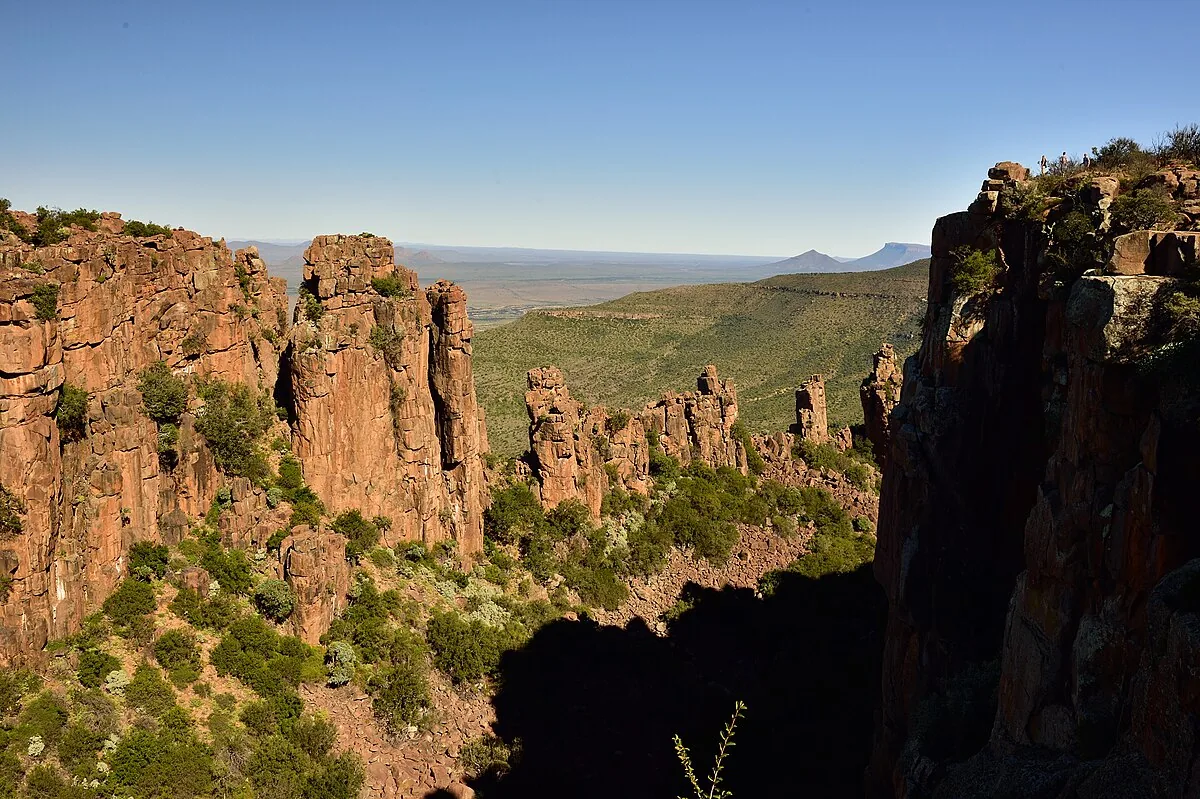
Valley of Desolation, South Africa
The formation of these pillars began roughly 180 million years ago during a period of intense volcanic activity associated with the breakup of the supercontinent Gondwana. Molten magma forced its way into the softer sedimentary layers of the Karoo, cooling slowly to form hard, vertical joints of dolerite. Over the following millennia, the softer rock washed away, leaving behind the stubborn, crystalline structures we see today. Local legends suggest that the Khoisan people viewed the valley with deep reverence, seeing the pillars as petrified spirits. In the modern era, the valley was declared a National Monument in 1939, and later became the centerpiece of the Camdeboo National Park in 2005. It remains a primary example of the 'Great Escarpment,' a geological feature that defines the interior plateau of Southern Africa.
The air is incredibly dry and thin, often smelling of sun-baked stone and the faint, resinous scent of Karoo bushes. The sharp, whistling wind as it cuts through the gaps between the pillars and the occasional rattle of loose shale under a lizard’s feet. Along the edge of the viewpoint, There is a visceral sense of vertigo and the strange, magnetic pull of the open space below. What catches you is the subtle color shifts in the rock, from deep charcoal to a warm rust where the iron has oxidized over centuries. The light at sunset is transformative, turning the entire valley into a golden furnace for a few brief minutes before the shadows turn purple. Up on the highest ledge, the vastness of the Karoo plains stretching toward the horizon makes the world feel ancient and indifferent. The valley is situated just a ten-minute drive from the historic town of Graaff-Reinet, often called the 'Gem of the Karoo.' A well-maintained tarred road leads from the town directly up into the Camdeboo National Park and to the top of the escarpment. You come across a short, easy circular walk from the parking area to the main viewpoints, as well as longer hiking trails for those who want to explore the deeper crevices of the mountain. Most people arrive by private vehicle, as there is no public transport to the site. The park entrance is clearly marked, and the ascent is steep but manageable for most standard cars.
The Experience
An odd, humbling insignificance as you stand between pillars that have stood unchanged since before the first humans appeared. Audibly, the of the wind is constant, a low-frequency hum that seems to vibrate through the rock itself. The tiny, hardy plants that grow in the cracks of the stone, surviving on nothing but the morning dew. People generally stay at the fenced viewpoints, but the real experience is finding a quiet spot on the rocks away from the path. The moment the sun dips below the horizon and the first stars appear over the plains is when the 'desolation' of the valley becomes a form of sanctuary.
Why It Matters
The Valley of Desolation is one of the most iconic geological sites in South Africa. It serves as a textbook example of volcanic intrusion and differential erosion. Culturally, it is the spiritual heart of the Karoo, representing the rugged, unyielding beauty of the South African interior and the geological forces that shaped the continent.
Why Visit
Visit the Valley of Desolation because it offers a scale of landscape that is difficult to find anywhere else. It is a place to confront the 'Deep Time' of the planet. You go for the dramatic photos, but you stay for the profound, prehistoric silence that can only be found on the edge of the Karoo.
Insider Tips
- 1
Arrive at the gate at least an hour before sunset to allow time for the drive up and the walk to the best viewing ledge.
- 2
Bring a pair of binoculars to spot the Verreaux's eagles that nest in the cliffs; they are often visible soaring at eye-level from the viewpoints.
- 3
Wear shoes with good grip, as the gravel paths near the edge can be slippery even if the walk is relatively flat.
- 4
Look for the 'Crag Lizard', a local species that blends perfectly with the dolerite and is frequently seen sunning on the rocks.
- 5
Carry water even for the short walk; the dry Karoo air can dehydrate you surprisingly quickly, especially in the afternoon heat.