Forty-five thousand unique aluminum panels wrap this structure in a metallic skin that contains not a single right angle, transforming a city block into a shimmering, liquid hall of mirrors.
About Dongdaemun Design Plaza
Architect Zaha Hadid won the international design competition in 2007, proposing a 'Metonymic Landscape' that would dissolve the traditional boundaries of a building. During the seven-year construction period, the discovery of the Igansumun water gate and the Seoul City Wall forced a redesign that incorporated these historical artifacts into the contemporary park. The DDP finally opened its doors in March 2014, immediately becoming the centerpiece of Seoul's creative economy and a hub for the city's biannual Fashion Week. Its construction signaled a shift in Korean urban planning, moving away from utilitarian blocks toward world-class experimental architecture.
Dongdaemun Design Plaza
Rising from the neon-soaked streets of Seoul's fashion district, the Dongdaemun Design Plaza (DDP) resembles a silver spacecraft that has settled gently into a bed of ancient ruins. Zaha Hadid’s neo-futuristic vision replaced a gritty baseball stadium with a seamless, flowing structure of 45,000 aluminum panels. Every curve suggests motion, a physical echo of the city’s restless energy. There are no straight lines here, only a continuous liquid landscape that blurs the boundary between floor, wall, and ceiling. It acts as the anchor for a neighborhood that never sleeps, standing in stark defiance of the rigid high-rises that surround it.
“Rising from the neon-soaked streets of Seoul's fashion district, the Dongdaemun Design Plaza (DDP) resembles a silver spacecraft that has settled gently into a bed of ancient ruins.”
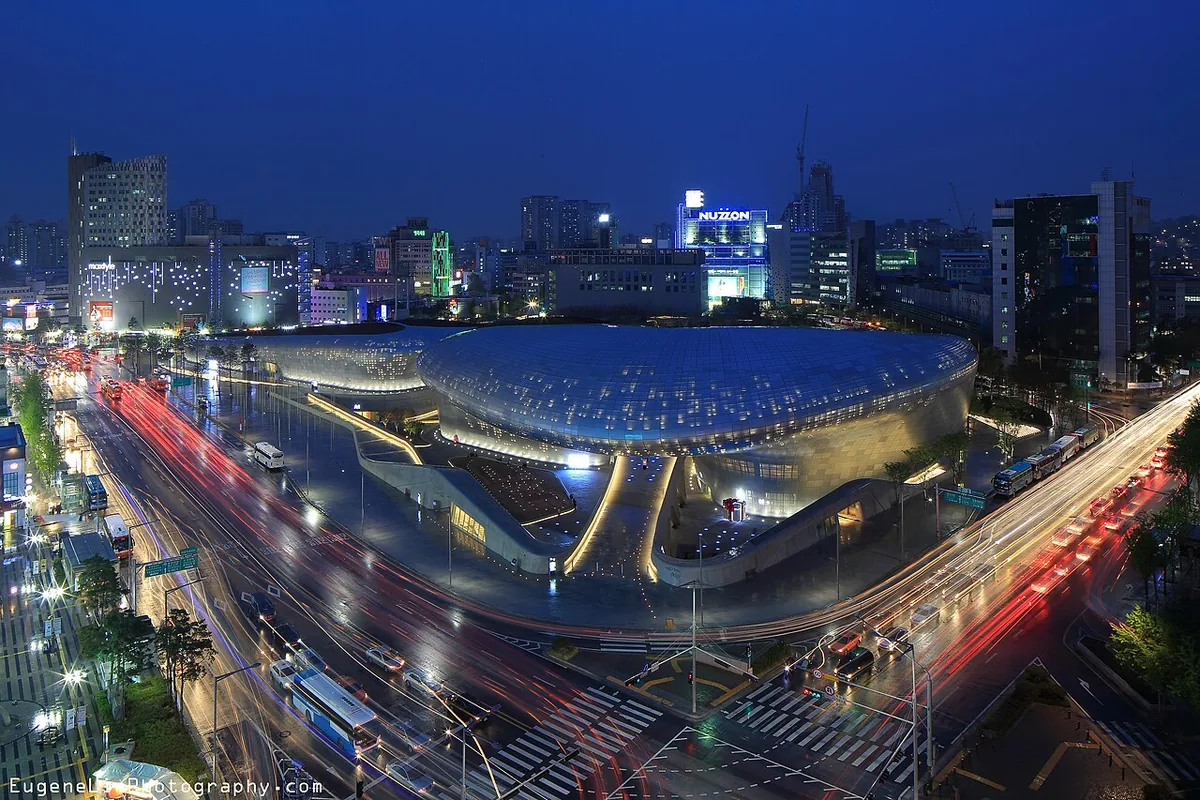
Dongdaemun Design Plaza, South Korea
urban renewal plan, 2007
The project began as an ambitious urban renewal plan in 2007, intended to cement Seoul’s status as a global design capital. During excavation, workers unearthed the remains of the 15th-century Seoul City Wall and an ancient military training camp. Rather than erasing this history, Hadid integrated the ruins into the park, creating a striking visual tension between the Joseon Dynasty and the 21st century. Completed in 2014, the building utilizes Building Information Modeling to manage its complex geometry, making it one of the most technologically advanced structures in the world. It is still a monument to the 'Pali-pali' (hurry-hurry) culture of South Korea, built with a speed and precision that few other nations could muster.
Navigating to this landmark is effortless
Navigating to this landmark is effortless via the Seoul Subway. Lines 2, 4, and 5 all converge at the Dongdaemun History & Culture Park Station, with exits leading directly into the belly of the plaza. To see the building at its most dramatic, arrive just as the sun sets. The transition from the harsh daylight reflecting off the silver skin to the soft glow of the night lighting reveals the true complexity of the facade. Most people stay late, fueled by the street food stalls of the nearby night market, where the smell of grilled tteokbokki mixes with the crisp, air-conditioned breeze emanating from the plaza’s vents.
Visiting Dongdaemun Design Plaza
Stepping into the DDP feels like entering a dream of the future where gravity is optional. The white, cavernous interiors of the Design Path wind upwards in a gentle spiral, leading you through galleries and labs without the interruption of a single staircase. The acoustics are strangely dampened, a quiet contrast to the roar of traffic just meters away. At night, the exterior panels are perforated by thousands of tiny lights, making the entire building glow with an otherworldly luminescence. You might find yourself wandering into the underground market where young designers sell experimental wares, or simply sitting on the grassy roof slopes, watching the lights of the surrounding shopping towers flicker like a digital forest.
The Experience
The air inside the DDP carries a sterile, fresh scent, and the silence of the long, sloping ramps is occasionally broken by the soft squeak of sneakers on polished floors. A sense of vertigo in the best way possible, as if the walls are tilting slightly toward the future. Outside, the LED rose garden, once a temporary installation, now a digital legend, pulses with a soft white light that mimics a field of flowers. Inside the central courtyard, the scale of the silver canopy makes you feel small, yet the organic curves make the massive structure feel strangely approachable and human.
Why It Matters
The DDP represents Seoul’s transformation from a manufacturing powerhouse into a global cultural trendsetter. It is more than an exhibition hall; it is a bridge between the fortress-walled history of the Joseon era and the digital ambitions of the modern Hallyu wave. It proves that heritage and futurism can coexist in the same footprint without compromising either.
Why Visit
Go because the DDP is the only place in Seoul where you can walk through a 15th-century gate and a spaceship-like gallery in the same breath. It is a masterclass in how architecture can manipulate space to make a massive city feel fluid and imaginative. While the nearby malls offer commerce, the DDP offers a glimpse into the soul of a city that refuses to stand still.
Insider Tips
- 1
Find the 'Design Staircase' on the basement level; its dramatic lighting and sharp angles make it the most popular spot for architectural photography.
- 2
Visit the rooftop park at dusk to see the city lights framed by the building's sweeping silver curves.
- 3
Check the basement level 'Design Store' for high-end souvenirs created by local artisans that you won't find in the tourist markets.
- 4
The building is open 24 hours, but the interiors close around 9:00 PM, so plan your indoor exploration for the afternoon.
- 5
Look for the preserved ruins of the military training camp located in the park area; they provide a quiet, grassy escape from the crowds.