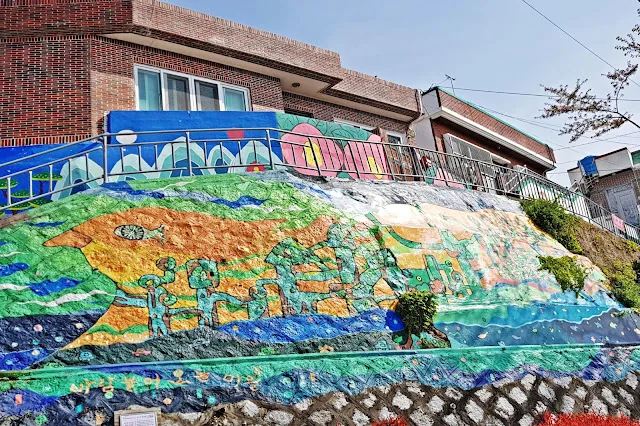
A neighborhood that was supposed to be demolished by bulldozers saved itself by inviting artists to turn its crumbling walls into a three-dimensional coloring book.
About Dongpiran Mural Village
Dongpiran was originally a settlement for refugees and low-income laborers who worked the docks after the Korean War. By the early 2000s, it was considered an eyesore by city planners who wanted to restore the Joseon-era Dongporu Pavilion that once stood on the summit. The 2007 mural initiative, led by the 'Tongyeong 21' civic group, invited students and artists to paint under the theme of 'life and hope.' The project was so successful that it sparked a nationwide 'mural village' trend, though Dongpiran remains the gold standard because of its authentic connection to the local fishing culture and its residents' active participation in the tourism economy.
Perched on a steep hillside overlooking the busy
Perched on a steep hillside overlooking the busy harbor of Tongyeong, Dongpiran Mural Village is a riot of color that was born from an act of defiance. What was once a crumbling slum slated for demolition has become a vibrant outdoor gallery where every wall tells a story. The name Dongpiran means 'east cliff,' and the neighborhood’s narrow, winding stairs offer some of the most panoramic views of the South Sea. The salt air of the fishing port meets the scent of fresh paint, and where the gritty reality of a working-class neighborhood has been transformed by the imaginative brushstrokes of artists from across the country.
Why it matters
In 2007, the local government planned to raze the dilapidated houses of Dongpiran to build a park and reconstruct part of the historic city wall. Facing eviction, the residents and a local NGO launched a 'Mural Painting Festival' to prove the neighborhood had cultural value. The plan worked better than anyone expected. The influx of visitors and the international attention saved the village from the wrecking ball. To keep the energy fresh, the murals are repainted every few years, meaning the village you visit today will look different from the one you see in five years. This constant cycle of renewal has turned Dongpiran into a symbol of successful community-led urban regeneration in Korea.
Exploring Dongpiran is a vertical adventure.
Exploring Dongpiran is a vertical adventure. An impression of incline in your legs as you navigate the 'stairway to heaven' paths, but every turn reveals a new surprise, a giant pair of angel wings, a whimsical sea creature, or a poignant portrait of a local grandmother. The sounds of the harbor, the foghorns of fishing boats and the cries of seagulls, float up the hill, grounding the art in its maritime context. What grabs you is the small details: a painted mailbox, a cat napping on a wall decorated with fish, and the laundry of residents drying next to a multi-million-won mural. Small cafes run by locals offer 'Ssanghwa-cha' (medicinal herb tea) and views that stretch across the shimmering water of the port below.
Tongyeong is accessible by express
Tongyeong is accessible by express bus from Seoul or Busan. Once in the city, Dongpiran is located just behind the Jungang Market. You can walk from the harbor front up into the village in about ten minutes. The entrance is marked by a sudden transition from the gray concrete of the market to the bright pastels of the hillside. It is best to visit in the late morning when the sun illuminates the seaward-facing murals, then descend back into the market for a lunch of Tongyeong’s famous 'Chungmu Gimbap' (seaweed rice rolls served with spicy squid and radish).
The Experience
You hear the sound of wind chimes and the distant clatter of the fish market as you climb. The grain of the village is a mix of rough, weathered stone and smooth, painted plaster. First you see the way the light reflects off the colorful walls, giving the narrow alleys a warm, saturated glow even on overcast days. There is a playful, interactive element to the experience; you find yourself posing with 3D art or following a trail of painted footsteps. Despite the tourists, the village retains a lived-in feel, with the smell of grilled fish drifting from open kitchen windows and neighbors chatting across the painted lanes.
Why It Matters
Dongpiran is a landmark of social sustainability. It proves that art can be a powerful tool for social justice and that preserving a community’s heart is often more valuable than historical reconstruction. It has transformed Tongyeong from a sleepy fishing port into a major cultural destination, providing a blueprint for how struggling neighborhoods can reclaim their future through creativity and collective action.
Why Visit
Visit Dongpiran because it is a place of pure, unadulterated optimism. It lacks the self-serious atmosphere of many museums, offering instead a joyful, tactile engagement with art. It is the best place in Korea to see how the past and the future can coexist through a simple pot of paint and a lot of community spirit.
✦ Photo Gallery
Best Season
🌤 May and June offer the clearest views of the South Sea, with the bright blue of the water perfectly complementing the vibrant murals and the blooming wildflowers on the hillside.
Quick Facts
Best time to visit
May and June offer the clearest views of the South Sea, with the bright blue of the water perfectly complementing the vibrant murals and the blooming wildflowers on the hillside.
Getting there
In Tongyeong, South Korea; reach Tongyeong first, then continue to the site.
Location
Tongyeong, South Korea
Type
attraction
Insider Tips
- 1
Buy a cup of 'Honey Bread' (Kkul-ppang) at the bottom of the hill; it is the local specialty and the sugar rush will help with the steep climb.
- 2
Look for the smaller, hidden murals inside the tiny residential courtyards, many residents have private pieces of art they are happy to show polite visitors.
- 3
Climb all the way to the Dongporu Pavilion at the top for the 360-degree view; it is the spot where the old fortress wall meets the new mural world.
- 4
The village is a maze; if you see a mural you really love, take a photo of the surrounding alleyway so you can find your way back to it.
- 5
Respect the 'Silence' signs; the residents have a pact with the city to keep the village open, so avoid shouting or peeking into private windows.