Once a desperate refuge for war-torn families, these terraced slopes now resemble a vibrant Lego set overlooking the industrial sprawl of South Korea's largest port.
About Gamcheon Culture Village
The neighborhood’s roots are deeply tied to the Taegukdo faith, which emphasizes the harmony of the universe and the mountain's energy. In the mid-20th century, the area was a crowded shantytown without running water, where the residents faced extreme hardship. The transition to a 'culture village' was not a demolition but a creative intervention, preserving the original footprint of the refugee settlement. This preservationist approach has allowed the neighborhood to maintain its identity while avoiding the gentrification that often erases historical layers. It serves as a model for urban regeneration across Asia, proving that color and community spirit can revive even the most neglected corners of a city.
What Gamcheon Culture Village actually is
Pastel-hued houses cling to the steep foothills of Busan like a sprawling, candy-colored Mediterranean dream transposed onto the Korean coast. Gamcheon Culture Village represents a triumph of communal art over urban decay, where narrow stairways and winding alleys replace traditional streets. The room here carries a mixture of sea salt from the nearby port and the aroma of freshly fried ssiat hotteok. You end up navigating a vertical labyrinth where every rooftop offers a different perspective of the harbor below. The hum of the city's industry hums in the distance, but within the village, the atmosphere is defined by the soft chatter of residents and the occasional creak of a wooden gate.
“Pastel-hued houses cling to the steep foothills of Busan like a sprawling, candy-colored Mediterranean dream transposed onto the Korean coast.”
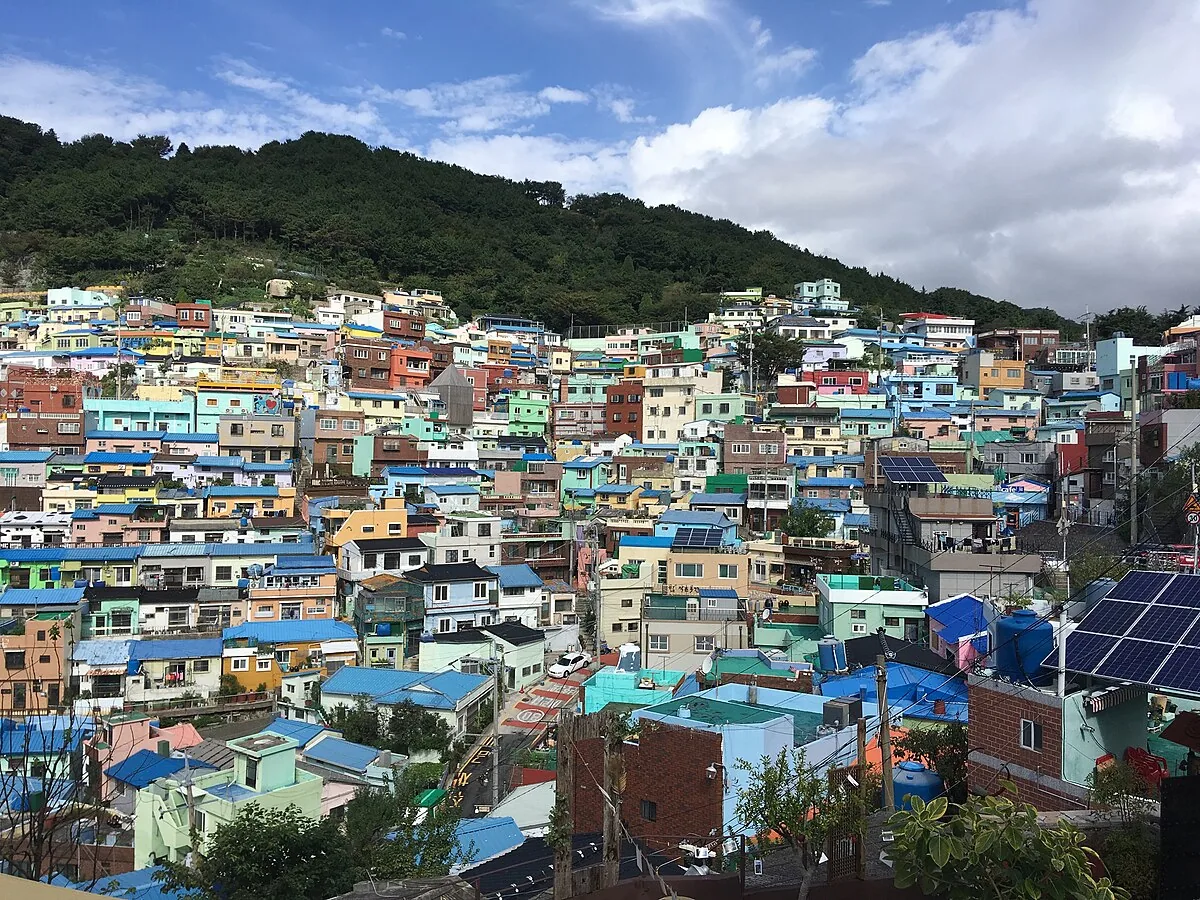
Gamcheon Culture Village, South Korea
The village began as a place of refuge
The village began as a place of refuge for those fleeing the Korean War in the 1950s, many of whom were followers of the Taegukdo religion. These early settlers built their homes in tiers along the mountain to ensure no house blocked the view of the one behind it, creating the unique terraced layout visible today. For decades, Gamcheon remained one of the city's poorest neighborhoods, a cluster of dilapidated shacks known as a 'moon village' because of its proximity to the sky. A radical transformation began in 2009 when the Ministry of Culture, Sports, and Tourism launched an art-led renovation project. Local artists and students painted the facades in vibrant shades and installed sculptures in unexpected corners, effectively turning the entire hillside into a living gallery that honors its difficult past while embracing a playful future.
Visiting Gamcheon Culture Village
Standing at the edge of a primary-colored terrace, the coastal wind tugging at your clothes looking down upon a sea of blue and pink roofs. What hits is the way the light reflects off the metallic sculptures, particularly the famous statue of the Little Prince who sits silently watching the port. Overhead, the space is an intimate collection of domestic noises: a radio playing trot music from an open window and the rhythmic tapping of a cane against the stone steps. The physical effort of the climb in your calves, an echo of the daily reality for the elders who still call these steep slopes home. The intricate murals that tell stories of the village's history, from its days as a religious enclave to its current status as a cultural icon. What lingers with you is discovering a quiet garden tucked between two houses, where the smell of blooming jasmine momentarily overwhelms the salt air.
Most visitors take the Busan Subway
Most visitors take the Busan Subway Line 1 to Toseong Station, exiting at Exit 6 and catching a local mini-bus that groans as it winds up the impossibly steep incline. Walking up from the base is possible but requires a level of fitness usually reserved for mountain goats. The village is best explored on foot, following the stamped map available at the entrance to ensure you don't miss the smaller art installations. Arriving before 9:00 AM allows you to see the village in its most authentic state before the day-trippers arrive, providing a clearer view of the residents going about their morning routines with quiet efficiency.
The Experience
The character of Gamcheon is a dizzying blend of nostalgia and whimsy. What registers is the texture of the rough stone walls juxtaposed against the smooth, brightly painted murals. You get a sun warming the narrow corridors where shadows dance between the tightly packed buildings. The sound of a distant foghorn from the Busan harbor provides a deep, bass note to the high-pitched laughter of children playing in the art zones. The weathered faces of the residents who sit on their porches, watching the world pass by with a practiced, patient gaze. The most striking detail is the 'House of Peace,' where the silence inside the small, dark room invites a moment of reflection on the village’s resilient origins. It is a place that rewards those who look closely at the gaps between the colors.
Why It Matters
Gamcheon is a vital symbol of South Korea's mid-century history and its modern creative resurgence. It represents the perseverance of the human spirit in the face of poverty and displacement. Historically, it is a rare surviving example of the unique 'moon village' architecture that once defined the urban landscape of developing Korea.
Why Visit
Go because this is the only place where you can walk through a history lesson that feels like a fairy tale. While Seoul has its polished palaces, Gamcheon offers a raw, colorful, and vertical look at the soul of Busan. You come for the photos of the Little Prince, but you leave with a deep respect for the families who turned a mountain into a home.
Insider Tips
- 1
Buy the stamp map at the entrance for two thousand won; completing it leads you to the best vantage points and earns you a commemorative postcard.
- 2
Respect the 'No Entry' signs on private residential homes, as this is a living neighborhood where people are trying to go about their daily lives.
- 3
Wear shoes with excellent grip; the staircases are frequently uneven and can become dangerously slick after a coastal mist.
- 4
The best view of the entire village is from the rooftop of the Haneul Maru information center, which offers a panoramic sweep of the mountains and the sea.