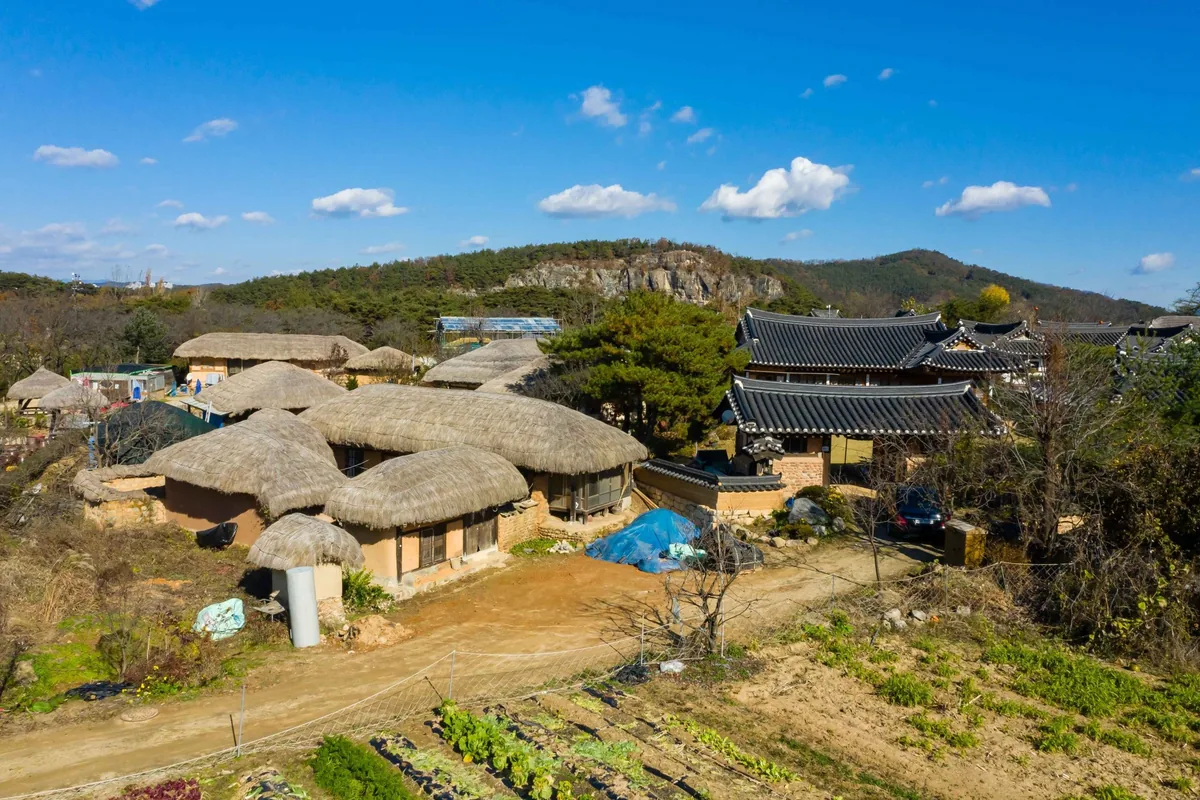
While the rest of Korea raced into the future, this village stayed behind in the 14th century, protected by a river that wraps around it like a protective loop of silk.
About Hahoe Folk Village
Hahoe was designed as a self-sustaining community where the social hierarchy was physically reflected in the architecture; the aristocratic 'yangban' lived in large tile-roofed houses at the center, while their tenants lived in smaller thatch-roofed cottages on the periphery. The village has survived centuries of conflict and modernization due to its isolated geography and the fierce devotion of the Ryu clan to their heritage. The Hahoe masks are the only wooden masks in Korea designated as National Treasures, each carved with a chin that moves to mimic human speech. Today, the village remains a bastion of traditional Confucian values, where ancestral rites are still performed with the same meticulous detail as they were five hundred years ago. It serves as a living laboratory for those wishing to understand the foundational social structures of traditional Korea.
About Hahoe Folk Village
The Nakdong River loops in a perfect S-shape around a cluster of thatch-roofed cottages and tile-roofed villas that have remained virtually unchanged since the 14th century. Hahoe Folk Village is a living relic of the Joseon Dynasty, where the Ryu clan has maintained their ancestral seat for over six hundred years. Here, The air smells of woodsmoke, sun-dried chilies, and the earthy aroma of the surrounding pine forests. The walk along dirt paths between stone walls. Notice how the houses are arranged according to the principles of 'pungsu' to face the river. The sound is a peaceful, pre-industrial murmur: the rhythmic thud of a wooden paddle washing clothes by the water and the distant, haunting call of a mountain bird.
Hahoe, which means 'river circling,'
Hahoe, which means 'river circling,' was founded during the Goryeo period and rose to prominence as a center of neo-Confucian thought. It was the home of legendary scholars like Ryu Seong-ryong, the Chief State Councillor who led Korea during the Imjin War. Unlike other folk villages that are open-air museums, Hahoe is a functioning community where residents still live in the original ancestral homes, passing down traditions like the Hahoe Byeolsingut Talnori mask dance. The village was famously visited by Queen Elizabeth II in 1999, which brought international attention to its preservation efforts. It was designated a UNESCO World Heritage site in 2010, recognized for its exceptional preservation of the social and architectural structures of a clan-based village.
Crossing the sandy banks toward the Buyongdae Cliff , the soft, fine sand of the Nakdong River between your toes. You register the way the afternoon light catches the golden thatch of the commoners' houses, making them look like giant mushrooms emerging from the earth. Sound-wise is an absence of modern noise that allows you to hear the rustle of the wind through the 600-year-old 'Samsindang' zelkova tree at the village center. Something of the cool, polished texture of the wooden 'maru' floors in the aristocratic mansions and notice the intricate patterns of the rice-paper doors. Immediately, the smell of the pine-needle fire used to heat the 'ondol' floors, a scent that defines the Korean countryside. The most magical moment is watching the traditional mask dance in the open-air theater, where the exaggerated expressions of the wooden masks bring centuries-old social satires to life.
The village is located near the city of Andong, accessible by taking an express train or bus from Seoul. From Andong Station, the 246 bus runs regularly to the village entrance. The best way to experience the scale of the village is to take the small ferry across the river and climb the short path to the top of Buyongdae Cliff. This vantage point offers the classic view of the river wrapping around the village like a protective arm. Arriving early in the morning allows you to see the mist rising from the river, a sight that has inspired Korean landscape painters for centuries. Staying overnight in one of the traditional guest houses provides a rare chance to experience the village after the last bus of tourists has departed.
The Experience
Arriving at Hahoe is one of profound, slow-motion continuity. What registers is the smell of the river, fresh, cool, and slightly silty, as it mingles with the dry fragrance of the rice-straw roofs. The physical stillness of the village, which seems to operate on a different clock than the rest of the country. The light filters through the pine trees in soft, dappled patterns that move slowly across the white plaster walls. What gets your attention is the tiny, vibrant vegetable gardens tucked into every available space, where residents grow the ingredients for their own kimchi. The most evocative detail is the sight of a village elder walking slowly down the path in a white 'hanbok,' a living extension of the history around him. It is a place that makes the concept of 'ancestral roots' feel tangible and vibrant.
Why It Matters
Hahoe Folk Village is one of the most important cultural heritage sites in South Korea and a UNESCO World Heritage site. It represents the pinnacle of Joseon-period clan village architecture and the enduring legacy of Korean Confucianism. Historically, it is a rare surviving site where the intangible heritage, dances, rites, and social customs, remains inextricably linked to the physical environment.
Why Visit
The reason to come: you need to see a place where 'tradition' isn't a performance. Hahoe is not a theme park; it is a living neighborhood where the 21st century has been politely asked to wait outside the gates. You come here to climb the cliff for the view, but you stay for the realization that a 600-year-old way of life can be both beautiful and functional in the modern world. It is the only place in Korea where you can hear the silence of the 1300s.
✦ Photo Gallery
Best Season
🌤 October tends to be the most atmospheric time, as the village hosts the Andong Mask Dance Festival and the surrounding hills are a riot of autumn colors that reflect in the river.
Quick Facts
Best time to visit
October tends to be the most atmospheric time, as the village hosts the Andong Mask Dance Festival and the surrounding hills are a riot of autumn colors that reflect in the river.
Getting there
In Andong, South Korea; reach Andong first, then continue to the site.
Location
Andong, South Korea
Type
attraction
Coordinates
36.5392°, 128.5167°
Insider Tips
- 1
Take the ferry across the river to climb Buyongdae Cliff; it costs only a few thousand won and provides the only panoramic view of the village's 'S-curve'.
- 2
The mask dance performance is usually held at 2:00 PM on specific days; check the schedule at the entrance so you don't miss this National Treasure in action.
- 3
Eat 'Andong Jjimdak' (braised chicken) or 'Gancheogoe' (salted mackerel) in the village restaurants; these are the local culinary specialties.
- 4
Stay in a 'hanok' guesthouse to experience sleeping on a traditional 'ondol' floor; it’s the best way to feel the rhythm of the village.
- 5
Visit the Hahoe Mask Museum near the parking lot before entering the village; it provides essential context for the characters you will see in the dance.