“This six-kilometer loop of stone and brick wasn't just built to stop an army; it was built by a grieving king to resurrect the honor of his murdered father.”
About Hwaseong Fortress
Completed in 1796, Hwaseong Fortress was the culmination of King Jeongjo's vision for a new, fortified city that would serve as the kingdom's economic and political hub. The construction was meticulously documented in the 'Hwaseong Seongyeok Uigwe,' a set of records so detailed they allowed for the perfect restoration of the site after it was heavily damaged during the Korean War. The wall features 48 separate structures, including secret gates, water towers, and artillery positions. It remains a landmark of the 'Silhak' (Practical Learning) movement, which sought to apply scientific principles to the governance and defense of the nation.
About Hwaseong Fortress
Encircling the heart of Suwon, the Hwaseong Fortress is a massive embrace of stone and brick that stretches for nearly six kilometers. Unlike the isolated mountain forts of earlier eras, Hwaseong was designed as a living city wall, integrating residential life with military defense. The undulating wall follows the natural terrain, rising over hills and dipping into the valley where the Suwoncheon stream flows through elegant arched gates. It represents a rare moment in history where scientific innovation and filial piety converged to create a structure that is as aesthetically pleasing as it was strategically sound.
Encircling the heart of Suwon, the Hwaseong Fortress is a massive embrace of stone and brick that stretches for nearly six kilometers.
commissioned the fortress, 1794
King Jeongjo commissioned the fortress in 1794 to honor the memory of his father, Prince Sado, who suffered a tragic and controversial death. The King intended to move the capital to Suwon, and to do so, he employed the most advanced technology of the time. The scholar Jeong Yak-yong designed the 'geojunggi,' a revolutionary pulley system that allowed workers to lift massive stones with minimal effort, significantly shortening the construction time to just over two years. The fortress was a marvel of the late Joseon Dynasty, blending traditional Korean building techniques with influences from Chinese and European military architecture, creating a defense system that was virtually impregnable for its time.
Walking the perimeter of the wall
Walking the perimeter of the wall is a passage through different moods. At the Paldalmun Gate, the fortress is surrounded by the noisy energy of a modern market, smelling of fried chicken and roasted chestnuts drifting up toward the stone ramparts. As you climb toward Seojangdae, the Western Command Post, the city noise fades, replaced by the wind whistling through the embrasures. The view from the top reveals the grid of the old city positioned within the defensive ring. At night, the entire length of the wall is illuminated by soft spotlights, turning the stone into a glowing ribbon that threads through the dark urban landscape. First, the precision of the brickwork and the small openings designed for archers, a trace of the wall's lethal original purpose.
Suwon is a straightforward trip
Suwon is a straightforward trip from Seoul, accessible via Subway Line 1 or a quick 30-minute ride on the Mugunghwa train from Seoul Station. From Suwon Station, a short bus ride or a twenty-minute walk brings you to the Paldalmun Gate. The best way to experience the fortress is to start at the Janganmun Gate and walk clockwise. This route builds anticipation moving from the flat sections of the wall toward the higher, more scenic vantage points. Many visitors choose to ride the 'Hwaseong Trolley,' a tourist train shaped like a royal carriage, which provides a relaxed overview before they explore specific sections on foot.
Suwon is a straightforward trip from Seoul, accessible via Subway Line 1 or a quick 30-minute ride on the Mugunghwa train from Seoul Station.
The Experience
The echo of your footsteps on the packed earth of the wall's path is steady and grounding. What registers is the temperature drop as you walk through the shaded stone tunnels of the gates, where the air is still and cool. In the early evening, local residents use the wall for their daily exercise, creating a sense of community that softens the fortress's military edges. First, the 'Hwahongmun' gate, where the stream cascades through seven stone arches, creating a fine mist that catches the afternoon light. It is a place where the grandeur of royalty meets the casual rhythm of modern suburban life.
Why It Matters
Hwaseong Fortress is a UNESCO World Heritage site that marks the transition from medieval to modern fortress design in East Asia. It is a physical record of the intellectual and cultural peak of the Joseon Dynasty. Beyond its military utility, it serves as a monument to filial devotion and the vision of a king who wanted to create a city that protected and nurtured its people.
Why Visit
Visit Hwaseong because it is the only place in Korea where you can experience the full scale of an ancient fortified city that still breathes with modern life. It offers a perfect blend of a moderate hike, a history lesson, and a scenic overlook. It is arguably the most pedestrian-friendly historical site in the country, providing a loop of constant discovery.
✦ Insider Tips
- 1
Try your hand at traditional Korean archery at the Yeonmudae Post; the targets are set at a challenging distance just as they were for soldiers.
- 2
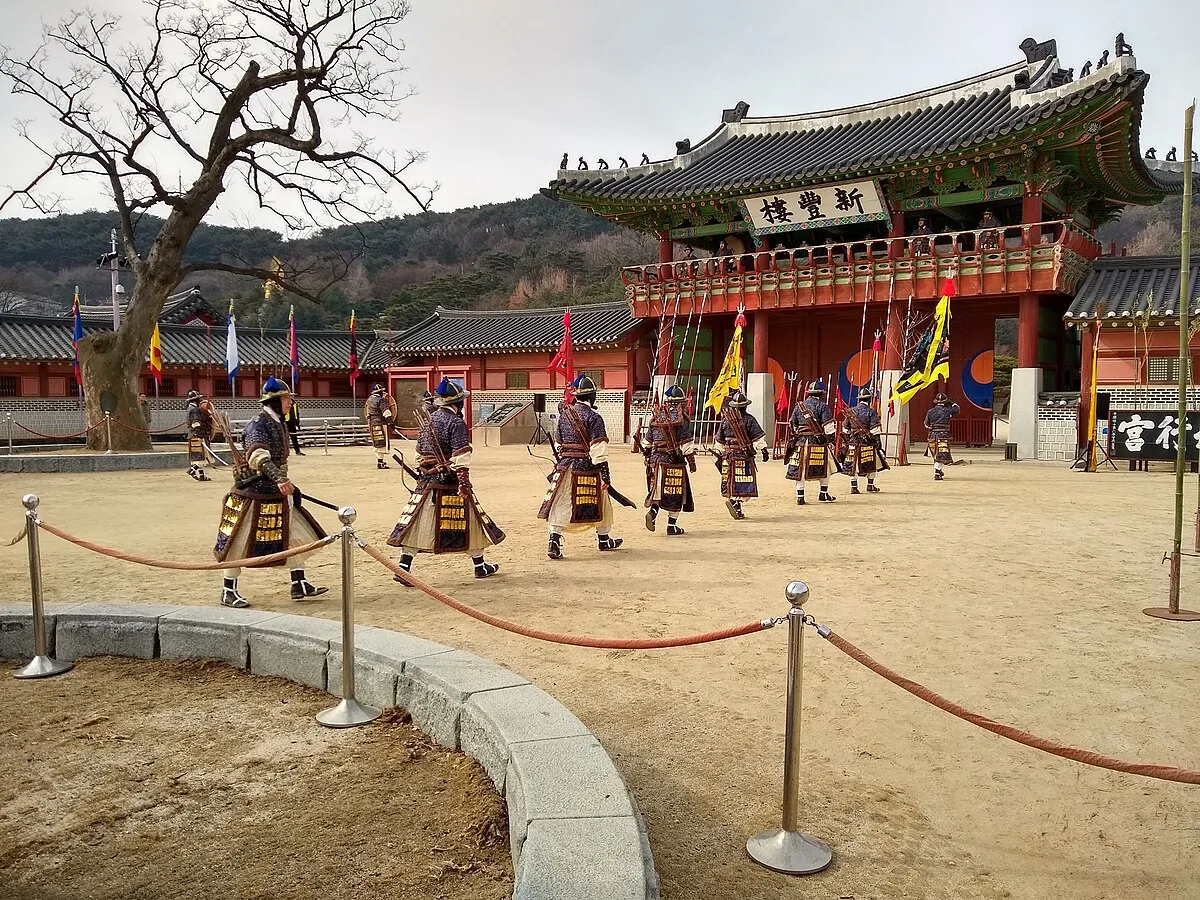
Visit the Hwaseong Haenggung Palace in the center of the fortress at 11:00 AM to catch the traditional martial arts performance.
- 3
Walk the section between Hwahongmun and Bangasuryujeong at sunset for the most photogenic views of the pond and the pavilion.
- 4
The 'Suwon Fried Chicken Street' is located just outside the wall near Paldalmun; it is a local culinary institution you shouldn't miss.
- 5
Stay for the evening 'Media Art' shows during the autumn festival, when the walls become a giant screen for digital storytelling.