“Hidden within these 15th-century wooden walls are over eighty thousand hand-carved blocks that haven't developed a single crack or a speck of mold in seven centuries.”
About Janggyeong Panjeon
The Tripitaka Koreana is recognized as the oldest and most accurate version of the Buddhist canon in Chinese characters. Each woodblock was prepared by soaking birch wood in sea water for three years and then boiling it in salt water to prevent warping. The Janggyeong Panjeon buildings were so effectively designed that when the Korean government considered moving the blocks to a modern, air-conditioned facility in the 1970s, a test move resulted in immediate mold growth, forcing the project to be abandoned. The site was designated a UNESCO World Heritage site in 1995, not just for the woodblocks, but for the extraordinary architectural ingenuity of the storage halls themselves. It remains the spiritual heart of the Jogye Order of Korean Buddhism.
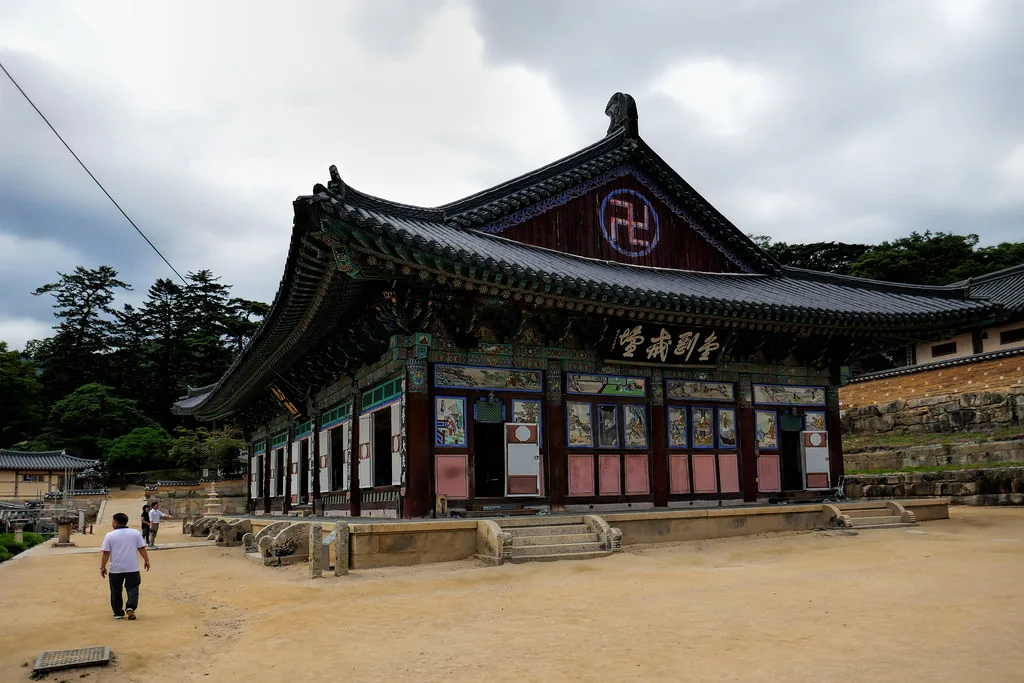
Janggyeong Panjeon
Four long wooden halls sit at the highest point of Haeinsa Temple, housing the world's most comprehensive collection of Buddhist scriptures carved into 81,258 individual woodblocks. Janggyeong Panjeon is a masterclass in 15th-century environmental engineering, a structure built specifically to prevent the rot and decay of its sacred contents. Within, the space the courtyards is exceptionally dry and carries the faint, ancient scent of lacquered birch and mountain pine. The walk along quiet stone paths, peering through simple wooden slats at rows of black blocks that have remained perfectly preserved for over seven hundred years. The sound is a profound, respectful silence, broken only by the distant chime of a temple bell or the rhythmic chanting of monks from the halls below.
Four long wooden halls sit at the highest point of Haeinsa Temple, housing the world's most comprehensive collection of Buddhist scriptures carved into 81,258 individual woodblocks.
The Tripitaka Koreana was commissioned
The Tripitaka Koreana was commissioned in the 13th century as a spiritual defense against the Mongol invasions, with the belief that the merit of carving the entire Buddhist canon would invoke divine protection for the nation. After the original set was destroyed by fire, this current version was carved between 1237 and 1248 on Ganghwa Island and eventually moved to Haeinsa. The Janggyeong Panjeon halls were built in the 1480s to house them, utilizing a sophisticated natural ventilation system. The architects varied the size of the windows on different walls to control the flow of air and used a floor made of charcoal, salt, and lime to regulate humidity. These 'intelligent' buildings have successfully protected the woodblocks from war, fire, and pests for centuries, outperforming modern temperature-controlled facilities.
Approaching the gated entrance to the storage area , the physical transition into a space governed by scientific precision and religious devotion. The first thing you register is the way the light filters through the uneven slats, casting long, rhythmic bars of shadow across the dust-free floors. The sound is an absence of noise that highlights the rustle of the wind through the surrounding Gaya Mountain forest. The coolness of the air that moves through the building, a natural draft that feels almost intentional. First, the rows of woodblocks, each one a reflection of the thousands of monks who carved each character with perfect consistency. The most moving moment is realizing that the building itself is the true miracle, a 500-year-old machine made of wood and mud that still works flawlessly without a single electric wire. Haeinsa Temple is located deep within Gayasan National Park, accessible via an express bus from the Daegu Seobu Terminal. Once at the park entrance, a twenty-minute uphill walk through a scenic stream valley leads to the temple complex. The Janggyeong Panjeon is at the very back of the temple, requiring a final climb up a steep set of stone stairs. Arriving in the late afternoon allows you to see the sun hitting the mountain peaks while the shadows grow long in the scripture halls. To protect the woodblocks, visitors are not allowed inside the buildings, but the view through the windows provides an intimate look at the scale of the collection.
The Experience
The feel of Janggyeong Panjeon is one of focused, invisible labor. What emerges is the smell of the mountain air, cold, crisp, and completely free of the city's humidity. The stillness of the woodblocks, which seem to hold the energy of the millions of hours spent carving them. The light reflects off the dark lacquer of the blocks, creating a subtle shimmer deep within the shelves. Immediately, the simple, unpainted wood of the buildings, which has silvered with age but remains structurally perfect. The most profound detail is the floor itself, where the mixture of salt and charcoal acts as a natural lungs for the building. It is a place that humbles you with its combination of ancient wisdom and absolute simplicity.
The feel of Janggyeong Panjeon is one of focused, invisible labor.
Why It Matters
Janggyeong Panjeon is a unique architectural monument and a pinnacle of pre-modern scientific achievement. It houses one of the world's most important religious treasures while being a masterpiece of functional design in its own right. Historically, it represents the resilience of Korean culture and the sophisticated understanding of thermodynamics in the 15th century.
Why Visit
What makes it worth the trip: you need to see a 500-year-old computer that never needs a software update. While other historical sites are about grandeur and decoration, Janggyeong Panjeon is about the beauty of pure function. You come here to see the woodblocks, but you will leave in awe of the building that knows how to breathe on its own. It is the only place in the world where the architecture is as sacred as the scripture.
✦ Insider Tips
- 1
Keep your voice to a whisper even when outside the gates; this is a highly sensitive religious and scientific area.
- 2
Look closely at the window sizes on the front and back of the buildings; they are different to create the specific air pressure needed for ventilation.
- 3
Wear comfortable walking shoes for the trek through Gayasan National Park, which is steep in several sections.
- 4
Participate in the 'Templestay' program at Haeinsa if you want to experience the evening chanting and see the halls at sunset.
- 5
Don't try to use a flash or stick your camera between the slats; the oils from human contact and the light are considered threats to the preservation of the wood.