“Two bronze statues sit in a silent, copper-lined room, their enigmatic half-smiles capturing a moment of perfect enlightenment that has lasted for fourteen hundred years.”
About National Museum of Korea
The National Museum of Korea was established in 1945 following the country's liberation, starting with a modest collection in a small palace building. During the Korean War, the museum's curators performed a heroic feat by transporting thousands of priceless items to the southern tip of the peninsula under heavy fire. The museum eventually found a temporary home in the former Japanese General Government Building before moving to its current, purpose-built facility in 2005. This move marked a symbolic reclaiming of the land, as the Yongsan area had been occupied by foreign military forces for the previous 120 years.
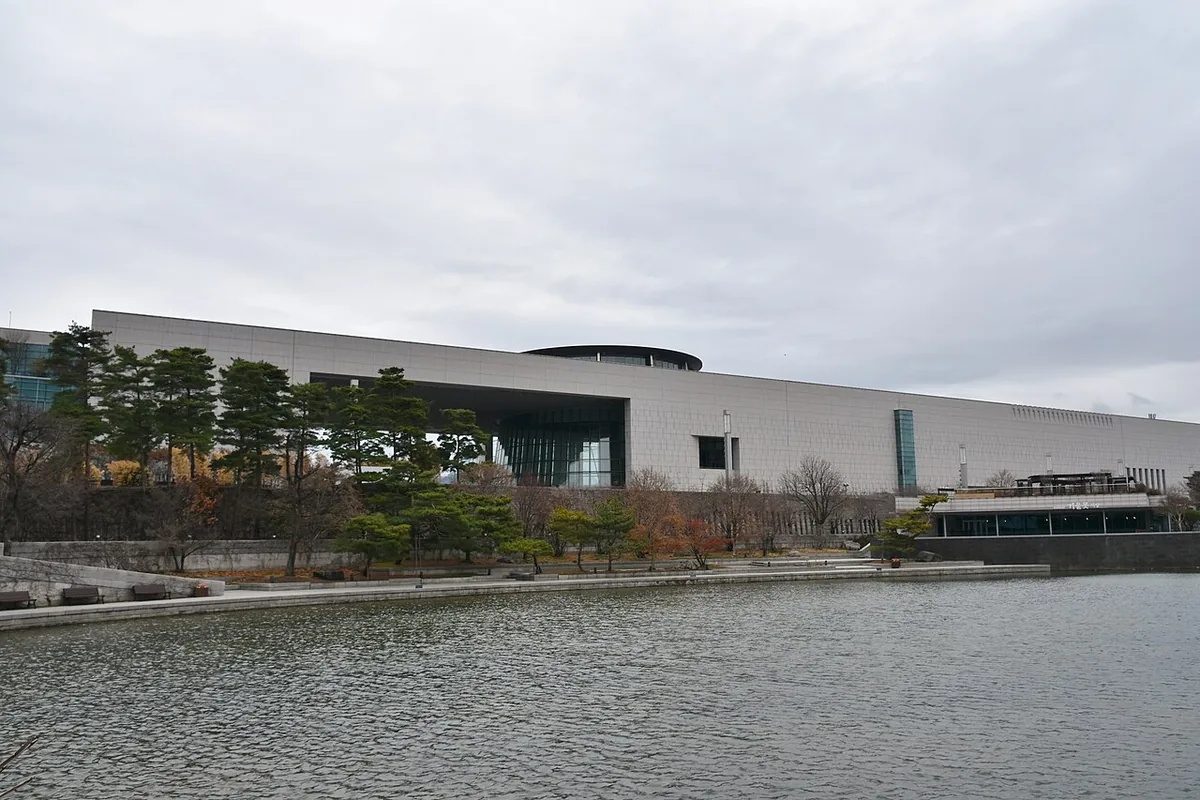
Facing the Han River with the Namsan Mountain
Facing the Han River with the Namsan Mountain at its back, the National Museum of Korea is a colossal structure that mirrors the traditional architecture of a Korean fortress and a palace. Its scale is intimidating, a vast horizontal expanse of stone and glass that houses the collective memory of the peninsula. The building is divided by a central 'Path to History,' an open-air plaza that frames a perfect view of the N Seoul Tower in the distance. Inside, the museum is a sanctuary of controlled light and profound silence, designed to showcase artifacts not just as objects, but as the DNA of a civilization that has survived countless upheavals.
Facing the Han River with the Namsan Mountain at its back, the National Museum of Korea is a colossal structure that mirrors the traditional architecture of a Korean fortress and a palace.
in Yongsan opened, 2005
The museum's current home in Yongsan opened in 2005, but its collection has moved through various locations since 1945, surviving the Korean War by being crated and shipped to the safety of Busan. The site itself has a complex history, having was a military base for foreign powers for over a century before being returned to the Korean people. The architecture, designed by Park Seung-hong, intentionally avoids the vertical aggression of modern skyscrapers, opting instead for a grounded, enduring presence. It is one of the largest museums in the world, built to endure for centuries and to serve as the definitive repository for over 300,000 artifacts ranging from prehistoric hand axes to the sleekest Joseon white porcelain.
Entering the main hall, you
Entering the main hall, you are greeted by the Ten-Story Pagoda from Gyeongcheonsa Temple, a towering marble monument that stretches toward the skylight. The museum's layout is chronological, allowing you to walk from the paleolithic era into the modern age. In the 'Room of Quiet Contemplation,' you find two Pensive Bodhisattva statues sitting in a dimly lit, copper-walled space. The lighting is so subtle that the bronze seems to glow from within, and the stillness is so absolute that You hear your own breathing. Moving through the galleries, you encounter the gold crowns of the Silla Dynasty, which shimmer with an intensity that seems impossible for something buried for over a millennium. Around you it is cool and filtered, and the transition between galleries is often marked by large windows that look out onto a peaceful reflecting pond and traditional gardens.
Located in central Seoul,
Located in central Seoul, the museum is directly connected to the Ichon Subway Station on Line 4 and the Gyeongui-Jungang Line. A dedicated underground walkway leads from the station directly to the museum grounds, protecting visitors from the elements. The museum is surrounded by a sprawling park, including a waterfall and several outdoor pagodas, making it a popular spot for locals to picnic. While the main galleries are free, it is worth arriving early on weekends to secure tickets for special rotating exhibitions, which often feature treasures on loan from the world's other great institutions.
Located in central Seoul, the museum is directly connected to the Ichon Subway Station on Line 4 and the Gyeongui-Jungang Line.
The Experience
The museum smells faintly of floor wax and old paper, a clean, academic scent that settles your mind as you explore. There is a feeling of transition from the packed city to this temple of history the moment you cross the wide stone plaza. The galleries are designed with a generous sense of space, ensuring that even on busy days, you can find a corner to be alone with a 5th-century pottery vessel or a delicate silk painting. You see how the curators have used shadows to emphasize the curves of the celadon ceramics, making the jade-colored glaze appear almost liquid under the spotlights.
Why It Matters
As the flagship museum of South Korea, this institution is the primary guardian of the nation's cultural identity. It provides a cohesive narrative of a people who have maintained a distinct language, script, and aesthetic despite being surrounded by larger empires. It serves as both a classroom for the next generation and a statement to the world about the depth and resilience of Korean heritage.
Why Visit
This is the single best place to understand the 'why' of Korea. While the palaces show you how the kings lived, the National Museum shows you how the people thought, what they valued, and how they turned clay, gold, and ink into a unique cultural language. It is a world-class facility that offers a deep, meditative experience that is entirely free of charge.
✦ Insider Tips
- 1
The 'Room of Quiet Contemplation' on the second floor is a sensory masterpiece; don't rush through it, sit for at least ten minutes.
- 2
Visit the museum shop for high-quality reproductions of traditional Korean stationery and ceramics that are far superior to standard tourist fare.
- 3
Check the digital immersive gallery for a 360-degree high-resolution projection of traditional folk paintings that brings the Joseon era to life.
- 4
The outdoor garden contains several original stone pagodas and lanterns that many visitors skip; it is a beautiful, quiet walk in the late afternoon.
- 5
Use the free lockers near the entrance so you don't have to carry your coat and bags through the three kilometers of gallery space.