Thirty-six massive granite blocks form a roof over the head of a three-meter Buddha, held in place by nothing more than the perfect calculation of gravity and weight.
About Seokguram Grotto
Legend says that during construction in 751, the stone for the ceiling broke into three pieces, causing the architect Kim Dae-seong to weep until he fell into a trance; he woke to find spirits had repaired the stone. This miracle inaugurated a golden age of Silla craftsmanship that saw the integration of Hindu and Buddhist motifs. The grotto was largely forgotten during the 19th century, protected by its remote mountain location, until a postal worker sought shelter from a storm in 1909 and stumbled upon the masterpiece. Subsequent decades saw it endure Japanese colonial 'improvements' involving concrete that unfortunately trapped moisture, requiring modern experts to install sophisticated climate controls to save the carvings.
What Seokguram Grotto is
High atop Mount Tohamsan, a white granite Buddha gazes toward the East Sea with a look of such profound serenity that it seems to still the very air in the chamber. Unlike the natural caves often associated with religious retreats, Seokguram is a masterwork of artificial engineering, a rotunda assembled from hundreds of pieces of granite fitted together with mathematical precision. The space feels compressed and holy, a pocket of silence carved into the mountain. Thousands of years of pilgrims have climbed this slope to witness the first rays of the sun strike the Buddha’s forehead, a moment that bridges the gap between celestial light and earthly stone.
“High atop Mount Tohamsan, a white granite Buddha gazes toward the East Sea with a look of such profound serenity that it seems to still the very air in the chamber.”
Seokguram Grotto, South Korea
on this sanctuary, 751
Prime Minister Kim Dae-seong began work on this sanctuary in 751, during the zenith of the Silla Dynasty. While the nearby Bulguksa Temple was built for his parents in their current life, this grotto was a tribute to his parents from a previous existence. The architects faced a grueling challenge: building a dome without mortar that could withstand the humidity of the mountain. They solved this by placing the structure over an underground stream, using the cold water to naturally dehumidify the air. For centuries, the grotto remained a secret known only to monks and the local elite, eventually falling into a state of neglect during the Joseon era until its rediscovery in the early 20th century. A series of clumsy colonial-era restorations nearly ruined the grotto’s natural ventilation, leading to the glass partition that visitors see today, yet the spiritual gravity of the site remains entirely intact.
A walk through the shaded pine forest leads
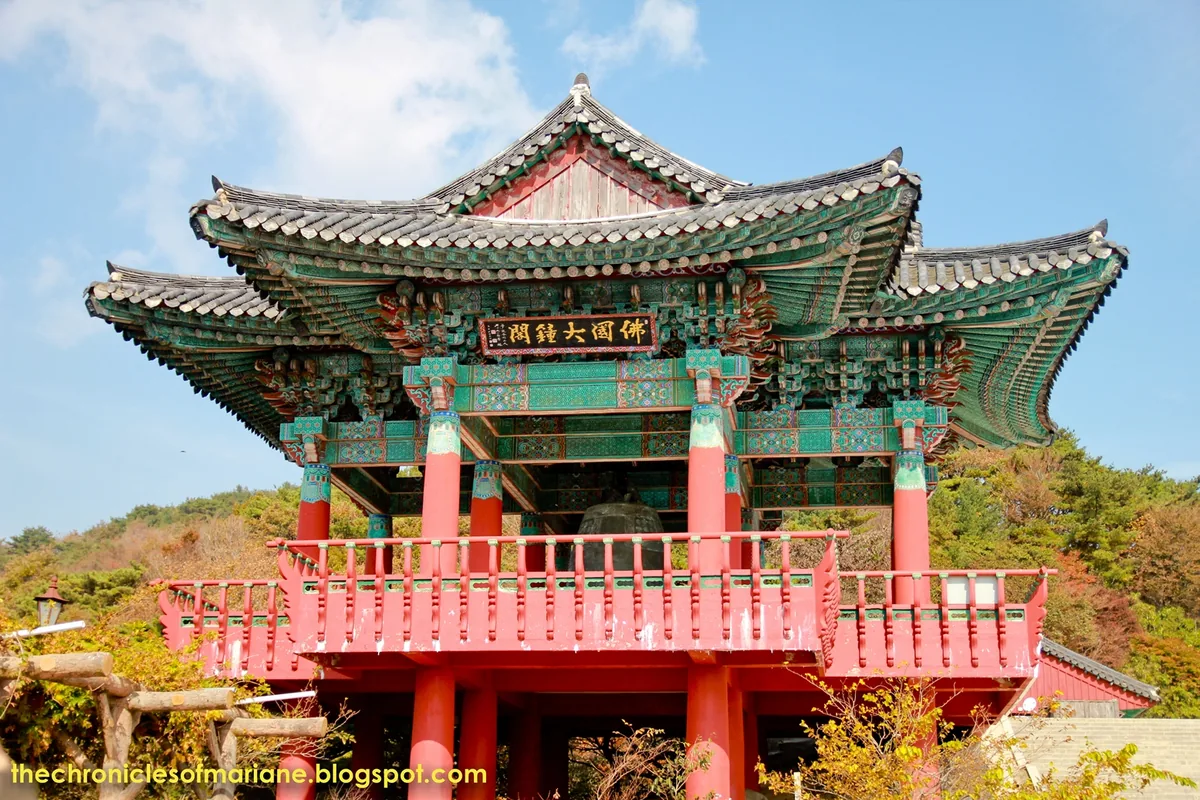
A walk through the shaded pine forest leads you to the grotto entrance, where the temperature drops noticeably. A weight of the mountain pressing in, balanced by the ethereal glow of the white granite. Behind a protective glass screen, the central Buddha sits surrounded by a pantheon of guardians and disciples carved in bas-relief. The detail in the stone drapery is so fine it mimics the movement of silk. Outside, the view of the coastline is vast and blue, providing a sharp contrast to the intimate, dim interior of the shrine. Sound-wise is the rhythmic tolling of a bronze bell from a nearby pavilion, a sound that resonates through the trees and anchors you to the present moment.
Reaching the grotto requires a winding
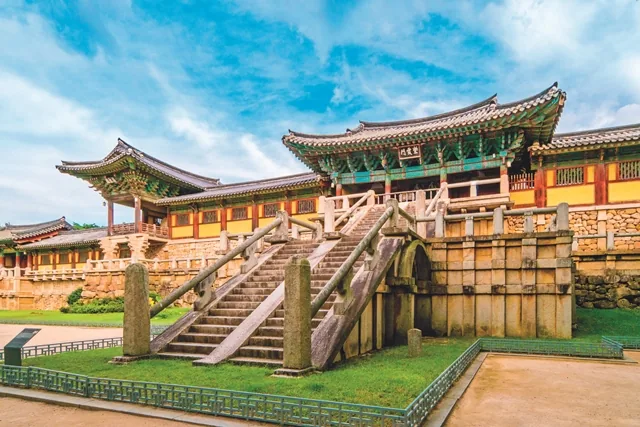
Reaching the grotto requires a winding bus journey from the city of Gyeongju, typically following a visit to Bulguksa. Bus 12 shuttles visitors up the steep mountain road every hour. The bravest travelers choose to hike the two-kilometer trail connecting the two sites, a path that rewards effort with sightings of mountain squirrels and damp earth and wild herbs. Arriving at dawn is a traditional practice, though mid-afternoon offers a different kind of beauty when the shifting light catches the moss on the stone lanterns.
“Reaching the grotto requires a winding bus journey from the city of Gyeongju, typically following a visit to Bulguksa.”
The Experience
You notice a hush that falls over the crowd as they approach the glass, a collective holding of breath in the presence of the Buddha's slight, enigmatic smile. The light inside the chamber is soft and diffused, making the granite appear almost translucent like fine jade. Most visitors rush past the relief carvings of the Four Heavenly Kings at the entrance, but if you linger, you can see the fierce expressions and muscle definition that give the stone a terrifying vitality. The scent of the surrounding pine forest follows you into the vestibule, mixing with the faint, metallic smell of cold mountain rock.
Why It Matters
Seokguram is the definitive example of the Silla Dynasty's scientific and artistic sophistication, representing a high point of East Asian Buddhist art. It remains a rare instance where architecture, mathematics, and geometry were used to serve a purely spiritual purpose. Its UNESCO status recognizes it as a structure that achieved a level of technical perfection that modern architecture still finds difficult to replicate without artificial aids.
Why Visit
Visit Seokguram to see what happens when human ambition refuses to accept the limits of nature. It is the only place where you can stand at the edge of a mountain and see a millennium of history reflected in a single piece of stone. The hike through the forest alone justifies the trip, but the silent encounter with the Buddha is what stays in your memory.
Insider Tips
- 1
Wait for a gap between the large tour groups to experience the grotto's natural silence; the groups usually move in twenty-minute cycles.
- 2
Bring a small coin to offer at the base of the mountain bell, where you can pay a nominal fee to ring the massive bronze instrument yourself.
- 3
The hike down from Seokguram to Bulguksa is significantly easier on the knees than the hike up and takes about 45 minutes.
- 4
Look closely at the Buddha's third eye; it is positioned so that it would catch the first glint of the rising sun on the winter solstice.
- 5
Pack a light jacket even in summer, as the mountain air remains cool and the grotto interior is strictly temperature-controlled.