Two thousand granite blocks assembled without mortar have kept this Roman aqueduct standing for nearly two thousand years, and water last flowed through it in 1973.
About Aqueduct of Segovia
Built in the first century CE under Domitian or Trajan, the Segovia aqueduct carried water fourteen kilometers from the sierra to the city using gravity and a precisely maintained gradient. The mortar-free construction relies entirely on precision-cut stone fit and the weight of the structure itself.
What Aqueduct of Segovia actually is
The Roman aqueduct at Segovia is one of the best-preserved ancient engineering structures in the world. Built around the first century CE, possibly under the emperors Domitian or Trajan, the aqueduct carried water from the Frío River to the city across a valley using 167 arches at its peak, rising to 28 meters at the highest point in the Plaza del Azoguejo. Over two thousand granite blocks, assembled without mortar, have held the structure together for nearly two thousand years.
“The Roman aqueduct at Segovia is one of the best-preserved ancient engineering structures in the world.”
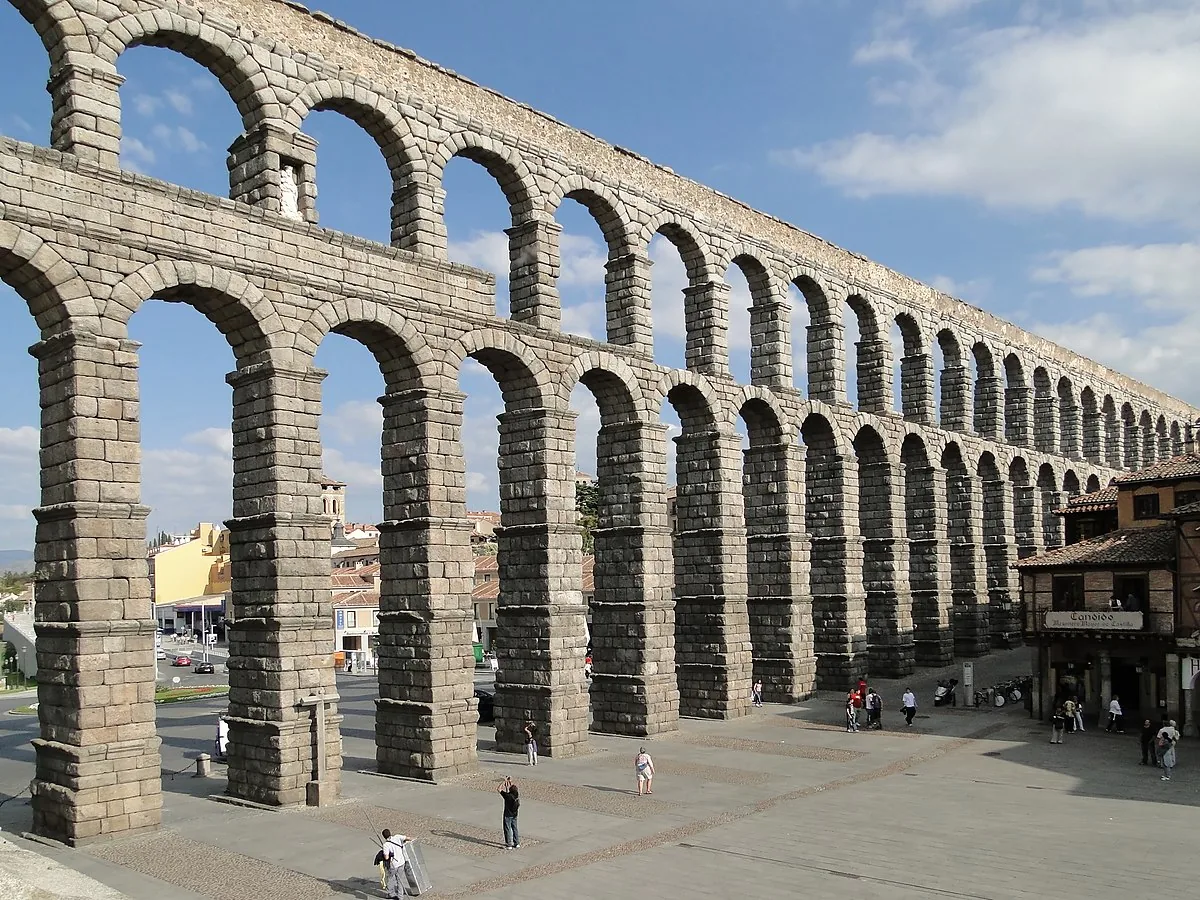
Aqueduct of Segovia, Spain
Roman aqueducts worked on the principle of gravity , water entered at a higher elevation and flowed continuously downhill through channels maintained at a precise gradient. The Segovia aqueduct transported water from a point fourteen kilometers away in the sierra, managing the gradient across intervening terrain through a combination of buried channel, surface channel, and the raised arcade that survives. The remarkable fact of the surviving structure is the absence of mortar: the granite blocks were cut and fitted with such precision that friction and weight alone have maintained the structure's integrity across nineteen centuries, through earthquakes, wars, and weathering.
The aqueduct is most dramatic where it crosses the Plaza del Azoguejo, the lowest point in the valley, here the full height of the double arcade is visible and the ancient city wall of Segovia can be seen joining the structure on the left. Walking beneath the arches and up the stairs to the viewing platform at arcade level provides the perspective of the water channel that once ran along the top. The old city of Segovia above the aqueduct is a UNESCO World Heritage Site in its own right, the Alcázar, with its fairy-tale tower profile, and the Gothic cathedral are both a short walk away.
Segovia is 90 kilometers from Madrid, reachable by high-speed Avant train in approximately twenty-five minutes from Madrid Chamartín. The aqueduct is a ten-minute walk from the train station downhill into the old city.
“Segovia is 90 kilometers from Madrid, reachable by high-speed Avant train in approximately twenty-five minutes from Madrid Chamartín.”
The Experience
View the double arcade at full height from the Plaza del Azoguejo, walk beneath the arches, climb to the viewing platform at channel level, and continue into the old city for the Alcázar and Gothic cathedral that complete the UNESCO World Heritage site.
Why It Matters
One of the best-preserved Roman engineering structures in the world, and the defining monument of a UNESCO-listed historic city.
Why Visit
The mortar-free construction detail, two thousand precision-cut stones held together by friction for nineteen centuries, makes the aqueduct more interesting the longer you think about it. The engineering confidence it represents is difficult to appreciate from photographs.
Insider Tips
- 1
The Segovia high-speed train takes twenty-five minutes from Madrid Chamartín, a day trip is easily justified.
- 2
The viewing platform at channel level requires climbing a staircase beside the Plaza del Azoguejo, the perspective from there is different from ground level.
- 3
The Alcázar at the far end of the old city is a thirty-minute walk from the aqueduct, the fairy-tale exterior is worth it; the interior is a castle history museum.
- 4
Lunch in Segovia is an occasion for cochinillo (roast suckling pig), the regional dish is taken seriously here in a way that has nothing to do with tourist performance.