“The Prado holds one of Europe's deepest royal collections, Velázquez, Goya's Black Paintings, and Bosch's Garden of Earthly Delights among the works assembled by four centuries of Spanish Habsburg patronage.”
About Museo del Prado
Built as a natural history museum by Juan de Villanueva and converted to a royal art gallery in 1819, the Prado houses the accumulated acquisitions of the Spanish Crown, Habsburg diplomatic connections to Flanders and Italy drove the depth of the Flemish and Italian holdings.
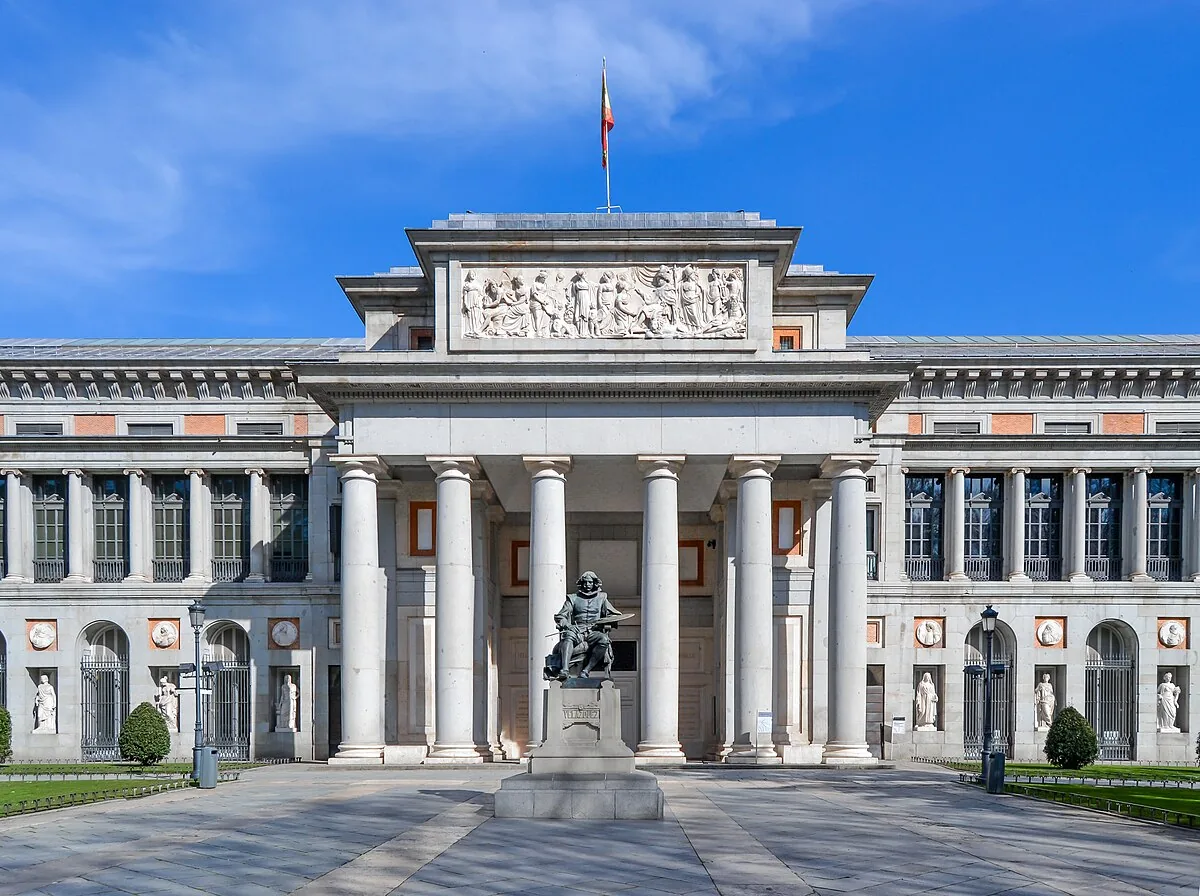
What Museo del Prado actually is
The Prado in Madrid holds one of the greatest collections of European painting assembled anywhere, with particular depth in Spanish, Flemish, and Italian work from the fifteenth through the nineteenth centuries. The collection reflects the tastes and acquisitions of the Spanish Crown across four centuries, Velázquez, Goya, El Greco, Rubens, Titian, Bosch, and Raphael are all represented in depth. The museum building, a neoclassical structure by Juan de Villanueva, opened to the public in 1819 and has been expanded multiple times since.
The collection reflects the tastes and acquisitions of the Spanish Crown across four centuries, Velázquez, Goya, El Greco, Rubens, Titian, Bosch, and Raphael are all represented in depth.
The Prado began as a royal collection.
The Spanish Habsburgs were among the most avid patrons and collectors in Europe, and their diplomatic and dynastic connections to Flanders and Italy drove the acquisition of works by Flemish and Italian masters alongside the Spanish court painters they employed directly. Velázquez, who served as court painter under Philip IV, acquired works for the royal collection on trips to Italy; Goya served in the same role under later monarchs. The collection passed into state ownership and became a public museum in 1819 under Ferdinand VII, though royal motivations at the time were as much political as cultural.
Velázquez's Las Meninas, the painting in which the artist depicts himself working on a canvas while the Infanta Margarita and her retinue occupy the foreground, is the work that draws the longest viewing queues and rewards the most time. Goya's Black Paintings, transferred from the walls of his house to canvas after his death, occupy a room that stops most visitors: Saturn Devouring His Son and The Dog are painted with a freedom and darkness that feels contemporary. Bosch's Garden of Earthly Delights, a triptych of hallucinatory complexity, requires a viewing distance that allows both overall structure and individual detail to register. The Prado is on the Paseo del Prado in central Madrid, adjacent to the Retiro park. Metro stops Banco de España and Atocha are both a short walk away. The museum is free to enter in the last two hours of each day, queues form but entry is generally possible.
The Experience
Spend time with Las Meninas' spatial complexity, stand in the Black Paintings room with Goya's Saturn and The Dog, and take sufficient viewing distance on the Garden of Earthly Delights to read both the triptych's structure and its individual scenes.
Why It Matters
One of the world's great encyclopedic art museums, with unmatched depth in Spanish, Flemish, and Italian painting from the Renaissance through the early nineteenth century.
Why Visit
Goya's Black Paintings justify the visit alone. The freedom and psychological darkness of those late works, painted on his house walls and never intended for exhibition, feels unlike anything else in a major museum collection.
✦ Insider Tips
- 1
The free entry period (last two hours) draws long queues, arrive forty-five minutes before it starts to be near the front.
- 2
The Black Paintings room is often less crowded than the Las Meninas room, go there first when the museum opens.
- 3
The Prado app has excellent room-by-room guides that are more detailed than the printed map.
- 4
A single visit rarely covers more than two or three major sections, decide in advance what matters most rather than trying to see everything.