The largest Gothic cathedral in the world was built on the footprint of a demolished mosque, preserving the minaret, converting it to a bell tower, and producing one of the most unusual architectural hybrids in Spain.
About Catedral de Sevilla
Construction began in 1401 on the demolished mosque's site, taking over a century to complete. The Giralda minaret was retained for its architectural quality and topped with a Renaissance bell chamber in the sixteenth century; Columbus's remains were transferred to the cathedral from Cuba in 1899.
The Cathedral of Seville is the largest Gothic cathedral in the world by volume and the third-largest Christian church overall. Construction began in 1401 on the footprint of the city's Great Mosque, demolished after the Christian reconquest, and the project took over a century to complete. The Giralda, the former minaret of the mosque, converted into a bell tower, is the cathedral's most visible feature and the defining element of the Seville skyline. The cathedral's interior contains the tomb of Christopher Columbus, whose remains were transferred here from Cuba in 1899.
“The Cathedral of Seville is the largest Gothic cathedral in the world by volume and the third-largest Christian church overall.”
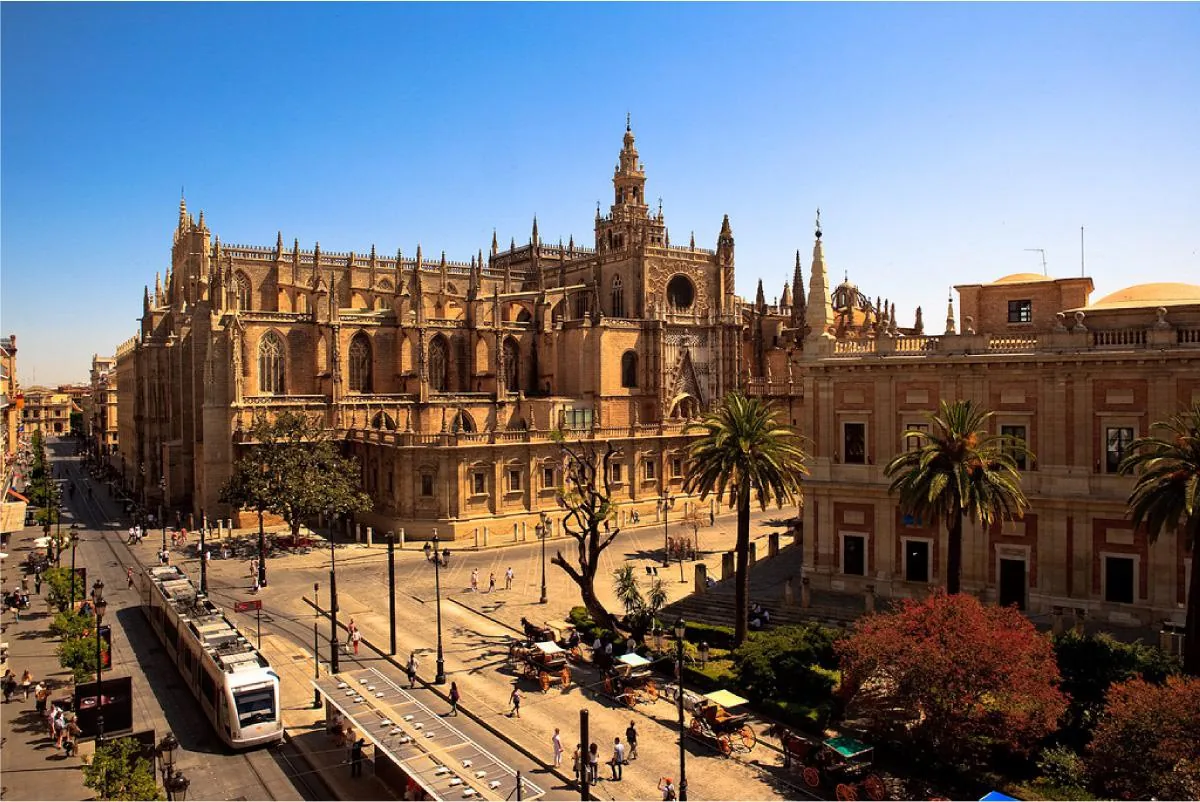
Catedral de Sevilla, Spain
The decision to build the cathedral was, according to contemporary accounts, accompanied by the declaration that the church would be so large that future generations would think the builders mad. Whether or not that account is accurate, the ambition was real: the cathedral covers an area of roughly 23,500 square meters and has eighty chapels. The Giralda minaret, preserved because it was considered one of the finest buildings in the Islamic world and because the chapter recognized the engineering difficulty of demolishing it, was topped with a Renaissance bell chamber in the sixteenth century. The resulting hybrid, Islamic shaft, Renaissance crown, is architecturally unusual and entirely successful.
The interior's scale
The interior's scale is the primary experience: the nave is 42 meters high and the crossing even higher, producing a vast dimly lit volume that makes individual chapels feel intimate by contrast. The Columbus tomb, four heraldic figures carrying the coffin on their shoulders, is theatrically over-scaled in a way that suits its subject. The Giralda ascent is via a series of ramps rather than stairs, built so that horses could be ridden to the top for the muezzin's call; the view from the top over Seville's rooflines is one of the best in the city. The Patio de los Naranjos, the mosque's former ablutions courtyard, now planted with orange trees, provides a shaded transition between the street and the cathedral. The cathedral is in the center of Seville's historic district, a short walk from the Alcázar palace. The nearest metro is Puerta Jerez. A combined ticket covers the cathedral and the Alcázar; booking ahead is recommended in spring and summer.
The Experience
Stand in the vast 42-meter nave, find the theatrical Columbus tomb, ascend the Giralda's ramps (designed for horses) to the bell chamber for views over Seville, and rest in the orange-tree Patio de los Naranjos between mosque courtyard and cathedral.
Why It Matters
The world's largest Gothic cathedral by volume, a UNESCO World Heritage Site, and the most ambitious expression of post-Reconquista Christian architectural ambition in Andalusia.
Why Visit
The Giralda ascent by ramp rather than stair, and the view from the top across Seville's roofline, is one of the city's best experiences. The interior scale is genuinely difficult to absorb in a single visit.
Insider Tips
- 1
Book tickets online in advance for the combined cathedral and Alcázar entry, on-the-day queues can mean a two-hour wait.
- 2
The Giralda ramp climbs continuously with no stairs, it's accessible but long; start early to avoid midday heat.
- 3
The Columbus tomb is easy to walk past, it's in the south transept and requires looking up to appreciate the scale of the four carriers.
- 4
The cathedral treasury contains significant silverwork and vestments; it's included in the ticket and undervisited.