The Gothic Quarter of Barcelona is built over a Roman colony, and the medieval street grid above the Roman one below can both be walked, the latter in the museum beneath the Plaça del Rei.
About Barri Gòtic
Medieval Barcelona's maritime empire funded the Gothic Quarter's fourteenth and fifteenth-century monuments. A significant portion of the 'medieval' fabric was actually rebuilt in the 1920s as a romantic revival, a detail guides sometimes elide. The Roman city of Barcino beneath dates to the first century BCE.
What Barri Gòtic is
The Barri Gòtic, Gothic Quarter, is the historic center of Barcelona, a dense urban fabric of medieval streets built over Roman foundations, with Gothic civic and religious buildings from the fourteenth and fifteenth centuries among the most intact examples of medieval municipal architecture in the Iberian Peninsula. The Roman colony of Barcino, founded in the first century BCE, left behind significant remains still visible in the basement levels of buildings and in the preserved section of the city wall.
“The Roman colony of Barcino, founded in the first century BCE, left behind significant remains still visible in the basement levels of buildings and in the preserved section of the city wall.”
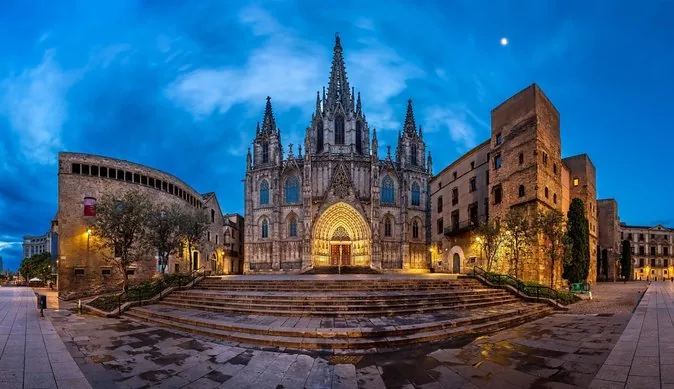
Barri Gòtic, Spain
Barcelona's medieval commercial prosperity, driven by the Catalan-Aragonese maritime empire that controlled much of the western Mediterranean in the thirteenth and fourteenth centuries, produced the money that built the Gothic Quarter's principal monuments. The Barcelona Cathedral, the Palau de la Generalitat, the Saló del Tinell, and the Santa Maria del Mar church just outside the Gothic Quarter's boundary were all products of this period. The nineteenth century brought significant idealization of the medieval fabric: several buildings commonly presented as medieval were in fact built or substantially rebuilt in the 1920s as part of a deliberate medieval revival, an inconvenient truth that guides sometimes avoid.
The Plaça de Sant Jaume, surrounded by the Ajuntament and the Palau de la Generalitat, is the civic heart of the quarter. The Roman temple columns preserved inside the Palau del Lloctinent courtyard, visible through a window, remind visitors of the Roman city beneath. The Call, the medieval Jewish quarter, absorbed into the Gothic Quarter, contains several sites associated with the pre-1391 Jewish community that was destroyed in that year's pogrom. The underground Museu d'Història de la Ciutat beneath the Plaça del Rei reveals the Roman street grid, drainage systems, and fish processing facilities two meters below the current street level.
The Barri Gòtic is in central
Barcelona, adjacent to La Rambla. Metro stops Jaume I (line 4) and Liceu (line 3) both access the quarter. The area is fully pedestrianized and best explored on foot.
“Metro stops Jaume I (line 4) and Liceu (line 3) both access the quarter.”
The Experience
Walk the Plaça de Sant Jaume civic space, find the Roman temple columns inside the Palau del Lloctinent, visit the underground Roman street grid in the Museu d'Història de la Ciutat, and navigate the Call streets of the former medieval Jewish quarter.
Why It Matters
The historic center of Barcelona, containing the most intact concentration of medieval municipal Gothic architecture in Catalonia alongside significant Roman remains beneath the street level.
Why Visit
The Museu d'Història de la Ciutat's underground Roman city, visible in context beneath the medieval layers above, is one of the most revealing urban archaeology experiences in Spain. People generally to Barcelona miss it entirely.
Insider Tips
- 1
The Museu d'Història de la Ciutat (MUHBA) beneath Plaça del Rei requires a separate ticket and is often uncrowded, go there early.
- 2
The Call Jewish quarter occupies the streets west of Plaça Sant Jaume, look for the Hebrew inscription stones embedded in building walls.
- 3
The 1920s medieval revival buildings are good, don't be disappointed when told they're not authentic fourteenth-century construction.
- 4
El Xampanyet cava bar near Santa Maria del Mar is one of the better old-school Barcelona bars for a mid-afternoon stop.