“A failed private garden city for Barcelona's wealthy left behind one of Spain's most unusual public spaces, a hillside park of mosaic benches, stone viaducts, and a dragon staircase designed by Antoni Gaudí.”
About Park Güell
Commissioned by industrialist Eusebi Güell in 1900 as a luxury garden city development, the project failed commercially and was donated to the city in 1922. Gaudí lived in one of the two completed houses from 1906 until 1925, a year before his death.
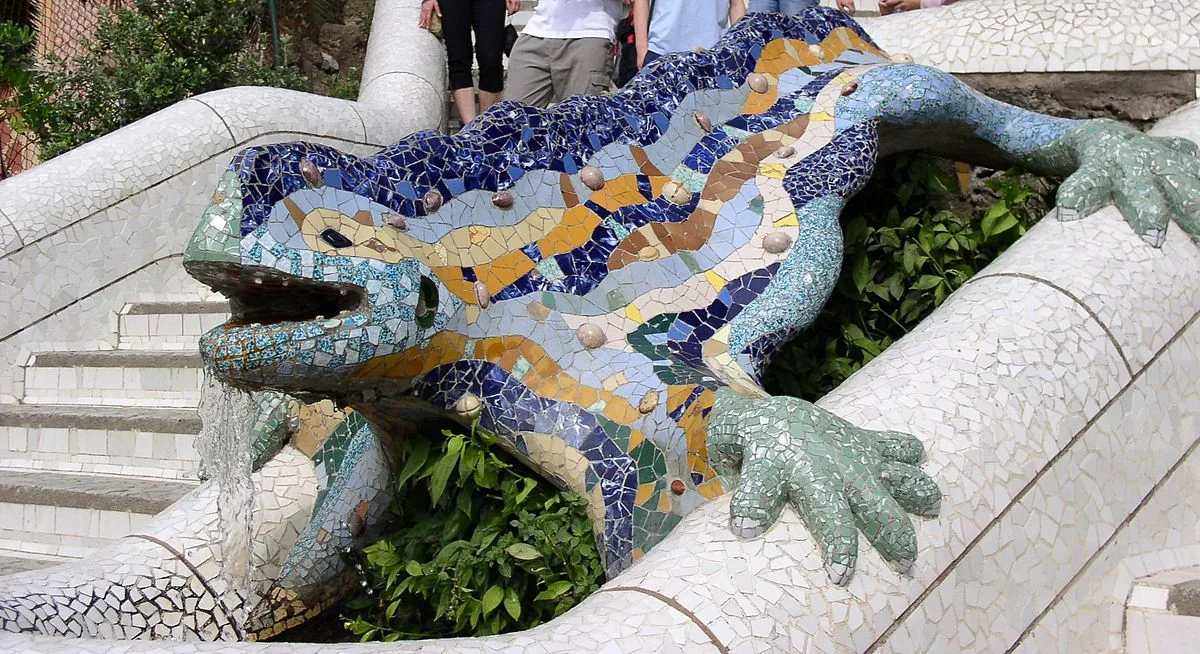
Park Güell occupies a hillside in the Gràcia district of Barcelona, a public park designed by Antoni Gaudí between 1900 and 1914 on commission from the industrialist Eusebi Güell. The original project was intended as a private garden city of sixty luxury plots; only two houses were built before the concept was abandoned and the land donated to the city. Gaudí's park infrastructure, the main terrace, the hypostyle hall of columns, the viaducts, and the winding paths, survived as one of the most unusual public spaces in Spain.
Park Güell occupies a hillside in the Gràcia district of Barcelona, a public park designed by Antoni Gaudí between 1900 and 1914 on commission from the industrialist Eusebi Güell.
Güell's ambition was to create an English-style garden city for Barcelona's haute bourgeoisie, on a hillside above the city with views over the Mediterranean. The project failed commercially, the location was considered too remote and the concept too unusual for buyers, but Gaudí's design work for the common areas was essentially complete. The famous mosaic dragon on the main staircase and the sinuous mosaic bench on the main terrace were among the works completed before the project stalled. Gaudí himself purchased one of the two completed houses and lived there from 1906 until 1925, a year before his death.
The Monumental Zone, the ticketed central area containing the main terrace, hypostyle hall, and dragon staircase, requires timed entry in advance. The famous serpentine bench, covered in a patchwork of broken ceramic tile fragments that Gaudí's collaborator Josep Maria Jujol composed with remarkable color intelligence, encircles the main terrace and offers views over Barcelona to the sea. The hypostyle hall below it, a covered market space supported by eighty-six Doric columns, has an undulating ceiling mosaic of startling complexity. The surrounding free park areas cover the broader hillside with stone viaducts and paths that are much less crowded than the central zone.
Park Güell is in the Gràcia-Carmel neighborhood, reached by Bus 24 from Passeig de Gràcia or by a steep uphill walk from the Vallcarca or Lesseps metro stations. Pre-booking timed entry tickets is mandatory for the Monumental Zone.
Park Güell is in the Gràcia-Carmel neighborhood, reached by Bus 24 from Passeig de Gràcia or by a steep uphill walk from the Vallcarca or Lesseps metro stations.
The Experience
Sit on the serpentine mosaic bench on the main terrace for views over Barcelona to the Mediterranean, study the hypostyle hall's eighty-six columns and undulating ceiling mosaic, and walk the free surrounding park's stone viaducts for the broader hillside landscape.
Why It Matters
A UNESCO World Heritage Site and one of Gaudí's most complete surviving works, a public park whose infrastructure represents his mature approach to integrating architecture with natural landscape.
Why Visit
The Jujol-composed ceramic mosaic on the main terrace bench, a collage of broken tile fragments that achieves extraordinary color coherence, is one of the most inventive decorative surfaces in Spain. The view of Barcelona from the terrace is also among the city's best.
✦ Insider Tips
- 1
Book Monumental Zone tickets at least two weeks ahead in summer, available slots genuinely disappear.
- 2
The free surrounding park areas above the Monumental Zone are quieter and have their own viaduct architecture worth walking.
- 3
The Gaudí House Museum in his former residence is included in some combined tickets, worth visiting for the personal context.
- 4
Arrive at the opening time of your ticket slot; the terrace bench fills quickly and the view is best without crowds.