Returning Atlantic sailors could see these limestone peaks from far out at sea and called them the Peaks of Europe, and the gorge walk cut through their core is four hours of near-vertical limestone walls above a river.
About Picos de Europa
Spain's oldest national park, established in 1918, the Picos contains Cantabrian brown bears and Iberian wolves alongside the Covadonga lakes, associated with the 722 CE battle that Spanish historiography marks as the beginning of the Reconquista.
Picos de Europa
The Picos de Europa is a limestone mountain massif in northern Spain, straddling the regions of Asturias, Cantabria, and Castilla y León, with peaks reaching 2,648 meters at Torre Cerredo. The national park, Spain's oldest, was established in 1918. The mountains rise abruptly from the narrow Cantabrian coastal plain, creating a landscape where the Atlantic meets high alpine terrain, a combination that produces exceptional biodiversity, dramatic gorge systems, and a visual contrast between green valleys and gray limestone summits unlike anything in the Spanish interior.
“The Picos de Europa is a limestone mountain massif in northern Spain, straddling the regions of Asturias, Cantabria, and Castilla y León, with peaks reaching 2,648 meters at Torre Cerredo.”
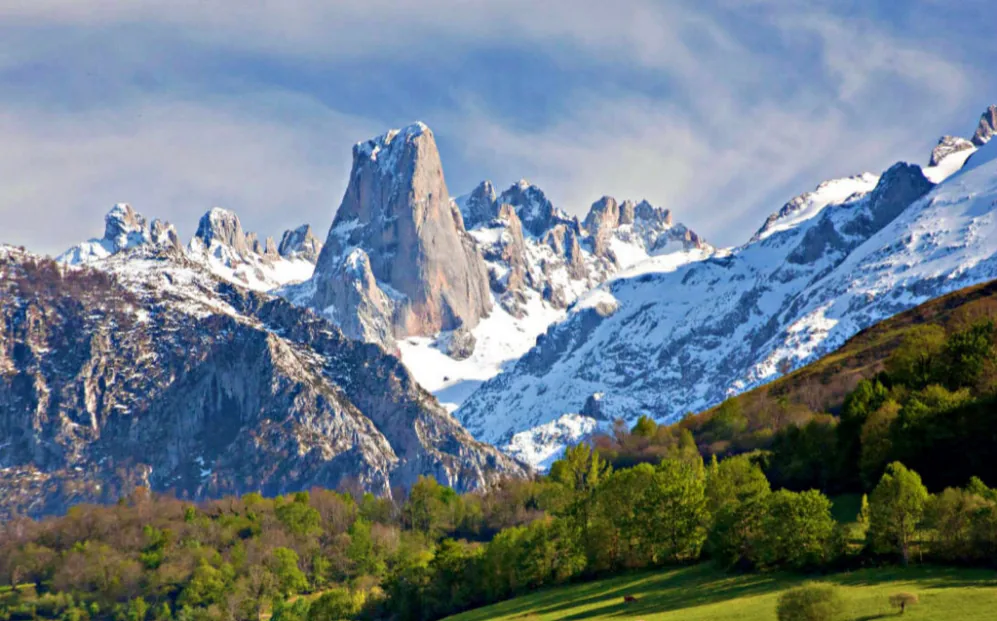
Picos de Europa, Spain
The mountains were called 'Peaks of Europe' by returning sailors whose first sight of land after crossing the Atlantic was these ranges visible from far out at sea. The area's remoteness preserved significant wildlife populations: the Cantabrian brown bear and the Iberian wolf both survive in the Picos and its surrounding areas, though sightings of bear are rare. The Covadonga lakes in the western massif are associated with the Battle of Covadonga in 722 CE, where a Visigothic noble called Pelayo defeated a Moorish force in what Spanish historiography treats as the beginning of the Reconquista, a significance that gives the lakes a national mythological weight beyond their considerable scenic value.
Visiting Picos de Europa
The Garganta del Cares gorge walk, a four-hour return path cut through a limestone gorge between Caín and Poncebos, following a water channel twelve kilometers through near-vertical walls, is the single most dramatic walking route in northern Spain. The Fuente Dé cable car in the Cantabrian side rises 800 meters in four minutes to a high plateau for walking and views over the Cantabrian massif. The Covadonga sanctuary and its lakes require a shuttle bus from lower down in summer, the road is closed to private vehicles. The village of Potes is the main gateway for the eastern Liébana valley. The nearest airports are Santander and Asturias/Oviedo, both about ninety minutes by car. The main entry points, Cangas de Onís in the west, Potes in the east, are connected by bus from regional cities. A car is strongly recommended for accessing the various gorge and lake areas efficiently.
The Experience
Walk the Garganta del Cares gorge path through twelve kilometers of near-vertical limestone canyon, take the Fuente Dé cable car to a high plateau for mountain walking, and visit the Covadonga sanctuary and its glacial lakes by shuttle bus.
Why It Matters
Spain's oldest national park and the most dramatic mountain landscape in northern Spain, the only place in the country where Cantabrian brown bears survive in their historic range.
Why Visit
The Cares gorge walk is one of the finest day hikes in Spain. The combination of deep limestone canyon, altitude exposure, and the channel path cut into the rock face produces an experience that no amount of preparation fully anticipates.
Insider Tips
- 1
The Cares gorge walk (Caín to Poncebos) is four hours return and requires no technical skill, but wear proper footwear, as the path is uneven rock.
- 2
The Fuente Dé cable car queue can be very long in August, arrive before 9am or after 4pm.
- 3
The Covadonga lake shuttle is mandatory in summer; park at the sanctuary and take the bus to the lakes.
- 4
Picos wildlife, specifically Cantabrian chamois, is reliably visible on the high plateaus above Fuente Dé.