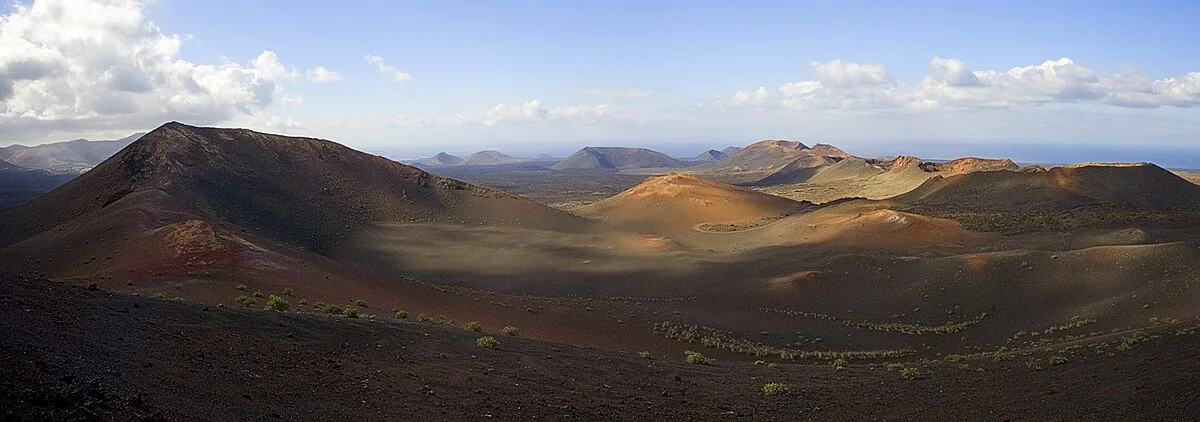
A volcanic eruption that lasted six years buried a quarter of Lanzarote's farmland in 1730, and the resulting black lava landscape has changed so little that the national park feels genuinely extraterrestrial.
About Timanfaya National Park
The 1730-1736 eruptions were among the largest in recorded European history, documented in detail by the local parish priest. César Manrique, the Lanzarote-born artist, later designed the park's visitor infrastructure to sit within the landscape rather than impose on it.
Timanfaya National Park occupies the southwestern corner of Lanzarote, an island in the eastern Canary Islands where a volcanic eruption lasting six years between 1730 and 1736 buried an entire agricultural district under lava and ash. The landscape that resulted, black and red lava fields, volcanic cones, solidified lava rivers, has barely changed since the eruptions ended. No plants grow within most of the park's protected interior, and the visual uniformity of the volcanic field in every direction creates a landscape that feels genuinely extraterrestrial.
The eruptions of 1730-1736 were among the largest volcanic events in recorded European history. Contemporary accounts from the parish priest of Yaiza, Andrés Lorenzo Curbelo, documented the eruptions in detail, the ground cracking open, the sea boiling, villages consumed by lava, the ash cloud that darkened the sky for weeks. Around one quarter of Lanzarote's agricultural land was destroyed. The volcanic activity continued sporadically until 1824. The national park was established in 1974, and the artist and architect César Manrique, a Lanzarote native, designed the park's visitor infrastructure to minimize visual intrusion on the landscape.
The Ruta de los Volcanes bus tour traverses the park's interior, access by private vehicle is prohibited. The route passes through the caldera area of Montañas del Fuego, where geothermal heat remains close to the surface: park rangers demonstrate this by pouring water into a vent to produce a geyser effect, and the restaurant El Diablo cooks food over a natural volcanic heat source. The park's entrance area features César Manrique's visitor center built into a volcanic tunnel. A dromedary ride at the park's edge is tourist-facing but gives a different vantage point on the lava field.
Lanzarote has an international airport near
Arrecife with connections across Europe. The park is about thirty minutes by car from Arrecife. Entry is by the organized bus tour only, private vehicles cannot access the volcanic interior. Tickets at the gate are available on a first-come basis; afternoon visits are less crowded than morning.
The Experience
Take the mandatory Ruta de los Volcanes bus through the volcanic interior, watch the geothermal geyser demonstration, eat at El Diablo restaurant cooking over natural volcanic heat, and visit Manrique's visitor center built into a lava tunnel.
Why It Matters
A national park preserving one of the most intact post-volcanic landscapes in Europe, shaped by an eruption sequence that lasted six years and whose geothermal heat remains measurable beneath the surface.
Why Visit
The visual uniformity of the lava field, black and red in every direction, with the volcanic cones rising in the distance, produces a genuinely disorienting sense of scale and absence. The geothermal activity is still present and measurable, not a metaphor.
✦ Photo Gallery
Best Season
🌤 Year-round. Lanzarote's climate is mild in all seasons; the volcanic interior is exposed and windy. Afternoon visits have shorter bus queues than morning arrivals.
Quick Facts
Best time to visit
Year-round. Lanzarote's climate is mild in all seasons; the volcanic interior is exposed and windy. Afternoon visits have shorter bus queues than morning arrivals.
Getting there
In Lanzarote, Spain; reach Lanzarote first, then continue to the site.
Location
Lanzarote, Spain
Type
attraction
Coordinates
28.9942°, -13.7933°
Insider Tips
- 1
The bus tour is the only access to the volcanic interior, there is no alternative route. Tickets are first-come at the gate.
- 2
El Diablo restaurant books up quickly at lunch, either arrive early or plan to eat before or after the main rush.
- 3
The César Manrique lava tube visitor center at the entrance is architecturally interesting in its own right, don't rush through it.
- 4
Combine with Manrique's other works on the island, the Jameos del Agua and Mirador del Río, for a full day of his landscape architecture.