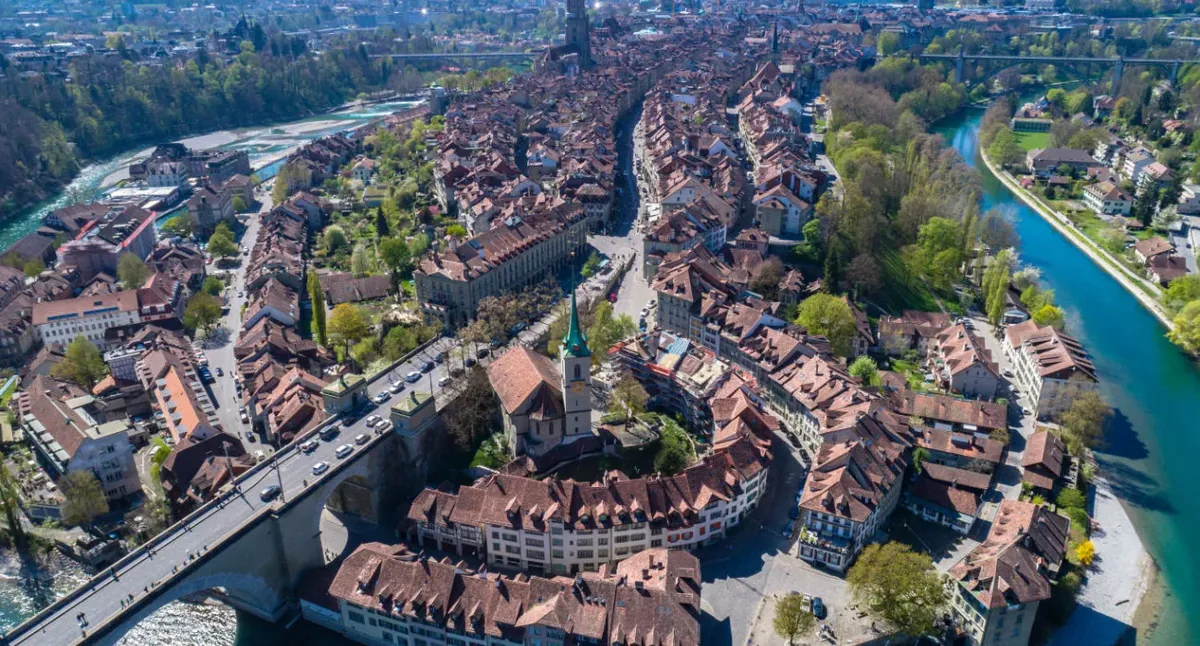
A monk who tripped on a thornbush in 612 and took it as a sign from God founded the institution that would become one of Europe's greatest libraries.
About Abbey Library of Saint Gall
The Irish peregrinus Gallus accompanied Columbanus on his mission through Frankish territory and split from the group around 612, settling in what is now eastern Switzerland after an illness, or, according to the beloved legend, after stumbling in a thorn bush and interpreting the fall as divine instruction to stop moving. His hermitage on the Steinach became a monastic community after his death, formally constituted as a Benedictine abbey in 747. By the ninth century, the scriptorium at Saint Gall was among the most productive in Carolingian Europe. Monks here copied Virgil and Cicero alongside the Church Fathers, and the monastery's own scholars produced original work. Notker Balbulus, writing in the 880s, developed the musical sequence, a form of sacred chant that spread across European liturgy. The monastery became a centre of learning so significant that Charlemagne's court maintained direct contact with its abbots. The current Baroque library hall was completed in 1767. The manuscripts survived the Reformation, wars, and political upheaval; 400 of them predate the year 1000.
The library at the Abbey of Saint Gall
The library at the Abbey of Saint Gall in eastern Switzerland is the oldest library in the German-speaking world still in operation, and among the most beautiful rooms in Europe. Built between 1758 and 1767 in the late Baroque style, the hall runs 70 metres in length beneath a ceiling painted with allegorical figures representing the arts and sciences, the light from tall windows falling across dark walnut shelves that reach from floor to gallery rail. The smell alone, old paper, leather, beeswax, cool stone, is reason enough to stand still for a moment after you walk in. The collection holds approximately 170,000 volumes, including manuscripts dating to the eighth century, among them the oldest surviving plan of a building in the Western world: the Plan of Saint Gall, drawn around 820, detailing the ideal layout of a Benedictine monastery. The library, the adjacent cathedral, and the surrounding precinct together form a UNESCO World Heritage site.
“The library at the Abbey of Saint Gall in eastern Switzerland is the oldest library in the German-speaking world still in operation, and among the most beautiful rooms in Europe.”
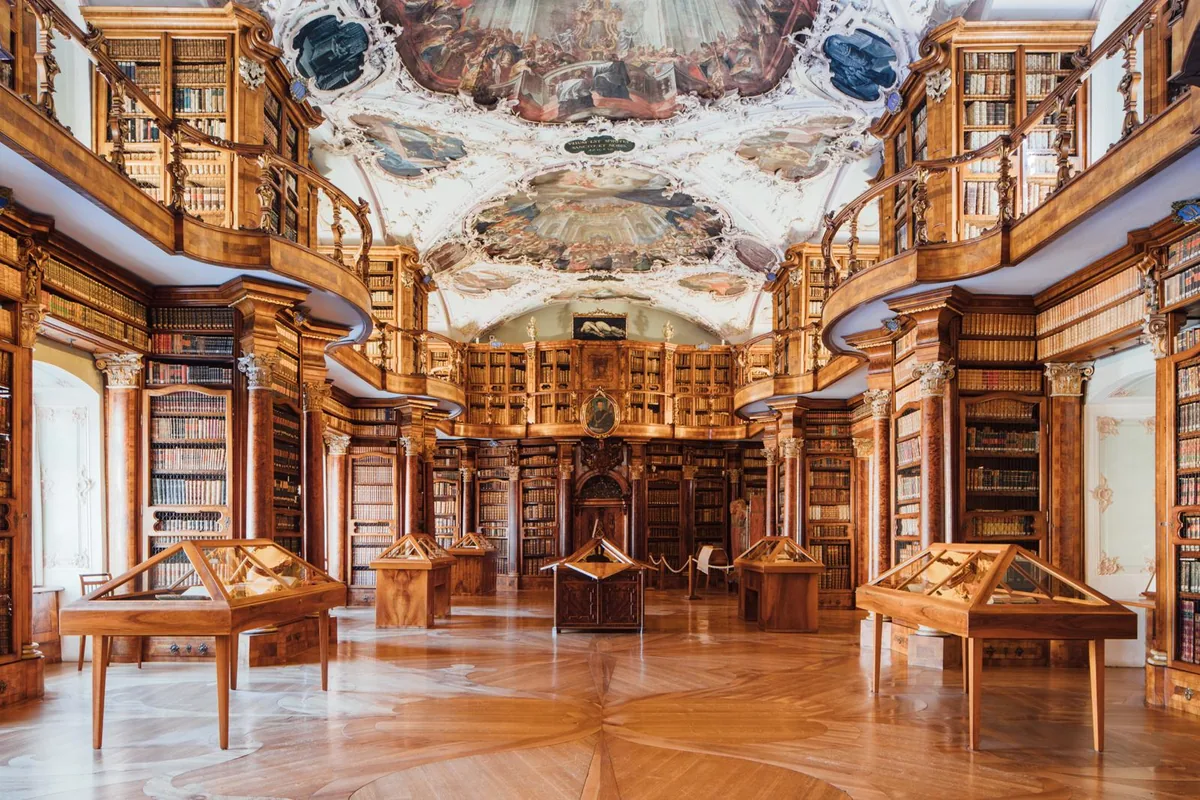
Abbey Library of Saint Gall, Switzerland
Getting there
Irishman Gallus, a monk travelling with Columbanus, sheltered in the Steinach valley around 612, reportedly tripped on a thorn bush, took it as a divine sign, and stayed. The small hermitage he built became a monastery after his death, and the monastery grew over the following century into one of the most influential scriptoria in Carolingian Europe, producing manuscripts that were copied and distributed across the continent. The library's golden age was the ninth and tenth centuries, when monks at Saint Gall were not only copying classical and theological texts but producing original scholarship. Notker Balbulus composed sacred music here in the late 800s, inventing a new form called the sequence that would influence sacred music for two centuries. The Thirty Years' War threatened the collection multiple times, and the abbot hid the most valuable manuscripts in Zürich for safekeeping in 1712. They were returned in 1718. The current Baroque hall replaced a medieval structure in 1767 and was never intended merely for storage. The architecture announces that books are not documents but a civilisation's argument for its own importance.
St
St. Gallen is a 47-minute express train from Zürich. The Abbey Library is a short walk from the main station through the old city. The library is open daily except Monday from April through November, and Tuesday through Sunday in the winter months. The separate ticket for the cathedral is not required, the library admission covers the precinct.
Visitors enter wearing felt overshoes, required
Visitors enter wearing felt overshoes, required to protect the original wooden floor, which has the curious effect of making everyone move more slowly and carefully than they otherwise would. The hall's acoustics are hushed rather than silent, absorbing conversation the way a forest does. You end up speaking quietly without being asked to. The manuscripts in the display cases change periodically, but the permanent exhibits include the Plan of Saint Gall in facsimile and several illuminated pages so vivid in colour they seem to have been painted last month. The gallery level, accessible by wooden staircase, gives a view down the full length of the hall that no ground-floor angle provides, from above, the symmetry of the space is absolute.
The Experience
The felt overshoes are not an affectation, the original floor, laid in 1767, has never been replaced, and the soft shuffle of dozens of visitors moving slowly across it creates a sound like distant applause. The gravity of the room's deliberate grandeur immediately: the ceiling paintings, the gallery balustrade, the colour gradient of the shelves moving from lighter wood at the base to darker at the top. The manuscripts in the display cases rotate, but the experience of standing beside a document written in the ninth century, legible, intact, the ink still dark, recalibrates your sense of what old means. Most visitors spend forty minutes; the ones who read the case notes carefully are still there after two hours.
Why It Matters
The Abbey Library of Saint Gall represents the most complete surviving example of an early medieval monastic library: the architecture, the collection, and the institutional continuity are all intact in a way that no other library in the world can match. The manuscripts held here are primary sources for Carolingian music, theology, natural science, and the Latin classical tradition, texts without which significant portions of early medieval European history would be unknowable.
Why Visit
Most great libraries are either beautiful buildings with indifferent collections or important archives in utilitarian rooms. Saint Gall is the rare case where the architecture and the contents are equally extraordinary. The Baroque hall was built specifically to honour the books it holds, and that intention is visible in every proportion of the room.
Insider Tips
- 1
The felt overshoes are provided at the entrance and are mandatory, wear socks rather than bare feet inside your shoes if you are visiting in summer.
- 2
The gallery level is accessible via a wooden staircase near the entrance; the view from above of the full hall length is the best single vantage point in the room.
- 3
The cathedral adjacent to the library is free to enter and contains Baroque decorative work of equal quality, allow extra time for both.
- 4
The library shop sells high-quality facsimile reproductions of the most important manuscripts, including the Plan of Saint Gall, at reasonable prices.
- 5
Photography is permitted in the library without flash; the natural light is usually sufficient for good results from a phone or compact camera.