“Albert Einstein worked out the special theory of relativity in a rented apartment above a butcher's arcade in this medieval city, between patent office shifts.”
About Old City of Bern
Bern was founded in 1191 by Duke Berchtold V of Zähringen as a fortified town on a defensible river bend. The name, according to legend, came from the first animal hunted in the surrounding forest, a bear, and the city has maintained live bears as civic symbols for over five centuries. Growth was rapid: within two generations, Bern had its own cathedral, markets, and the beginning of the covered arcades that now run unbroken for six kilometres through the city centre. The fire of 1405 destroyed most of the original timber structures, and the subsequent rebuilding in local sandstone defined the city's appearance permanently. Bern joined the Swiss Confederation in 1353, became a formidable military power through the fifteenth century, and was designated the federal seat in 1848, a compromise choice, since the larger cities of Zürich and Geneva both wanted the role. Einstein arrived as a 23-year-old in 1902. He left in 1909, having published four papers that altered physics entirely. The patent office where he worked still stands on Speichergasse.
What Old City of Bern actually is
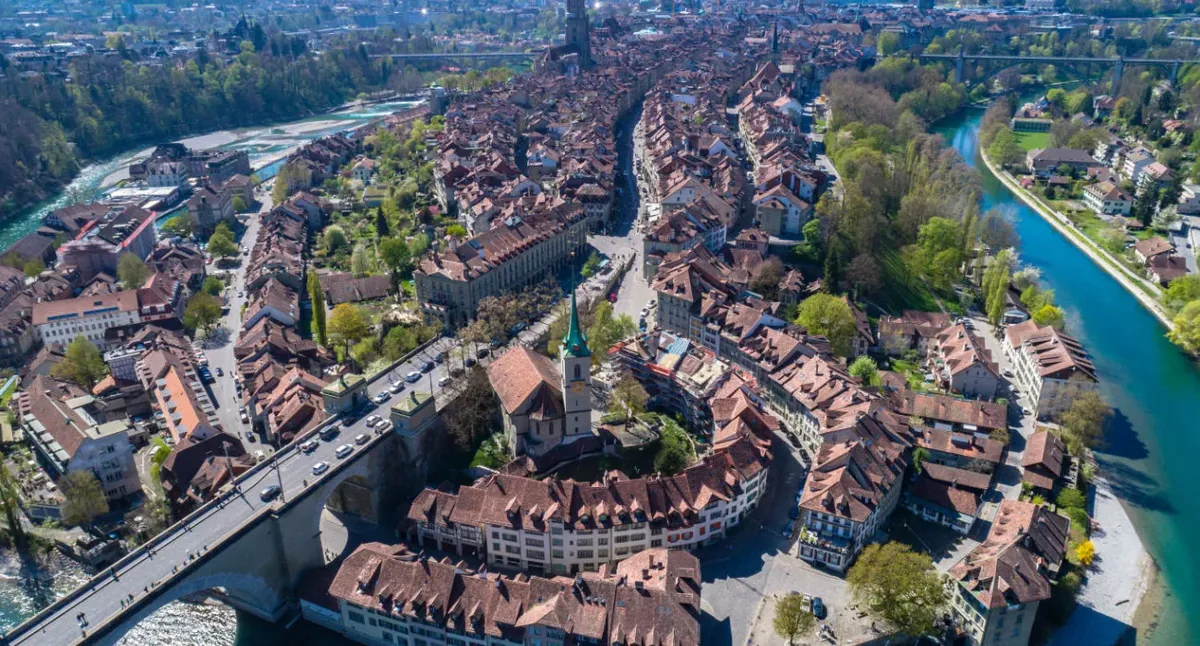
Bern does not announce itself. Switzerland's federal capital occupies a sandstone peninsula looped on three sides by a green river, and its medieval core has changed so little in seven centuries that the UNESCO committee, when they listed it in 1983, described it simply as 'an outstanding example of a planned medieval town.' That phrase undersells what walking through it actually feels like. Six kilometres of arcaded walkways run unbroken beneath the amber facades, sheltering pedestrians from rain and snow in covered passages that have been in continuous use since the thirteenth century. The city's patron is the bear, a heraldic pun on the name Bern, and live bears have been kept here since at least 1513. They still are, in an open riverside pit just below the old city, visible from a bridge on which people stop and lean and watch the animals with the same unselfconscious attention their ancestors gave them five hundred years ago.
' That phrase undersells what walking through it actually feels like.
Zähringen founded Bern, 1191
Duke Berchtold V of Zähringen founded Bern in 1191 on a loop of the Aare, choosing the site for its natural defensibility. The city grew along a single ridge, its main street stretching east to west and the arcaded lanes feeding off it with the regularity of a comb. A catastrophic fire swept through in 1405 and destroyed most of the timber buildings; the reconstruction in sandstone gave Bern the warm ochre palette it has kept ever since. Albert Einstein lived at Kramgasse 49 from 1902 to 1909, working days at the patent office and evenings in the apartment above the arcade where he developed the special theory of relativity. The apartment is now a small museum. The connection between this quiet, orderly city and one of the most disruptive ideas in scientific history remains genuinely strange.
Visiting Old City of Bern
The arcades change character by hour. At eight in the morning they carry the smell of fresh bread from the bakeries set back behind low steps; by noon they fill with office workers moving quickly between lunch appointments; by evening the same corridors go quiet and the amber light from the shop windows turns the sandstone the colour of honey. The Zytglogge clock tower performs its mechanical theatre at four minutes before every hour, figures emerge, bells ring, the golden cockerel crows. Crowds gather on the pavement below with upturned faces. The show lasts barely a minute, which feels exactly right. The Rose Garden above the city gives the clearest view of the peninsula's geography: the river wrapping the old city on three sides, the bridges connecting it to the modern quarters, the whole arrangement immediately comprehensible from above.
Bern's main railway station sits
Bern's main railway station sits at the western end of the old city, placing you inside the historic centre the moment you step outside. Zürich is 58 minutes by fast train; Basel under an hour; Geneva just over an hour and a half. The old city is compact enough to cover entirely on foot, and the arcades mean you can walk its full length in any weather without an umbrella.
Bern's main railway station sits at the western end of the old city, placing you inside the historic centre the moment you step outside.
The Experience
Walking the arcades in Bern is not sightseeing, it is simply how the city moves. There is a logic of the medieval plan immediately: the main street wide enough for market stalls, the arcaded shoulders keeping the rain off buyers and sellers alike. The sandstone underfoot has been worn smooth by centuries of foot traffic, and in the low winter light the whole corridor glows. The detail that most visitors walk past is the painted fountains standing in the middle of the main street. There are eleven of them, each topped with a sixteenth-century figure, a bear in armour, a Bernese herald, a child-eating ogre, vivid and strange and completely unannounced by any signage.
Why It Matters
Bern holds a peculiar position in European capital cities: it is both ancient and functional, a medieval grid that houses the Swiss federal parliament, foreign embassies, and one of the country's oldest universities without any of those institutions requiring the city to modernise its bones. The UNESCO listing acknowledges this as an achievement in urban continuity that very few cities anywhere in the world have managed.
Why Visit
Geneva has the lake; Zürich has the banks and the art. Bern has something harder to name: a medieval city that is also a living capital, where parliament sits inside a sandstone dome and people eat lunch in arcades that have not changed structurally since the 1400s. The ordinariness of the daily activity against the antiquity of the setting is what makes it worth the journey.
✦ Insider Tips
- 1
The Einstein Museum inside the Historisches Museum Bern gives far more context on his years in the city than the small apartment on Kramgasse, visit it first.
- 2
The animated figures on the Zytglogge clock perform at four minutes before each hour, not on the hour; arriving late means you have missed it.
- 3
Bern's lower arcade level, below street level, accessed by steps, contains several of the city's oldest bars and wine cellars, largely unmarked from above.
- 4
Buy a day pass for the trams; the old city is walkable but the outlying museums, including the Zentrum Paul Klee, require crossing the modern city.