“Byron wrote The Prisoner of Chillon overnight during a storm, sheltering on the lake below the castle walls, his name scratched into the dungeon pillar is still there.”
About Château de Chillon
The rock on which Chillon sits has been inhabited since at least the Bronze Age, its position above the lake road making it strategically irresistible to every power that controlled the region. The current castle took shape under the Counts of Savoy in the twelfth and thirteenth centuries, when it served simultaneously as a residence, a garrison, and a toll point controlling the mountain pass road. François Bonivard, the prior of Saint-Victor in Geneva, was imprisoned here between 1530 and 1536 for his support of the Genevan independence movement against the Duke of Savoy. He spent four years chained to a pillar in the dungeon, pacing a circle around it so regularly that a groove worn into the stone floor is still visible today. Byron and Shelley visited in June 1816, part of the famous summer on Lake Geneva that also produced Frankenstein. Byron's poem made Chillon internationally famous and turned it into a literary destination years before formal tourism existed as a concept. Over a million people visit annually, it is the most visited historic monument in Switzerland.
What Château de Chillon in Switzerland is
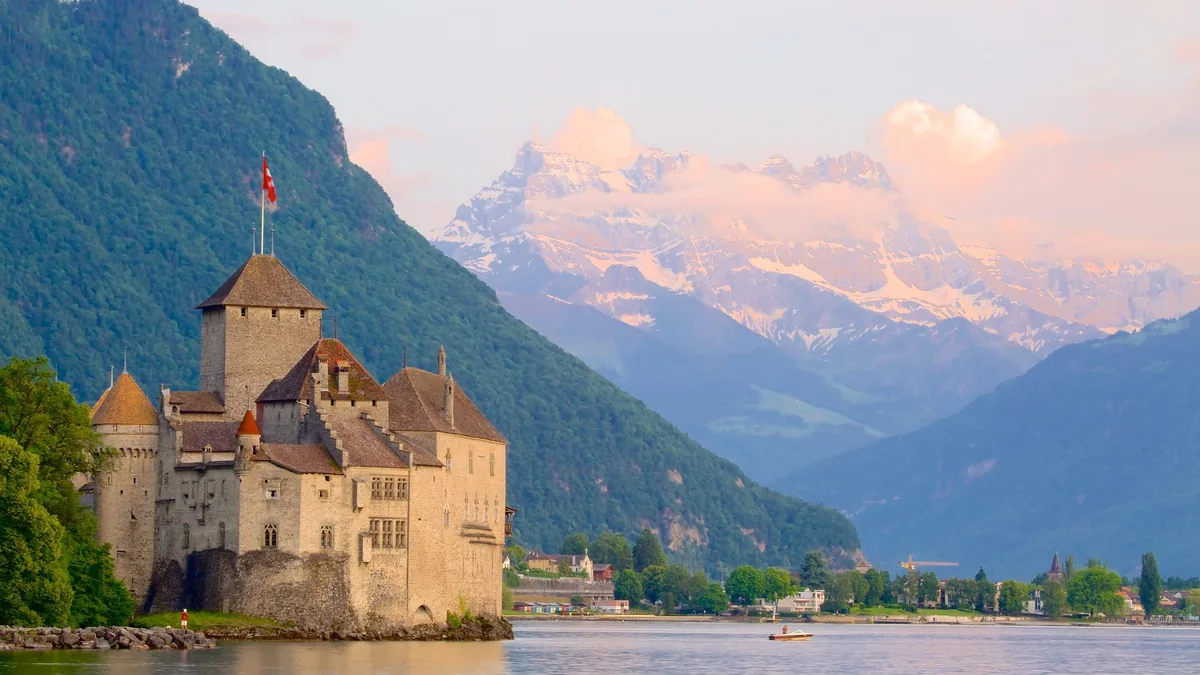
Château de Chillon appears to grow directly from the surface of Lake Geneva, its towers rising from a narrow rock outcrop so close to the water that on grey days the stone and the lake seem to share the same colour. The castle stands between Montreux and Villeneuve on the eastern shore, where the Rhône valley begins to narrow into the Alps, and it has occupied this particular rock for nearly a thousand years. What makes it unusual among medieval fortifications is the condition: not a ruin, not a reconstruction, but a place you can walk through and feel the accumulated life of the centuries, the courtyard cool in summer heat, the great halls still hung with painted coats of arms, the dungeon columns carved with the initials of prisoners who had nothing else to do.
The castle stands between Montreux and Villeneuve on the eastern shore, where the Rhône valley begins to narrow into the Alps, and it has occupied this particular rock for nearly a thousand years.
The site was likely occupied
The site was likely occupied as early as the Bronze Age, positioned to control the only viable road between the Alps and Lake Geneva's western shore. The castle as it now stands was built primarily in the twelfth and thirteenth centuries under the Counts of Savoy, who used it both as a military stronghold and a toll collection point, every merchant, pilgrim, or soldier passing between Italy and northern Europe was required to stop here and pay. The castle's most famous prisoner was François Bonivard, a Genevan prior and political agitator whom Duke Charles III of Savoy had chained to a column in the dungeon from 1530 to 1536. Lord Byron visited in May 1816 and was so taken by the story that he wrote The Prisoner of Chillon in a single sitting overnight while sheltering from a storm on the lake. His name, scratched into the dungeon pillar, is still visible beside Bonivard's carved initials.
Visiting Château de Chillon
Entering through the main gate, the castle shift around you, the rooms are not arranged for display but for habitation, each connected to the next by passages that tighten and open unexpectedly. The Great Hall of the Count faces the lake through tall windows, and the light off the water fills the room with a constant, restless shimmer. In summer the effect is theatrical; in November, when the lake turns the colour of pewter and the mountains across the water disappear into cloud, it is something closer to elemental. The dungeon is the one room where time seems to compress. The seven Gothic pillars stand in low light, the chains are real, and the floor is noticeably colder than anywhere else in the building. Byron's graffiti, fourth pillar from the entrance, left side, is marked by a small discrete label. Knowing he stood exactly here and scratched his name like any other tourist is oddly humanising.
Chillon is 3 kilometres east
Chillon is 3 kilometres east of Montreux along the lake shore, walkable via a pleasant promenade path in under an hour. The regional train between Montreux and Villeneuve stops at Veytaux-Chillon, a five-minute walk from the entrance. Boats run from Montreux and other lake towns between April and October. The castle itself opens daily year-round.
Chillon is 3 kilometres east of Montreux along the lake shore, walkable via a pleasant promenade path in under an hour.
The Experience
The castle reveals itself room by room in a way that rewards slow movement. You come across a shift between the upper halls, where the light off the lake makes the painted walls glow, and the dungeon below, where the temperature drops several degrees and the stone absorbs sound rather than reflects it. Most visitors photograph the exterior from the lakeside walk and spend thirty minutes inside. The ones who linger discover the chapel on the second level, its thirteenth-century frescoes still bright, and the boat dock below the east tower, where the lake laps directly against the castle foundation, the cleanest illustration of how thoroughly the water defines this place.
Why It Matters
Chillon is one of the best-preserved medieval castles in Europe, significant not because it was the site of a single dramatic event but because it accumulated nine centuries of continuous use without substantial destruction or over-restoration. The layers, Savoyard fortress, Bernese granary, Romantic literary landmark, modern heritage site, are all still readable in the fabric of the building.
Why Visit
Most medieval castles ask you to imagine their past; Chillon does not require that effort. The rooms are intact, the mechanisms work, the graffiti is original. Bonivard's pillar groove and Byron's signature are in the same room, six feet apart, and neither is behind glass. For a building nearly a thousand years old, the access is extraordinary.
✦ Insider Tips
- 1
Byron's name is on the fourth pillar from the entrance on the left side, the small label identifying it is easy to walk past.
- 2
The boat from Montreux gives the best exterior view of the castle's relationship to the water; approach by land and you miss the full drama of the rock.
- 3
The lakeside promenade walk from Montreux to the castle takes about 45 minutes and passes the Freddie Mercury statue, making it a logical combined route.
- 4
Arrive before 10am on summer days; by midmorning the courtyard fills with school groups and the dungeon becomes difficult to stand in quietly.