A cigarette butt in 1993 destroyed two-thirds of a bridge that had stood for 660 years, the rebuilt version reopened within eight months.
About Chapel Bridge
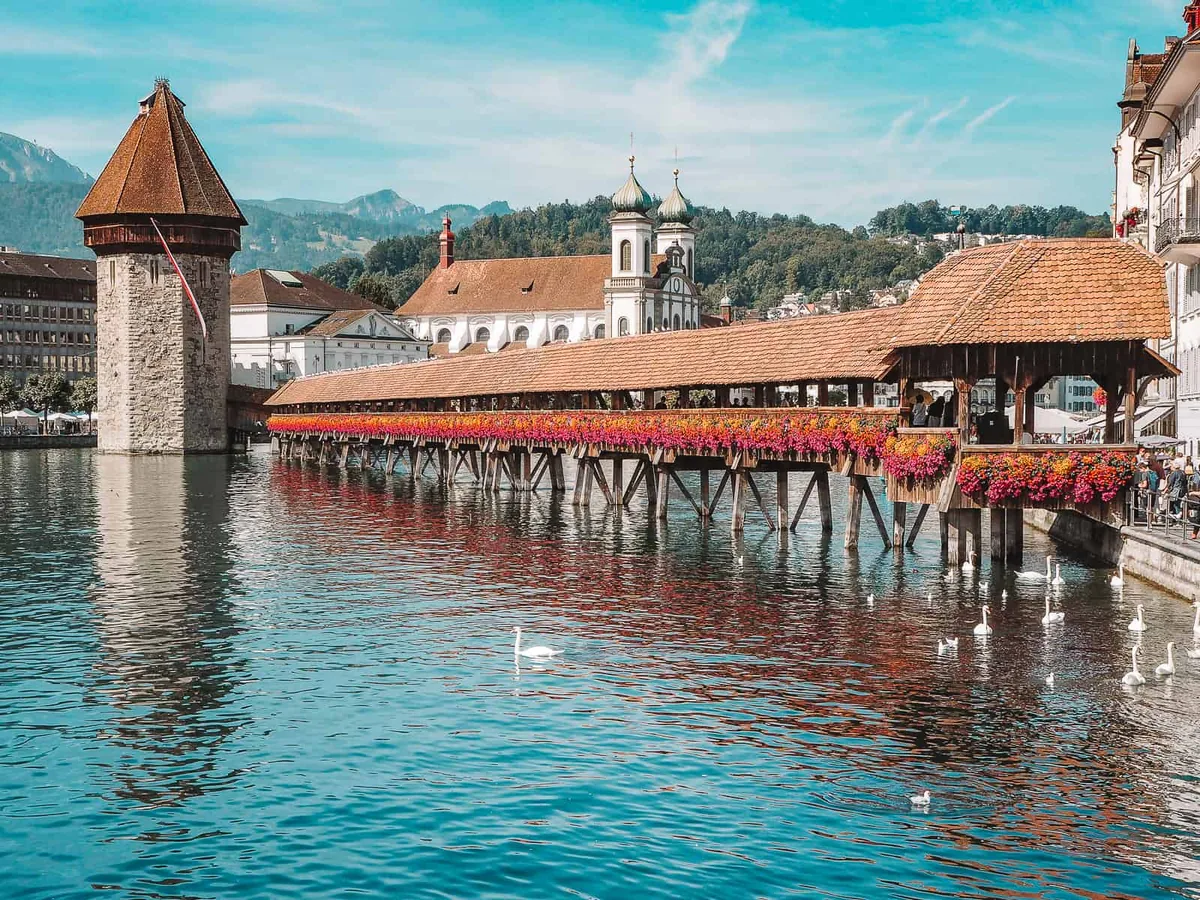
Lucerne built the Chapel Bridge around 1333 as a defensive structure spanning the Reuss at an angle calculated to give archers the widest possible field of fire across the water. The Water Tower predates the bridge by several decades, built around 1300 as a standalone fortification; the bridge was constructed to connect with it, and the two have been read as a single composition ever since. The painted ceiling panels, added in the seventeenth century, served a civic and religious purpose, visual storytelling for a population that navigated the city by landmarks rather than written signs. By the eighteenth century the panels had become historical decoration, and eventually beloved heritage. The 1993 fire shocked Switzerland with the speed of the destruction. The city's decision to rebuild rather than leave the damaged structure as a memorial was contested at the time but has since been accepted. The 30 surviving original panels are marked; the gaps make the loss legible.
The Chapel Bridge crosses the Reuss River
The Chapel Bridge crosses the Reuss River in Lucerne at a diagonal, as if it were built in a hurry, which it partly was, medieval engineers laid it on a slant to maximise its defensive arc across the water. At 173 metres, the covered wooden structure is the oldest surviving bridge of its kind in Europe, and it remains in daily pedestrian use. The dark timber lattice of its roof, the geranium boxes hanging along its railings, the octagonal Water Tower rising from the river beside it, the whole composition is so photogenic that it has become the default image of Switzerland for half the world, which risks making you numb to it before you even arrive. The bridge is worth the hype. See it at seven in the morning before the tour groups arrive, when the light comes through the gaps in the wooden planking and the river below is still and green, and you understand why the image has proved so durable.
bridge was built, 1333
The bridge was built around 1333 as part of Lucerne's fortifications, linking the city walls on the south bank with the northern defenses and the Water Tower, which served variously as a treasury, a prison, and an archive over the centuries. The 112 triangular panels mounted between the rafters, painted in the seventeenth century, depicted scenes from the city's patron saints and from Lucerne's own history, functioning as a kind of illustrated chronicle for a largely illiterate population. On the night of 18 August 1993, a fire started by a carelessly discarded cigarette destroyed two-thirds of the bridge and most of the paintings. The rebuilding was completed within months. Of the original 112 panels, 30 survived intact; the rest were lost. The reconstructed bridge opened in April 1994 and the city decided, pragmatically, to treat the rebuild as a continuation rather than a rupture.
Walking the bridge, moving through
Walking the bridge, moving through a tunnel of dark wood with periodic openings to the river below. The surviving painted panels hang overhead, their pigments darkened by age and smoke, depicting bearded saints and battle scenes. The panels that burned were replaced with photographs of what had been there, a quiet, factual acknowledgment of the loss rather than an attempt to pretend it did not happen. The Water Tower beside the bridge is not open to visitors, but its base is reachable from the bridge walkway. Standing next to the massive octagonal stones and looking back at the bridge from mid-river, the combination of wood, water, and mountain backdrop becomes something you want to stand in for longer than seems practical. Lucerne's main railway station opens directly onto the lake and the river, placing you within two minutes' walk of the bridge's southern entrance. From Zürich, the train takes 46 minutes. From Basel, about an hour. The bridge itself is open at all hours and costs nothing to cross. The surrounding old city is entirely walkable from the station.
The Experience
The bridge's interior is darker than you expect. The roof planking filters the light into shifting bars that move across the wooden walkway as you cross, and the smell, old timber, river damp, the residue of thousands of visitors, is specific and persistent. The geraniums along the railings are replanted every spring by the city and maintained by local volunteer groups, a civic gesture so ordinary it surprises you. Below the planking, through the gaps, the Reuss runs fast and cold even in August, a clear, slightly blue-green that belongs to snowmelt rather than lowland river.
Why It Matters
The Chapel Bridge is the oldest covered wooden bridge in Europe still serving pedestrian traffic. Beyond the architecture, it functions as the emotional centre of Lucerne, the image the city uses to represent itself, the structure its residents defend and maintain with conspicuous care. The 1993 fire and rapid reconstruction revealed how much the bridge meant to the city's sense of its own identity.
Why Visit
Lucerne is well-supplied with things to look at. The Chapel Bridge earns its place because it is not decorative infrastructure, it is a structure that has been in continuous daily use for nearly seven centuries, that survived partial destruction and was rebuilt by people who understood what they were losing. Walking across it, you are not sightseeing; you are using it, exactly as intended.
✦ Photo Gallery
Best Season
🌤 October and November bring low morning mist off the Reuss that fills the bridge's interior with diffuse white light and empties the walkway of crowds by 8am. June and July are reliable for photography but require early-morning timing to avoid the tour group rush.
Quick Facts
Best time to visit
October and November bring low morning mist off the Reuss that fills the bridge's interior with diffuse white light and empties the walkway of crowds by 8am. June and July are reliable for photography but require early-morning timing to avoid the tour group rush.
Getting there
In Lucerne, Switzerland; reach Lucerne first, then continue to the site.
Location
Lucerne, Switzerland
Type
attraction
Insider Tips
- 1
The 30 surviving original painted panels are distinguished from the photographic replacements by their darker, smoke-tinged pigment, look up as you cross slowly.
- 2
The Spreuerbrücke, the city's second covered bridge downstream, is almost always empty and contains a complete set of original seventeenth-century Death panels, far more atmospheric than the Chapel Bridge at peak hours.
- 3
Cross the Chapel Bridge from north to south in the morning so the light falls on the painted panels rather than into your eyes.
- 4
The Water Tower's exterior is best seen from the small jetty below the bridge's midpoint, accessible via a short stone staircase from the walkway.
- 5
Lucerne's old city restaurants get extremely busy at lunch; the streets one block back from the river have the same food at lower prices and no queue.