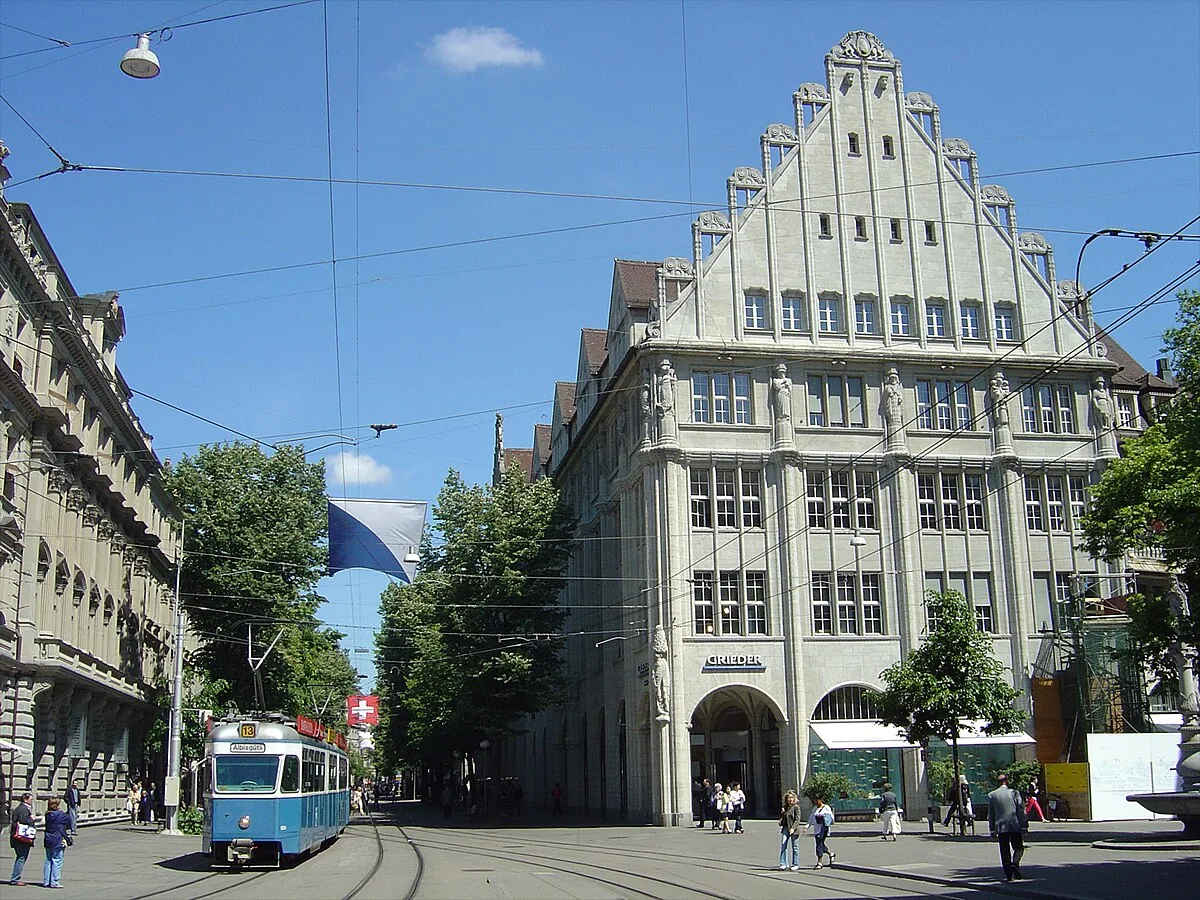
Roughly 40 billion Swiss francs in gold are stored in vaults directly beneath the street's cobblestones, the most expensive pavement in Europe, in every sense.
About Bahnhofstrasse
Bahnhofstrasse did not exist before 1864. The site was a medieval drainage canal, the Fröschengraben, that ran along the western edge of Zürich's fortifications. When the city dismantled its walls and filled the canal as part of a nineteenth-century expansion programme, the resulting boulevard was designed as a commercial and civic statement, wide enough for tram lines, long enough to connect the new station to the lake, and lined with the kind of dressed-stone architecture that growing Swiss commercial wealth was learning to commission. The private banking tradition that defines the street's deeper identity preceded the boulevard itself. Zürich's banks had been managing northern European Protestant money since the Reformation, when religious refugees brought capital with them across the border. The discretion that became a selling point, no names on buildings, entry by appointment, legally enforceable banking secrecy until 2009, was not invented for Bahnhofstrasse but found its most concentrated architectural expression there. The luxury retail layer that now defines the street's surface identity arrived later, driven by the strong franc and the wave of international brand expansion from the 1980s onward. The watch flagships, the jewellers, and the department stores occupy the street's most visible buildings while the banks sit quietly behind unmarked doors two streets over.
What Bahnhofstrasse actually is
Bahnhofstrasse runs 1.4 kilometres from Zürich's main railway station to the shore of Lake Zurich, a straight line of cobblestone and tram rails through one of the most concentrated accumulations of private wealth in Europe. The street is not subtle about what it is: the watch boutiques, the private banks, the jewellers occupying nineteenth-century stone facades do not pretend to be anything other than what the address implies. And yet the street functions as Zürich's spine, the route every resident takes between the lake and the station, walked as casually by people on lunch breaks as by anyone carrying a shopping bag from Bucherer. Below the street itself, roughly 40 billion Swiss francs in gold reserves sit in bank vaults, a fact that the street gives no indication of and that most people walking it do not think about, but which is part of what Bahnhofstrasse actually is.
street was created, 1864
The street was created in 1864 by filling in the Fröschengraben, a medieval canal that had defined the western edge of Zürich's old city. The decision to fill the canal was part of a broader civic modernisation programme; the resulting boulevard was modelled on the Parisian grands boulevards, wide enough for tram lines and promenade, lined with the kind of institutional architecture that nineteenth-century Swiss commercial ambition produced at its most confident. The private banks that made Zurich synonymous with financial discretion began consolidating on and around Bahnhofstrasse in the late nineteenth and early twentieth centuries, their architecture deliberately low-key, no signs larger than legally required, no display windows, entry by appointment. The discretion was commercially calculated: wealth management requires clients to feel that their affairs are private, and the architecture performed that privacy. The street's current retail identity evolved after the Second World War, as Swiss prosperity and the franc's strength made Zürich a destination for European luxury consumption. The flagship boutiques that define its current character arrived from the 1970s onward.
The street's rhythm is set by the trams
The street's rhythm is set by the trams, lines 6, 7, 11, 13, and 17 all run its length, passing every few minutes with the quiet insistence that characterises Zürich's public transit. Pedestrians share the cobblestones with the rails, and the movement of trams and people has a flow that the street's width makes comfortable rather than crowded. The lake end of the street, Bürkliplatz, opens onto a lakeside promenade that extends in both directions, north toward the old city's quays, south toward the Zürichhorn gardens. On the quay itself, the flea market on Saturdays between May and October occupies the full width of the lakeside, drawing both the serious collectors who arrive at 6am and the casual browsers who arrive at noon.
Bahnhofstrasse begins at the exit
Bahnhofstrasse begins at the exit of Zürich Hauptbahnhof, stepping off the train and you are on it. The lake end is a 20-minute walk from the station. Tram lines serve the full length continuously from early morning to midnight. The street itself is free to walk at any hour.
The Experience
The street works best on foot, at the pace of the trams. The window displays change slowly, this is not a street that follows seasonal retail cycles with any urgency, and the quality of the objects on display rewards close looking. The watch complications in the Patek Philippe window are not decorative; they are engineering demonstrations, and understanding what you are looking at requires stopping. The lake end is where the city opens up. Bürkliplatz, the square at the street's terminus, has a wide view across the water to the Zürichhorn on the far shore and the Alps visible to the southeast on clear days. The flower market that operates here on Tuesday and Friday mornings turns the square into something domestic and unhurried, a counterpoint to the financial formality of the street behind it.
Why It Matters
Bahnhofstrasse is not simply a shopping street, it is the physical address of a specific kind of financial capitalism that shaped the twentieth century. Swiss banking secrecy, the neutrality that allowed Zürich's banks to hold assets for both sides during two world wars, the accumulation of private wealth management expertise that made 'Swiss bank account' a global synonym for discretion, all of this has an address, and most of it is on or directly adjacent to this 1.4-kilometre boulevard.
Why Visit
Window-shopping on Bahnhofstrasse is free and genuinely interesting if you approach it as a material culture exercise rather than a retail one. The objects in the windows, the watches, the jewellery, the couture, are made to standards that their prices reflect, and looking at them carefully is a form of education in craft. The street also connects the station to the lake through the most compressed demonstration of Zürich's commercial identity available.
✦ Photo Gallery
Best Season
🌤 The street operates year-round, but the pre-Christmas period from late November through December 23 brings a light installation called Lucy that covers the street's full length in suspended LED orbs, one of the most effective urban light displays in Europe. Summer evenings, when the lake end fills with people on the lakeside promenade, are also excellent.
Quick Facts
Best time to visit
The street operates year-round, but the pre-Christmas period from late November through December 23 brings a light installation called Lucy that covers the street's full length in suspended LED orbs, one of the most effective urban light displays in Europe. Summer evenings, when the lake end fills with people on the lakeside promenade, are also excellent.
Getting there
In Zurich, Switzerland; reach Zurich first, then continue to the site.
What's nearby
Grossmünster, Rhine Falls and Abbey Library of Saint Gall are also in the area.
Location
Zurich, Switzerland
Type
attraction
Coordinates
47.3714°, 8.5387°
Insider Tips
- 1
The shops on Bahnhofstrasse close on Sundays; if you want the street to yourself, Sunday morning is the best time to walk it without the weekday commercial energy.
- 2
Sprüngli at Paradeplatz, the midpoint of the street, is the original location of the company that later became Lindt, the truffles and Luxemburgerli macarons sold here are different products from the supermarket brand and worth the price.
- 3
The Zürich flea market at Bürkliplatz runs on Saturday mornings from May to October and is free to browse; serious pieces, old watches, silverware, early Swiss design, appear regularly among the general items.
- 4
The private banks along Bahnhofstrasse and the adjacent Paradeplatz are identified by small brass plaques rather than signs; locating them all is a discreet form of architectural puzzle for the attentive walker.
- 5
Tram lines 6, 7, 11, 13, and 17 all run the street's length, use them for the return trip from the lake rather than walking back, and observe the street from the tram window at a different pace.