The oldest known painted cycle in the Western world on this scale has survived for twelve centuries in a valley most Swiss people have never visited.
About Benedictine Convent of Saint John
The Val Müstair's first historical mention appears in a document of 805 CE, by which point the convent at its head was already established. Carolingian chroniclers associated the foundation with Charlemagne, and the scale of the fresco commission, covering every interior surface of the church, suggests imperial patronage rather than local resources. The paintings were executed around 800 in a style that blends Byzantine icon tradition with the emerging Carolingian interest in narrative sequence. They tell the Life of Christ from Annunciation to Resurrection on the nave walls, and the Final Judgement in the apse, a programme that functions as both theological teaching and visual display of power. The commission coincided with Charlemagne's coronation as Holy Roman Emperor, and the theological confidence of the programme reflects that political moment. The Reformation reached the valley in the sixteenth century, and the paintings were whitewashed over, a common fate for Catholic imagery in Protestant-influenced regions. The layer preserved what it was meant to destroy. Systematic restoration began in the twentieth century and continues today, with new details emerging from the paint layers as techniques improve.
What Benedictine Convent of Saint John in Switzerland
At the eastern end of Switzerland, in a valley so narrow and remote it was not connected to the national road network until the twentieth century, stands a convent that has been continuously inhabited since the late eighth century. The Benedictine Convent of Saint John in Müstair, in the Val Müstair of Graubünden, holds the finest and most complete cycle of Carolingian frescoes in the world, paintings commissioned around 800 CE, possibly at the order of Charlemagne himself, that cover the interior walls of the convent church with a narrative programme of such ambition that scholars are still working out its full theological meaning. The convent is a UNESCO World Heritage site and still an active religious community. The nuns who live and pray here are the latest in an unbroken line stretching back twelve centuries.
“The convent is a UNESCO World Heritage site and still an active religious community.”
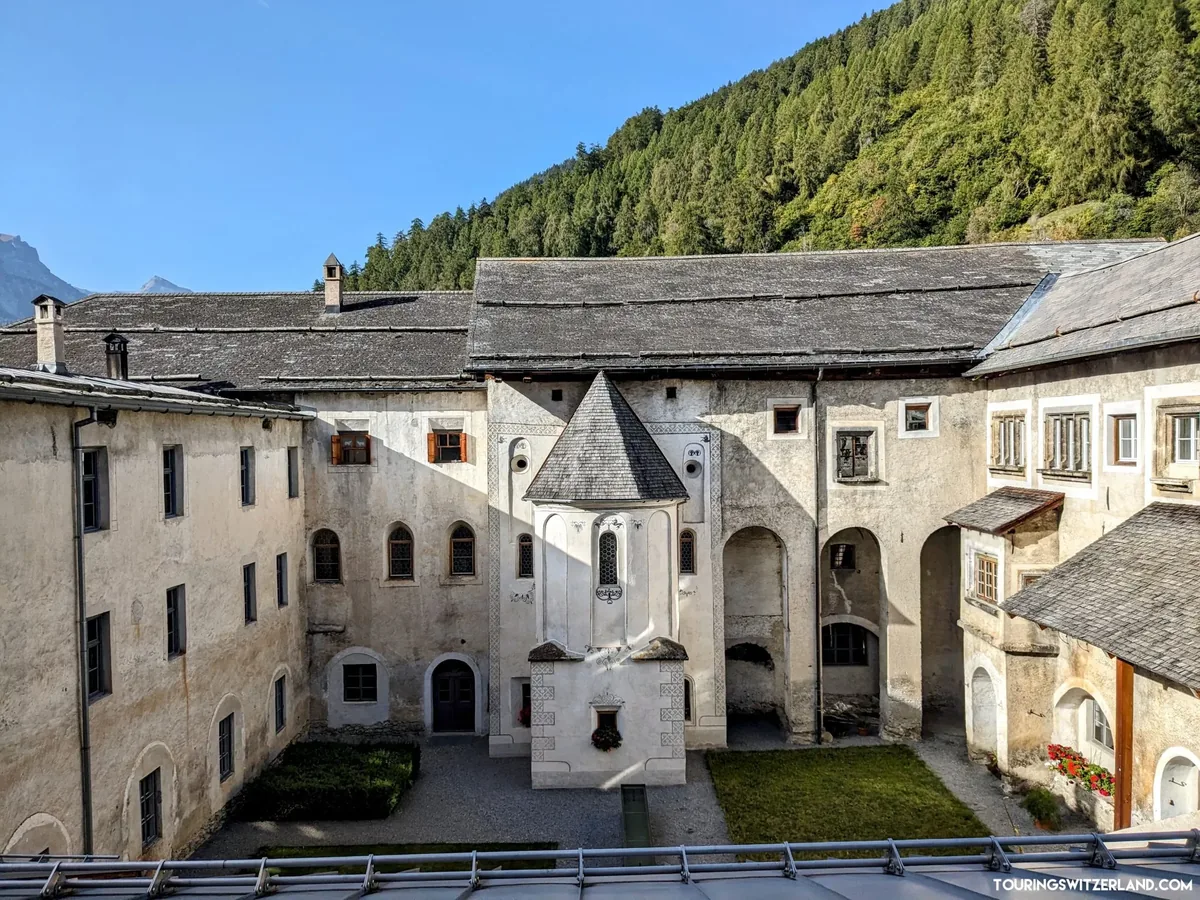
Benedictine Convent of Saint John, Switzerland
according to tradition, 775
Charlemagne founded the convent, according to tradition, in 775, after sheltering in the valley during an Alpine crossing. The story is likely embellished, but archaeological evidence confirms an early Carolingian establishment. The church was frescoed around 800 in a Byzantine-influenced style that reflects the Carolingian Renaissance, the period in which Charlemagne's court deliberately revived classical Roman learning and art as a vehicle for consolidating imperial authority. The frescoes survived the Reformation and subsequent centuries through a combination of geography, the valley's remoteness made it difficult to reach, and the consistent care of the convent community. A layer of whitewash applied in the sixteenth century, which would have been meant as erasure, paradoxically preserved the paintings beneath it. When the whitewash was removed in the twentieth century, the Carolingian colours emerged largely intact.
Entering the convent church, the scale
Entering the convent church, the scale of the fresco programme takes a moment to absorb. Every surface, apse, nave walls, triumphal arch, carries narrative painting. The scenes from the Life of Christ and the Final Judgement unfold with a directness that has no time for decorative flourish; the figures are not beautiful in any conventional sense but they are extraordinarily present. The convent museum, housed in adjacent medieval buildings, displays sculpture recovered from the site, including a significant eighth-century head of Charlemagne, or so it has been identified, carved in limestone, its features worn but still recognisable as a formal portrait. The museum also shows the stratigraphy of the paintings: layers of fresco, whitewash, and restoration laid out in cross-section that make the history of the church's walls legible. Müstair is reached by PostBus from Zernez or from Mals in South Tyrol, Italy, through the Ofenpass. From Zürich by public transport, allow five to six hours. The remoteness is genuine and part of the point. The convent church is open to visitors daily; the museum has seasonal hours. Mass is sung by the community according to the Benedictine Rule and is open to the public.
The Experience
The church interior is small enough that the frescoes are never more than a few metres away. A sense of watched, in a non-threatening way, by the dozens of figures arranged in their narrative sequence around the walls, the apostles in the triumphal arch, Christ ascending in the apse, the damned arranged below the saved with a compositional clarity that leaves no ambiguity about the painter's intent. The quality that separates these paintings from academic art history and makes them viscerally interesting is the lack of idealisation. The faces are individual rather than generic, the emotions legible. The Last Judgement's damned are not stock villains but people who look alarmed, the way a person looks when something they were warned about has actually arrived.
Why It Matters
The Müstair frescoes are the most complete Carolingian pictorial cycle in existence, the primary visual evidence for what Carolingian church art looked like at its moment of highest ambition. Their survival, improbable, accidental, dependent on a layer of whitewash applied with destructive intent, means that the eighth century is readable here in a way it is not anywhere else.
Why Visit
The journey to Müstair is long and the valley is genuinely remote. The frescoes are the reason to make it. No reproduction, and the reproductions are good, conveys the experience of standing in a small church and having twelve centuries of Christian painting pressed against you from every direction. The scale is intimate, which is what makes it overwhelming.
Insider Tips
- 1
The community sings the Liturgy of the Hours at fixed times daily; the schedule is posted at the convent entrance, and attending a sung office adds a dimension to the visit that no museum exhibit can replicate.
- 2
The convent museum ticket includes access to both the church and the adjacent exhibition; buy it at the museum entrance rather than separately at the church door.
- 3
Binoculars are genuinely useful for the upper fresco registers, which are above comfortable reading distance without magnification.
- 4
The village of Müstair itself is small enough to walk in twenty minutes; the old houses and Romansh signage are part of the same cultural landscape as the convent.
- 5
Combine with a visit to the Swiss National Park by staying overnight in Zernez, which positions you for both in a single trip without doubling back.