On New Year's Day 1519, a priest in this church put down the assigned lectionary and started reading the Bible from page one in German, and the Reformation began.
About Grossmünster
The site of the Grossmünster carries a founding legend involving Charlemagne's horse kneeling above a martyr's grave, which is the kind of story that tells you more about how a city wants to understand itself than about what actually happened. Confirmed construction began around 1100 under the direction of the local bishop, and the Romanesque church was consecrated in 1220, a substantial building for a city of Zürich's size at that period. Huldrych Zwingli arrived as people's priest in 1519 and immediately began dismantling the medieval liturgical framework. His method was exegetical, continuous verse-by-verse reading of scripture in the vernacular, and his conclusions were radical: no Mass, no images, no music, no sacramental tradition that lacked direct Biblical warrant. By 1525, Zürich's Reformation was complete. The church's art was stripped, its organ silenced, its walls painted over. The austere space that resulted has remained essentially unchanged. Zwingli died at the Battle of Kappel in 1531, fighting alongside Zürich's Protestant troops. A monument marks the site of his death, 25 kilometres south of the city. The Reformation he launched spread to Calvin in Geneva and from there across the Reformed Protestant world.
What Grossmünster actually is
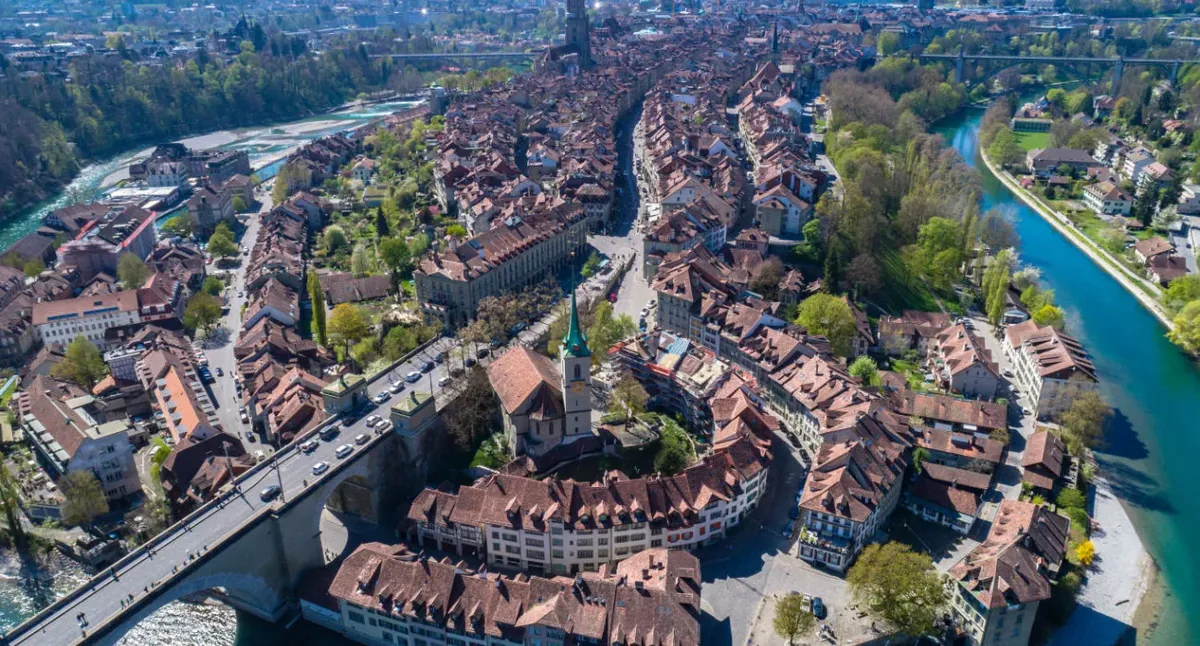
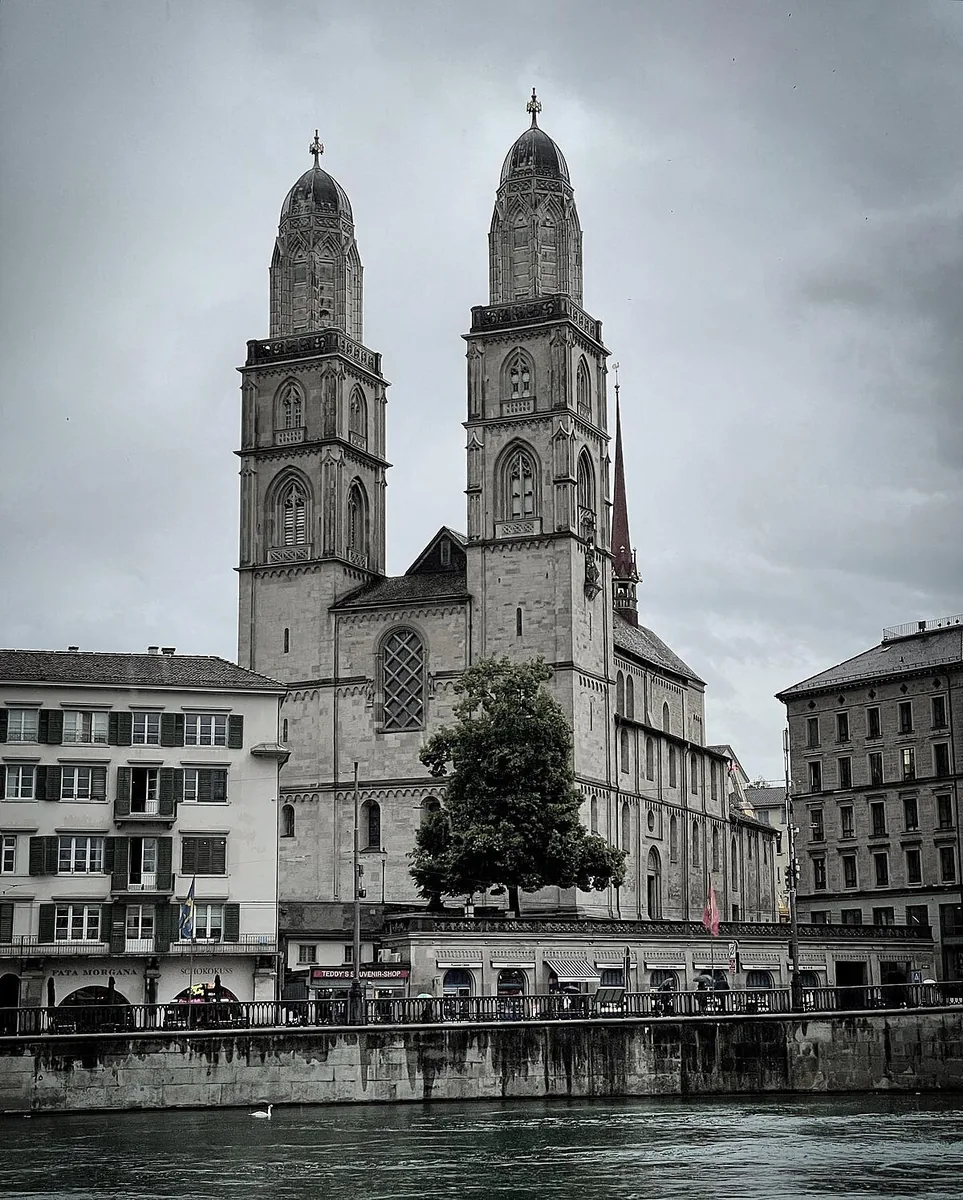
Two square towers rise above Zürich's right bank with the blunt authority of a building that has never needed to be graceful. The Grossmünster, Great Minster, has defined the city's skyline since the twelfth century, its Romanesque bulk anchoring the old town above the Limmat River where the river narrows before emptying into the lake. The church is not large by European cathedral standards, but it carries a weight that goes beyond stone: this is where Huldrych Zwingli stood in January 1519 and began preaching through the Bible from the beginning, verse by verse, in German rather than Latin, setting in motion the Swiss Reformation that would fracture Christianity across the continent. The towers are climbable. From the north tower's viewing platform, the arrangement of Zürich is immediately legible, the river splitting the old city, the lake opening behind it, the Alps on clear days forming a white line across the southern horizon.
“Two square towers rise above Zürich's right bank with the blunt authority of a building that has never needed to be graceful.”
Grossmünster, Switzerland
Charlemagne, according to legend, founded a chapel
Charlemagne, according to legend, founded a chapel on this site after his horse knelt spontaneously above the graves of the martyrs Felix and Regula, patron saints of Zürich. The story is hagiographic, but building activity here is confirmed from the early ninth century, and the current Romanesque structure was begun around 1100 and consecrated in 1220. The decisive event came on 1 January 1519, when Zwingli was appointed people's priest and immediately broke from the liturgical tradition of reading assigned scriptural passages. He started at the beginning of Matthew's Gospel and worked through it systematically. The congregation had never heard the Bible this way, continuous, vernacular, interpreted by a man who took questions after the service. Within three years, Zürich had abolished the Mass. Within a decade, the church's medieval art, altarpieces, and organ had been removed, its walls whitewashed, its stained glass replaced with plain glazing. The stark interior you see today is not poverty, it is a theological position.
The whitewashed nave is enormous and empty
The whitewashed nave is enormous and empty in a way that takes adjustment. Where most historic churches press meaning onto every surface, the Grossmünster offers almost none. The walls are bare, the stone is cold, and the light comes through plain windows at angles that change with the hour. In the crypt beneath the choir, a weathered Carolingian statue of Charlemagne, a copy; the original is in the tower, sits in a niche, watching. The crypt chapel contains windows by Augusto Giacometti, added in 1932, whose colour and warmth form a deliberate contrast to the austerity above. Most people never go down. In the chapter house, windows by Sigmar Polke, installed in 2009, use agate slices as glazing, the mineral veins casting extraordinary amber and rust patterns across the floor in afternoon light.
The Grossmünster stands on the right
The Grossmünster stands on the right bank of the Limmat in Zürich's old town, a ten-minute walk from the main station across the river. Trams 4 and 15 stop at Helmhaus, one minute from the entrance. The church is open daily; tower access requires a small fee and the climb involves 187 steps.
“The Grossmünster stands on the right bank of the Limmat in Zürich's old town, a ten-minute walk from the main station across the river.”
The Experience
The whitewashed interior reads as severity until you sit in it for ten minutes, at which point it begins to feel like clarity. The absence of accumulated devotional objects, the layers of candles, votive offerings, altarpieces, memorial plaques that fill most old churches, means the architecture is unmediated. The proportions of the nave are Romanesque and correct. The Polke agate windows in the chapter house are the detail most visitors walk past. Installed in 2009 in stone frames that date to the twelfth century, each panel is a slice of Brazilian agate, its natural banding and mineral inclusions transmitting light in amber, rust, and cream. In afternoon sun, the floor beneath them glows.
Why It Matters
The Grossmünster is the ground zero of Reformed Protestantism, the church from which Zwingli's theology spread to Geneva, to the Netherlands, to Scotland, and eventually to the English Puritan tradition that shaped American religious culture. The theological decisions made here in the 1520s still organise how roughly 800 million people worship. The building itself, stripped of ornament by those same decisions, is the most visible architectural consequence of Zwingli's theology.
Why Visit
Zürich has better-looking churches. The Grossmünster is not about beauty, it is about understanding why this particular city, in this particular decade, changed the shape of Western Christianity. The empty whitewashed walls are the argument. Knowing what used to be there and what was deliberately removed makes the austerity eloquent rather than cold.
Insider Tips
- 1
The Polke agate windows are in the chapter house, accessed from inside the church via a door on the south side, easily missed without the guidemap available free at the entrance.
- 2
Tower access requires 187 steps with no lift; the climb takes about 15 minutes and the platform is narrow but the view of Zürich from above the Limmat is the best available from any publicly accessible point.
- 3
The Carolingian-period statue of Charlemagne in the crypt is a copy; the original, better preserved, is in the south tower and accessible on the tower climb.
- 4
The Fraumünster church directly opposite on the left bank of the Limmat has Chagall windows that the Grossmünster explicitly lacks, visiting both in sequence makes the Reformation aesthetic contrast vivid.
- 5
Sunday services are held at 10am and are open to non-members; the spoken liturgy in Swiss German is the direct descendant of Zwingli's vernacular practice.