“An entire city was rebuilt after a fire in 1794 with streets designed specifically to give watchmakers the right quality of northern light, and that city went on to define precision timekeeping for two centuries.”
About International Museum of Horology
Watchmaking in the Swiss Jura traces its organised beginnings to the late seventeenth century, when the craft spread through the mountain valleys as a winter trade for farming communities whose fields were snow-covered for five months a year. The work required no heavy equipment, could be done at home, and produced objects small enough to carry to markets in Geneva and Lyon. Within a century, the Jura valleys had developed a sophisticated division of labour, different families specialising in cases, movements, balance wheels, jewels, that anticipated industrial mass production by decades. La Chaux-de-Fonds burned to the ground in 1794. The rebuilt city was planned by architect René Morel on a strict grid, with building regulations that specified window sizes and orientations to provide consistent natural light for precision work. This planning decision gave the city a systematic advantage in watchmaking that it maintained for more than a century. The twentieth century brought the quartz crisis of the 1970s, when Japanese electronic watches destroyed the market for Swiss mechanical movements. The response, a deliberate repositioning of Swiss watches as luxury objects rather than functional timekeepers, is one of the more successful industrial pivot stories of the modern era.
La Chaux-de-Fonds in the Jura mountains of canton
La Chaux-de-Fonds in the Jura mountains of canton Neuchâtel is the watchmaking capital of the world, and the International Museum of Horology is its deepest argument for why that distinction matters. The city itself was rebuilt after a fire in 1794 on a grid plan designed specifically to optimise watchmaking, long, north-south streets providing consistent diffused northern light to the workshops. UNESCO listed both La Chaux-de-Fonds and the neighbouring town of Le Locle in 2009 as outstanding examples of mono-industrial urban planning, the only cities in the world whose entire layout was determined by a single craft. The museum houses 4,500 timepieces, from Egyptian water clocks to twenty-first-century complications, and presents them not as decorative objects but as mechanical arguments about how human beings have understood and subdivided time.
La Chaux-de-Fonds in the Jura mountains of canton Neuchâtel is the watchmaking capital of the world, and the International Museum of Horology is its deepest argument for why that distinction matters.
Watchmaking arrived in the Jura
Watchmaking arrived in the Jura in the seventeenth century, partly by accident. Daniel JeanRichard, a blacksmith's apprentice in Le Locle, reportedly repaired a pocket watch brought to the region by an English merchant around 1679 and taught himself the mechanism well enough to begin making his own. Whether or not this origin story is precisely accurate, it captures something true: Swiss watchmaking grew from craft transmission rather than industrial top-down organisation, each artisan training the next, the skills moving through families and neighbourhoods over generations. By the nineteenth century, La Chaux-de-Fonds had become the densest concentration of horological expertise on earth. The city produced Charles-Édouard Jeanneret, better known as Le Corbusier, who trained as an engraver of watch cases before becoming the century's most influential architect, and Louis Chevrolet, whose family ran a watchmaking workshop before he emigrated to race cars in America.
The museum's permanent collection is arranged
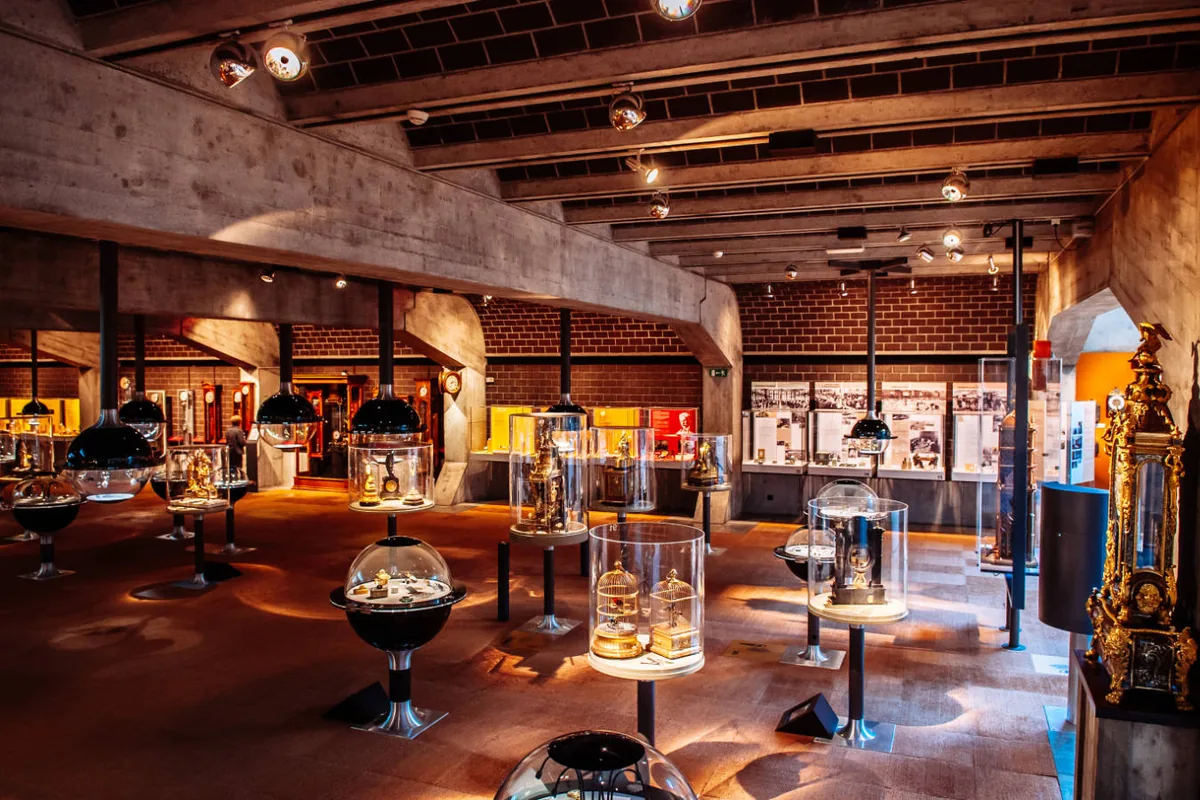
The museum's permanent collection is arranged chronologically, from sundials and water clocks through mechanical escapements to the electronic and quartz revolutions. The density of objects is deliberate, this is a collection built for people who want to understand the mechanisms, not merely admire the cases. The exploded cutaway displays showing escapement geometry are among the clearest mechanical explanations available anywhere. The carillon clock tower outside the museum performs on the hour, its bells striking a sequence that can be heard across the neighbourhood. Inside, the automation room, clocks, watches, and music boxes with animated figures, occupies a section that could easily absorb an hour on its own. The mechanical musicians, shepherdesses, and acrobats that eighteenth-century watchmakers built for aristocratic entertainment are here in quantity, their movements demonstrating a level of miniaturisation that the period's best engineering produced.
La Chaux-de-Fonds is connected
La Chaux-de-Fonds is connected to Neuchâtel by direct train in 35 minutes and to Bern in about 75 minutes. The museum is a 15-minute walk from the train station along the main grid street. Opening hours are Tuesday through Sunday year-round. The city's grid layout means it is entirely walkable, and a combined visit to the museum and the Le Corbusier birthplace on rue de la Serre takes a comfortable half day.
La Chaux-de-Fonds is connected to Neuchâtel by direct train in 35 minutes and to Bern in about 75 minutes.
The Experience
The museum's ground floor announces its intentions with a water clock in a glass case, dripping at a regulated pace that measured time for Egyptian priests four thousand years before the first escapement. The journey from there to the tourbillon complications in the final gallery covers, in physical space, twenty metres and, in human ingenuity, three millennia. The automation room tends to detain visitors longer than any other section. The eighteenth-century automated figures, a silver duck that appears to eat grain and digest it, a writing boy that can be programmed to spell different sentences, a flute player with articulated lips and fingers, are outright extraordinary. They were the smartwatch demonstrations of their era, the objects through which watchmakers proved what their craft could do at maximum ambition.
Why It Matters
The International Museum of Horology is the primary repository for the history of mechanical timekeeping, an industry that produced not only watches and clocks but the precision manufacturing techniques that made the Industrial Revolution possible. The skills required to cut a watch escapement to tolerances of a few microns in the eighteenth century were directly transferred to the manufacture of scientific instruments, firearms, and eventually machine tools. The museum presents this lineage clearly.
Why Visit
The relationship between Switzerland and precision timekeeping is well-known but rarely explained with any depth. The museum does the explanation. After two hours here, you understand why the Swiss Jura produced this industry, what it required of its craftspeople, and why the quartz crisis of the 1970s was an existential rather than merely economic threat. The 4,500 objects are the evidence; the argument they make is genuinely interesting.
✦ Insider Tips
- 1
The carillon clock tower outside the museum performs on the hour, position yourself in the street below rather than inside the museum to appreciate the full sound.
- 2
The automation room requires patience with the demonstration schedule; the major pieces perform on a timer every 15-20 minutes, and arriving mid-cycle means a wait worth taking.
- 3
Le Corbusier's birthplace on rue de la Serre is 10 minutes' walk from the museum and open to visitors; the combination of the two gives a complete picture of what La Chaux-de-Fonds produced beyond watchmaking.
- 4
The museum shop carries precision-printed publications on the history of Swiss horology that are not available outside specialist bookshops.
- 5
Allow three hours minimum if you intend to read the mechanism explanations, the cutaway displays repay close attention and cannot be absorbed quickly.