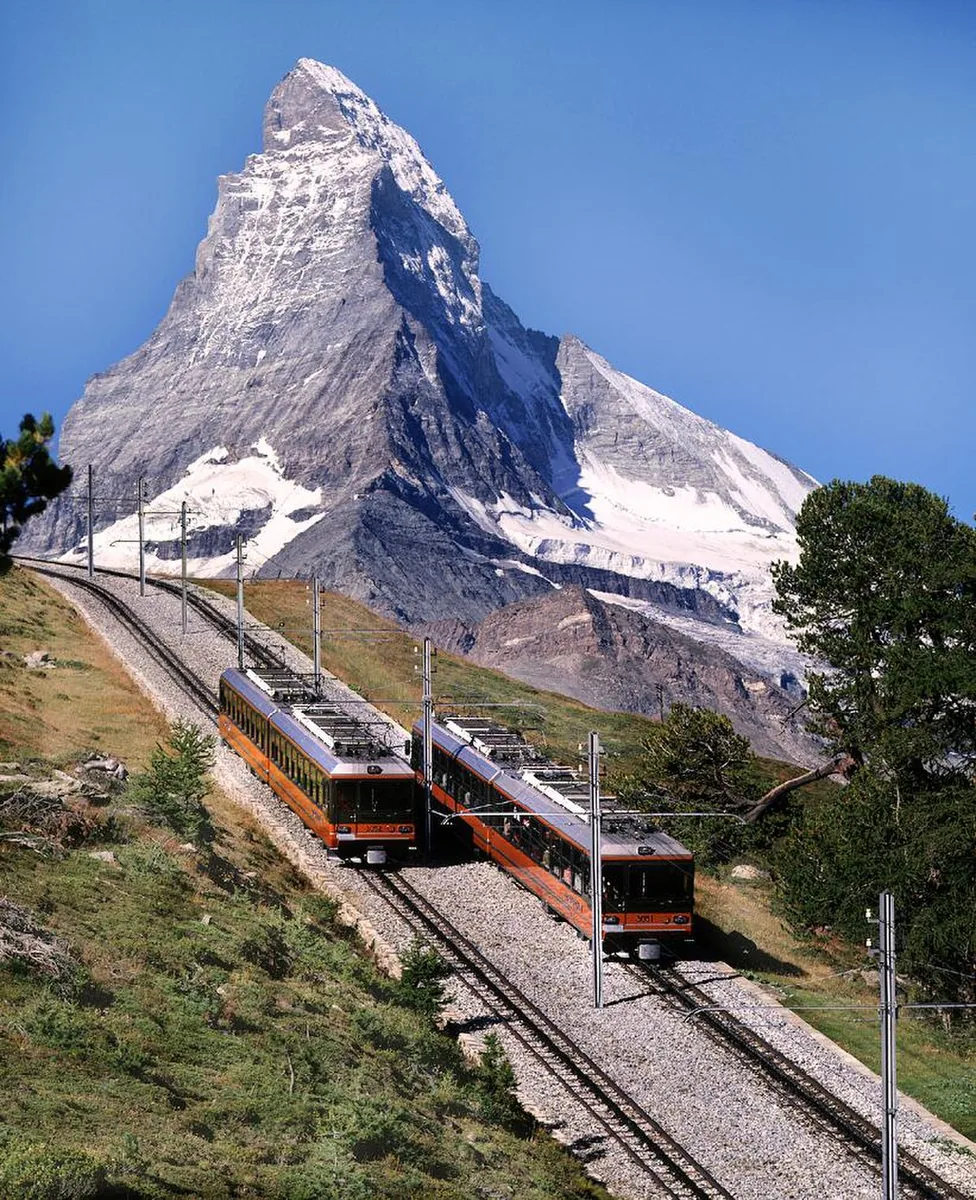
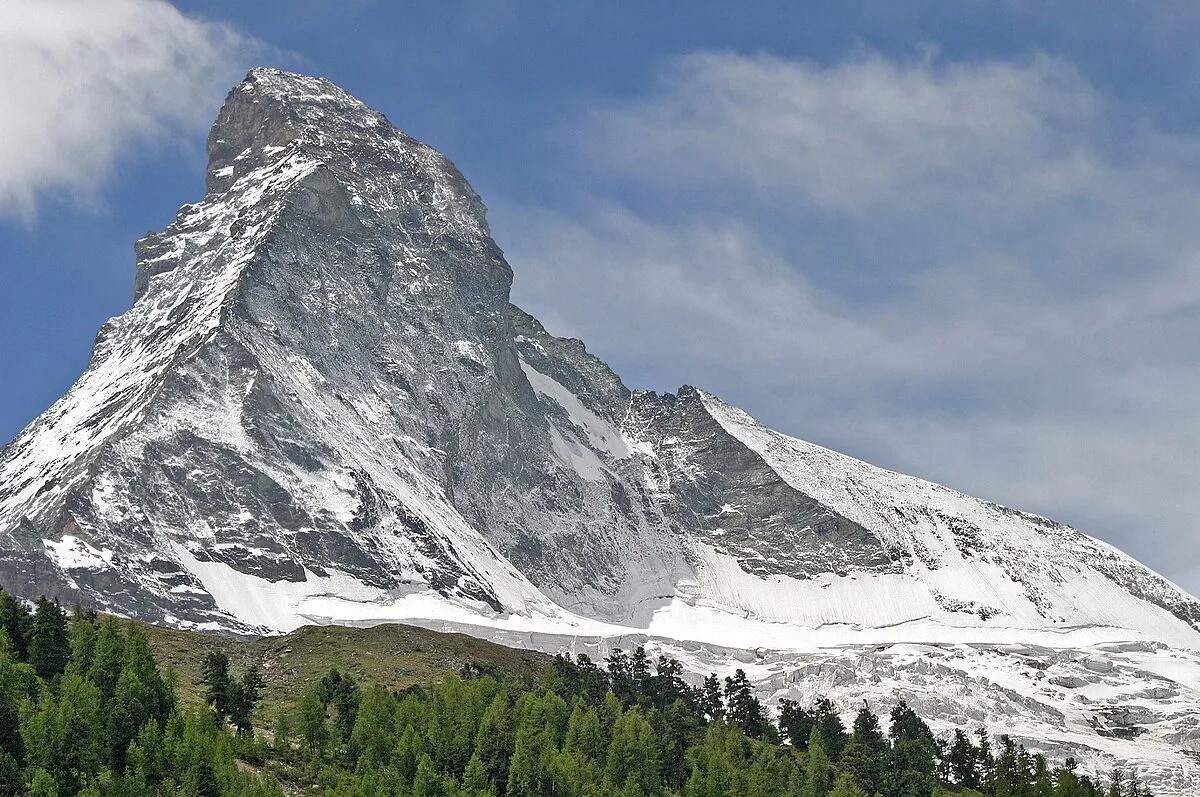
Boring a 7-kilometre tunnel through the Eiger and Mönch took sixteen years, thirty workers' lives, and the determination of a textile manufacturer who had never built a railway before.
About Jungfraujoch
Adolf Guyer-Zeller sketched the railway plan on a piece of paper during a walk near Grindelwald in 1893, reportedly after watching the crowds queuing for views of the Jungfrau from the valley below. His proposal, to cut a tunnel through the Eiger and Mönch and emerge at the saddle between them at 3,454 metres, was submitted to Swiss authorities in 1894 and approved in 1895 despite widespread scepticism from the engineering establishment. Construction began in 1896 at the Eiger's base and advanced upward through volcanic rock and compressed snow using compressed air drills and blasting powder. Intermediate stations were blasted into the cliff face to allow passenger viewing during construction, and two of those stations, Eigerwand and Eismeer, remain open today as windows cut directly into the north face of the Eiger and the glacier face of the Mönch. Guyer-Zeller died in 1899, before the project was complete, and the railway opened to its first passengers in 1912. The Sphinx Observatory, added in 1937 on the ridge above the station, has provided continuous high-altitude atmospheric data ever since, one of the longest unbroken climate records in the Alps.
What Jungfraujoch actually is
At 3,454 metres above sea level, the Jungfraujoch station sits in a saddle between the Jungfrau and Mönch peaks in the Bernese Oberland, making it the highest railway station in Europe. The journey to reach it, by rack railway from Grindelwald or Lauterbrunnen, through a tunnel bored directly through the Eiger, is itself one of the engineering achievements of the twentieth century, and the view from the top justifies every superlative the Swiss tourism industry has applied to it. The Aletsch Glacier, Europe's largest, begins here and runs 23 kilometres southward into the Rhône valley, a river of ice moving at roughly 200 metres per year. The station complex at the top includes the Sphinx Observatory, a meteorological and astronomical research station that has been operating since 1937, and a network of tunnels cut into the ridge that connect the station to platforms facing both north and south. In summer, 5,000 visitors arrive daily. The mountain does not care.
“At 3,454 metres above sea level, the Jungfraujoch station sits in a saddle between the Jungfrau and Mönch peaks in the Bernese Oberland, making it the highest railway station in Europe.”
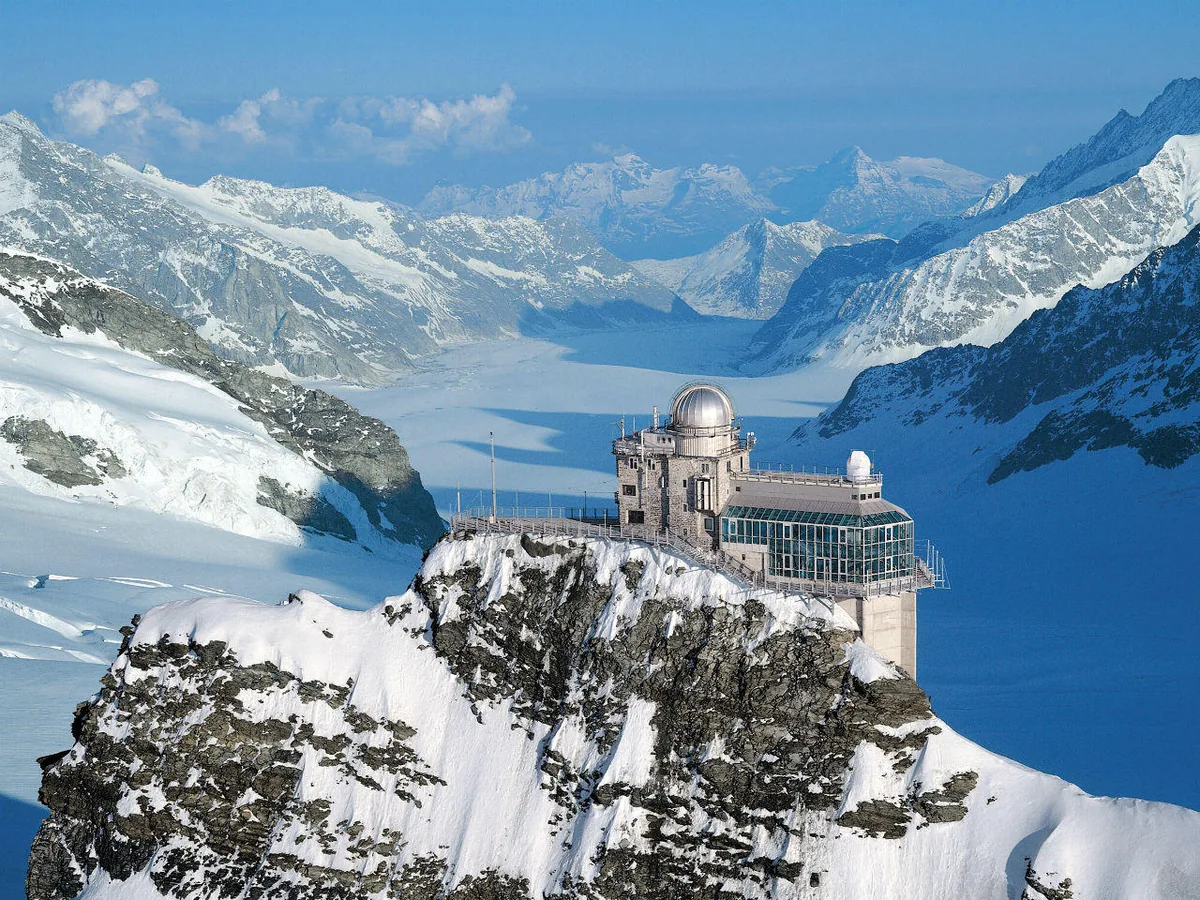
Jungfraujoch, Switzerland
proposed the railway, 1894
Adolf Guyer-Zeller, a Zürich textile magnate, proposed the railway in 1894, drawing derision from engineers who considered boring a 7-kilometre tunnel through two major Alpine peaks an impossible project. Construction began in 1896 and took sixteen years, proceeding through basalt and ice with hand tools and early explosives. At least thirty workers died during the build. The line opened to the public in 1912, the same year the Titanic sank, and received rather less attention as a result. The railway's original terminus was planned for the Jungfrau summit itself at 4,158 metres. The First World War halted construction at the Jungfraujoch saddle in 1912, and the terminus was never extended further. The saddle station became the destination by default, a compromise that has worked out rather well.
The altitude announces itself immediately.
The altitude announces itself immediately. At the top, the air holds roughly 40% less oxygen than at sea level, and the effect, a mild headache, slight shortness of breath, a general sense of moving a degree more slowly than usual, arrives before you have taken twenty steps from the platform. Almost all visitors adjust within thirty minutes; a small number do not and take the next train down. The view from the Sphinx terrace, accessed by elevator from within the tunnel complex, is the clearest possible demonstration of what a glacier actually is. The Aletsch fills the valley below completely, a grey-white mass of compacted snow visibly striated with the annual layers of its accumulation, the far shore of mountains across the glacier close enough to feel reachable and far enough to feel impossible. In clear weather the view extends to the Black Forest in Germany and the Vosges in France. The standard route ascends by cogwheel railway from Kleine Scheidegg, itself reached from Grindelwald or Lauterbrunnen by separate rack railway. From Interlaken Ost, allow approximately two hours each way. The Jungfrau Railway operates year-round, though fog and cloud make the summit invisible on many days, check the live webcam at the summit before committing to the journey. An Early Bird ticket departing before 8am offers a significant price reduction.
The Experience
The change from the valley to the summit happens gradually enough that the altitude catches you by surprise. The cogwheel grind of the railway becomes background noise; the windows of the tunnel stations cut dramatic rectangles of ice and sky into the dark. When you emerge at the top, the brightness is total, the sun at this elevation is unfiltered by the atmospheric haze that softens it in the lowlands. The Sphinx terrace faces south over the Aletsch, and the scale of the glacier is the thing that most people are unprepared for. Photographs show a white valley; the reality is a moving mass of ice 900 metres thick at its deepest point, flowing toward you at a speed you can calculate but cannot perceive. On clear days the silence is absolute except for the wind off the glacier face.
Why It Matters
The Jungfraujoch railway is the engineering capstone of the Belle Époque Alpine tourism boom, the proof that no landscape was too extreme for Swiss infrastructure. Beyond tourism, the Sphinx Observatory has contributed continuous climate and meteorological data since 1937, providing one of the longest unbroken high-altitude weather records in the world, data that has become critical to understanding glacial retreat and atmospheric change.
Why Visit
The Aletsch Glacier is one of the last large glaciers in the Alps not yet in dramatic retreat, and the Jungfraujoch is the single vantage point from which its full scale is visible. It has lost significant volume since measurements began and will continue to shrink. Visiting now and seeing it at current size is not morbid tourism; it is bearing witness to something extraordinary while it remains at something approaching its historic scale.
Insider Tips
- 1
Check the Jungfraujoch live webcam the morning you plan to travel, cloud sits over the summit more than half the days in summer and the journey is pointless in zero visibility.
- 2
The Early Bird discount ticket requires departure from Interlaken Ost before 8am and saves roughly 30% on the standard price.
- 3
The intermediate Eigerwand station, where a window cut into the Eiger's north face gives a view of the rockface 2,800 metres above the valley, is inside the tunnel, most passengers stay seated and miss it.
- 4
Altitude sickness affects a proportion of visitors; if you have a history of sensitivity, take 30 minutes at the intermediate Eismeer station before proceeding to the top.
- 5
The Lindt chocolate shop at the summit charges identical prices to valley shops, the novelty of buying chocolate at 3,454 metres does not come with a markup.