Every April, several thousand people stand in a cobblestone square and vote on their laws by raising their hands, exactly as their ancestors have done since 1378.
About Landsgemeindeplatz
The Landsgemeinde of Appenzell Innerrhoden is the oldest continuously operating direct democracy of its kind in the world. The practice is documented from 1378, though its origins likely predate written records. The form was common across the Swiss forest cantons in the medieval period, a practical solution to governance in communities too small and too dispersed for a permanent representative body, and too egalitarian (among the male landowning population) to accept purely delegated authority. Most cantons abandoned the Landsgemeinde during the nineteenth century as populations grew and representative democracy became the more practical option. Appenzell Innerrhoden retained it partly by choice and partly because its small population, around 16,000 eligible voters, makes the outdoor assembly physically manageable in a way that no larger canton could sustain. The canton's refusal to extend voting rights to women became an international embarrassment during the latter half of the twentieth century, when Switzerland, itself among the last European democracies to grant female suffrage at the federal level, doing so only in 1971, pressed its cantons to follow. Appenzell Innerrhoden voted no repeatedly until the Federal Supreme Court intervened in 1990, ruling the exclusion unconstitutional. The first Landsgemeinde at which women voted was held in April 1991.
What Landsgemeindeplatz actually is
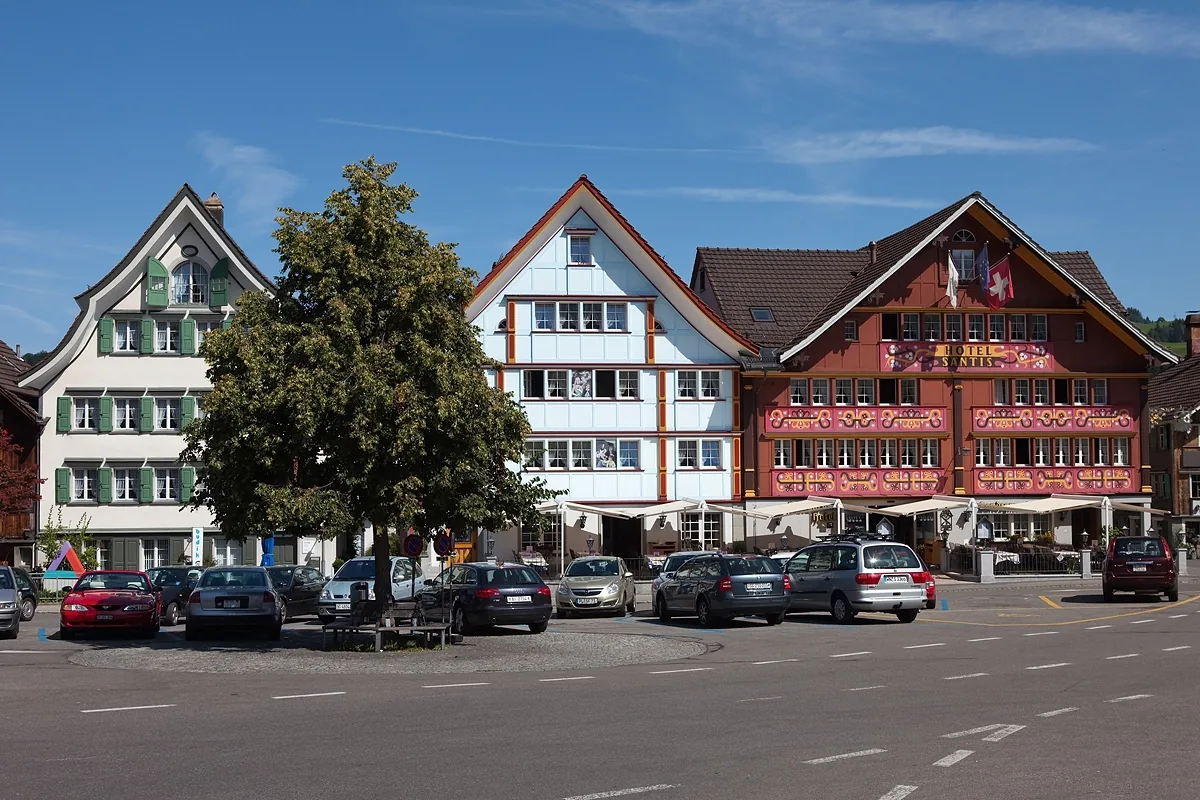
On the last Sunday of April each year, the citizens of Appenzell Innerrhoden gather in an open square in the centre of their small cantonal capital and vote on their laws by raising their hands. The Landsgemeinde, the open-air cantonal assembly, is one of the oldest functioning forms of direct democracy in the world, a practice that has continued in Appenzell Innerrhoden without interruption since the fourteenth century. The square where this happens, the Landsgemeindeplatz, is an unremarkable cobblestone space for the other 364 days of the year, ringed by painted wooden houses and a parish church, with a stone-paved ring in its centre that marks where the voting citizens stand. That ring is the thing worth seeing even when the assembly is not in session. Standing inside it, you understand the mechanics of the oldest democracy you are ever likely to encounter in person.
The Landsgemeinde tradition in the Inner
The Landsgemeinde tradition in the Inner Rhodes of Appenzell dates to at least 1378, when documentary records confirm the practice of annual outdoor assemblies for communal decision-making. The form has changed remarkably little: eligible citizens gather, business is introduced by the Landammann (the cantonal governor), proposals are debated briefly, and votes are taken by the raised right hand, the traditional gesture that also served, in earlier centuries, as proof that the voter was carrying a sword and thus a legitimate citizen. Women were excluded from participation until 1990, not through choice but through a Federal Supreme Court ruling that forced Appenzell Innerrhoden to extend voting rights after the canton had refused to do so voluntarily. The canton was the last in Switzerland to grant women's suffrage, making 1990 the moment Appenzell Innerrhoden's medieval democratic tradition and the twentieth century finally negotiated terms. The neighbouring half-canton of Appenzell Ausserrhoden abolished its Landsgemeinde in 1997, finding it impractical. Innerrhoden has kept it. The annual assembly draws participants from across Switzerland and international observers who want to see a democratic form that most of the world abandoned centuries ago.
Visiting outside the assembly is an exercise
Visiting outside the assembly is an exercise in reading a space that most of the year operates entirely without explanation. The painted houses around the square date from the seventeenth and eighteenth centuries, their facades covered in the distinctive Appenzell style, pastel tones, arched windows, decorative shutters. The parish church of Saint Mauritius anchors the north side. The ring in the pavement at the square's centre marks the boundary within which citizens stand during the vote. On assembly day in late April, the square fills with several thousand people in varying degrees of traditional dress, the cantonal functionaries in formal regalia at the central podium, the crowd arranged in concentric rings outward. The vote itself, on constitutional amendments, budget matters, cantonal elections, lasts several hours and is conducted with a seriousness that the informal setting makes more, not less, impressive.
Appenzell village is reached
Appenzell village is reached by train from St. Gallen in about 45 minutes via Gossau. From Zürich, allow roughly 90 minutes with one change. The village is small enough to cover entirely on foot; the Landsgemeindeplatz is in the centre, a five-minute walk from the station. The Appenzell Museum on the square documents the Landsgemeinde tradition and opens Tuesday through Sunday.
The Experience
The square in ordinary time has a pleasant emptiness, the painted facades, the church, the café tables along one edge, the cobblestone surface, that gives no hint of what it becomes one day a year. The stone ring in the pavement is the only permanent record of the assembly's mechanics, and standing inside it requires a specific act of imagination to populate with several thousand people. On assembly day, the transformation is total and surprisingly affecting. The crowd is not a performance, these are voters making binding decisions about their canton, and the raised hands are counted carefully by officials who move through the crowd with practiced attention. The procedure is the point. Democracy as a physical act, conducted outdoors, in the open, where every participant can see every other participant, has a quality of accountability that no ballot box replicates.
Why It Matters
The Landsgemeindeplatz in Appenzell represents the continuity of a democratic practice that most of Western Europe abandoned during the medieval period. Its survival into the twenty-first century, functioning, binding, attended by the full eligible citizenry, is simultaneously an anachronism and a reminder that the distance between a citizen and their government can be measured in square metres. The 1990 extension of women's suffrage connects the medieval form to the modern world in a way that is both incomplete and important.
Why Visit
Most of what we call democracy is mediated, by representatives, by ballots, by institutions that operate at a remove from the citizenry. The Landsgemeinde in Appenzell is democracy conducted in the open air, with a show of hands, in a space where every voter is physically present. For those who find this inspiring or unsettling probably depends on your assumptions about how governance should work. Either response is worth the journey.
✦ Photo Gallery
Best Season
🌤 The Landsgemeinde takes place on the last Sunday of April, which is the primary reason to visit. Check the exact date each year as it varies. The village is worth visiting outside assembly season for its Appenzell architecture, the Appenzell Museum, and the surrounding Alpstein hiking region, but arriving on assembly Sunday is the experience that justifies the trip.
Quick Facts
Best time to visit
The Landsgemeinde takes place on the last Sunday of April, which is the primary reason to visit. Check the exact date each year as it varies. The village is worth visiting outside assembly season for its Appenzell architecture, the Appenzell Museum, and the surrounding Alpstein hiking region, but arriving on assembly Sunday is the experience that justifies the trip.
Getting there
In Appenzell, Switzerland; reach Appenzell first, then continue to the site.
Location
Appenzell, Switzerland
Type
attraction
Insider Tips
- 1
The Landsgemeinde date is announced by the cantonal government in January; confirm the exact Sunday before booking travel as it shifts within the final week of April.
- 2
Arrive by 9am on assembly day, the formal proceedings begin at around 10am and the square fills quickly; late arrivals stand at the perimeter.
- 3
The Appenzell Museum on the square provides the best English-language context on the Landsgemeinde tradition and opens before and after the assembly on the day itself.
- 4
Appenzell village is also the centre of the Alpstein hiking region; combining the assembly with a day on the Hoher Kasten or Ebenalp ridgeline makes the journey from Zürich worthwhile for two separate reasons.
- 5
Traditional Appenzeller Biber, a honey-almond pastry stamped with a bear, is made by several local bakeries in the village and is the genuine local product, distinct from the mass-produced version sold elsewhere in Switzerland.