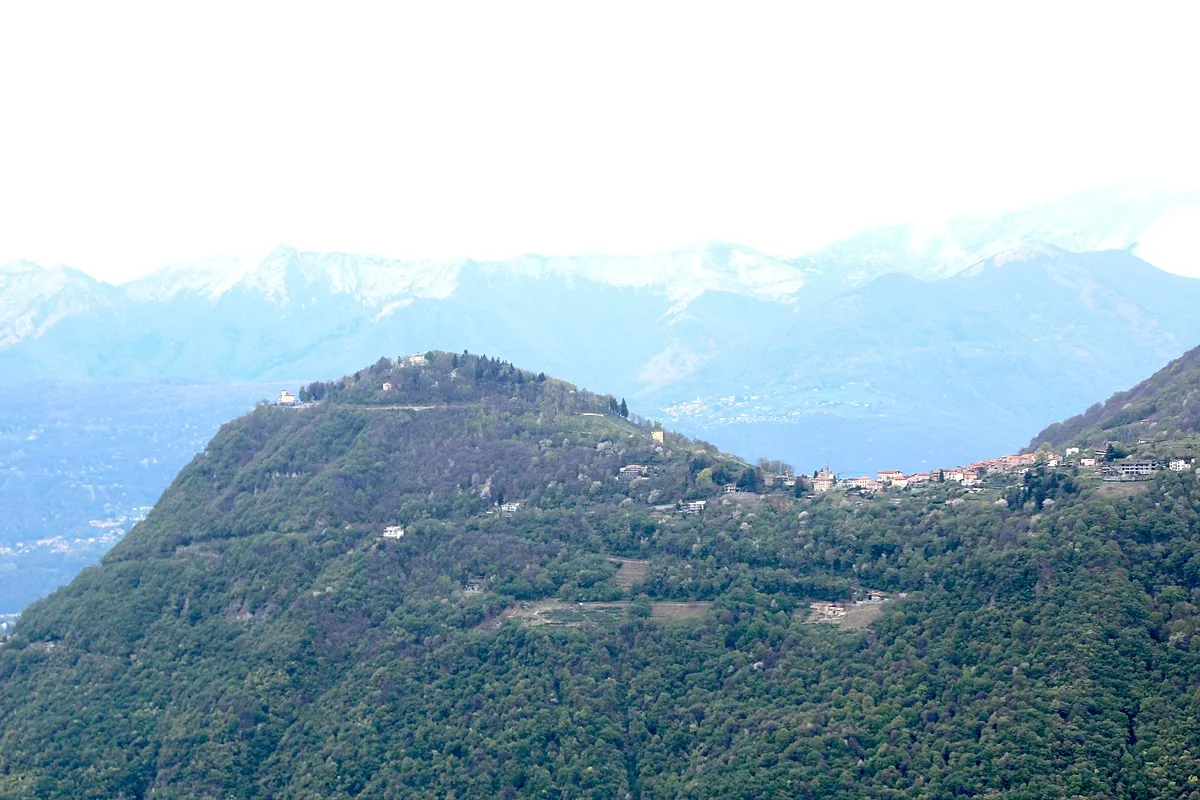
On the clearest autumn days, the summit of Monte Brè gives a sightline of 150 kilometres to the Bernese Alps, standing between Switzerland's German north and Italian south simultaneously.
About Monte Bré
Ticino joined the Swiss Confederation in 1803, but its cultural orientation had always faced south toward Lombardy rather than north toward the German-speaking cantons. The canton's history under Milanese and later Spanish domination shaped its architecture, its cuisine, and its relationship to the mountains, which were barriers to be managed rather than landscapes to be celebrated. The Monte Brè funicular opened in 1912 at a moment when the lakeside resort towns of Lugano, Locarno, and Ascona were establishing themselves as destinations for northern European visitors seeking warmth and Italian colour without the need to cross into Italy. The funicular made the mountain accessible as a day excursion and brought Brè village, previously a farming community known only to locals, into the tourist map. Hermann Hesse settled in Montagnola, 10 kilometres from Lugano, in 1919 after a personal crisis and spent the rest of his life in Ticino, producing watercolours of the lake and mountain landscape alongside his fiction. His presence, and that of other Central European artists who followed, gave the region a cultural layer that distinguishes it from purely resort destinations.
What Monte Brè actually is
Monte Brè rises 925 metres above Lugano in the Italian-speaking canton of Ticino, its summit reached by one of the steepest funiculars in Switzerland. What makes it worth the ascent is not the altitude but the transition: from the lakeside city of palm trees and Milanese fashion to the high stone village of Brè, where It smells of pine resin and the views extend over the full length of Lake Lugano in both directions, the water shifting between deep green and silver depending on the cloud cover overhead. Ticino is Switzerland's southern exception, a canton that speaks Italian, cooks Italian, and whose landscape is Mediterranean rather than Alpine. Monte Brè is the clearest vantage point from which to understand the peculiarity of that position: from the summit, seeing the Swiss Alps to the north and the Italian lowlands dissolving toward Milan in the south, and Lugano sitting between them like a translation.
Brè funicular opened, 1912
The Monte Brè funicular opened in 1912, connecting the Cassarate neighbourhood of Lugano to the village of Brè in a single steep run. The village itself predates the funicular by centuries, a farming community that survived at altitude by terrace agriculture and the trade road to the mountain pass. The arrival of the funicular transformed it into a leisure destination, and the artists and writers who began visiting from Lugano brought a bohemian reputation that the village has never quite lost. The painter Hermann Hesse, a Nobel laureate better known for his novels, painted extensively in the Ticino landscape from 1919 until his death in 1962, and the light quality around Monte Brè and Lake Lugano is visible in the watercolour palette he developed during those decades. Brè village maintains a small collection of reproductions in the local church.
The funicular ride takes about twenty minutes
The funicular ride takes about twenty minutes and passes through thick chestnut and beech forest before emerging onto the open summit meadows. The village of Brè at the top is a collection of grey stone houses along a single lane, with a church, two restaurants, and a terrace that faces south over the lake. In late afternoon, when the light comes from behind the Alps and strikes the water at a low angle, the lake turns the colour of old pewter, and the mountains on the far shore, Italian territory, visible in detail, take on a depth that daylight flattens. The summit above the village, a further 20-minute walk on a marked path, gives a 360-degree view that adds the northern Alps to the southern panorama. On exceptionally clear days, which occur most often in late autumn after the first cold fronts push the summer haze south, the Bernese Alps are visible, more than 150 kilometres distant.
The Monte Brè funicular departs from Cassarate
The Monte Brè funicular departs from Cassarate, a fifteen-minute walk or short bus ride from Lugano's central Piazza della Riforma. Lugano is connected to Zürich by direct train in about two hours and forty minutes, and to Milan by train in about an hour. The funicular operates year-round with seasonal schedule variations; check departure times in advance as service is not continuous.
The Experience
The funicular's upper section is steep enough to produce a visceral sensation of ascent, the car tilts at an angle that makes standing feel precarious, and the chestnut canopy closes over the track before giving way to open sky at the top. You step out into a temperature several degrees cooler than Lugano and a quiet that the city does not offer. The restaurant terrace at Brè faces south over the lake, and the afternoon light there in September is the specific, amber quality that painters have been trying to capture in this region for a century. The stone village behind the terrace operates entirely at its own pace, with vegetable gardens running up to house walls and cats sleeping on warm window ledges. The separation from Lugano below feels greater than the twenty minutes of funicular travel suggests.
Why It Matters
Monte Brè represents something particular in the Swiss landscape: the point at which the country's northern European identity encounters its southern Mediterranean one. The canton of Ticino is genuinely bilingual in character rather than by administrative designation, and the mountain above Lugano makes that duality physically visible. The view from the summit, Alps behind, Po Valley ahead, is a geographical argument about where Switzerland ends and Italy begins.
Why Visit
Lugano's lakeside is pleasant but not unusual for this part of Europe. Monte Brè earns a separate visit because the village at the top operates differently from the resort below, and the summit view resolves the landscape into something you can understand spatially rather than just admire. The funicular itself is worth taking for the engineering alone, one of the steepest in a country that builds them as a matter of course.
✦ Photo Gallery
Best Season
🌤 Late September through October delivers the best visibility from the summit, as the summer haze clears and the chestnut forest on the slopes turns gold. May is also excellent for the flowering meadows around the summit and the cooler walking temperatures. Avoid August for the funicular, when queues from Lugano's tourist peak extend the journey time considerably.
Quick Facts
Best time to visit
Late September through October delivers the best visibility from the summit, as the summer haze clears and the chestnut forest on the slopes turns gold. May is also excellent for the flowering meadows around the summit and the cooler walking temperatures. Avoid August for the funicular, when queues from Lugano's tourist peak extend the journey time considerably.
Getting there
In Lugano, Switzerland; reach Lugano first, then continue to the site.
What's nearby
Jungfraujoch, The Matterhorn and Swiss National Park are also in the area.
Location
Lugano, Switzerland
Type
attraction
Coordinates
46.0086°, 8.9865°
Insider Tips
- 1
Walk down from Brè village to Lugano on foot via the marked trail through the chestnut forest, about 90 minutes and considerably more atmospheric than the funicular descent.
- 2
The two restaurants at Brè village serve polenta and grilled meat dishes using local Ticino recipes; the terrace of the lower restaurant faces the lake directly, book ahead on weekends.
- 3
The summit above the village requires a separate 20-minute walk on a marked path; most visitors stop at the village terrace and miss the 360-degree view above.
- 4
The funicular does not run continuously, departures are scheduled, not on-demand; check the timetable before walking to the base station.