The building was designed to prevent another world war, it was still under construction when the second one began.
About Palais des Nations
The League of Nations took shape in 1919 from Woodrow Wilson's Fourteen Points, his blueprint for a new international order after the devastation of the First World War. Wilson won the Nobel Peace Prize for the effort but could not win the support of the US Senate, and the League functioned throughout its existence without its most powerful prospective member. Geneva was chosen as headquarters in 1920; the Palais was commissioned and built between 1929 and 1938. The League's failures were fundamental: it could not prevent Japanese aggression in Manchuria in 1931, Italian invasion of Ethiopia in 1935, or German rearmament through the mid-1930s. By the time the Palais was formally inaugurated in 1938, the organisation it was built to house was already too weakened to function. The Second World War ended the League definitively. The United Nations absorbed the Palais in 1946, making Geneva the UN's European centre. The Office of the UN High Commissioner for Human Rights, the World Health Organization, the World Trade Organization, and over forty other international bodies now have their headquarters in Geneva, a concentration of multilateral institutions with no parallel anywhere else in the world.
What Palais des Nations actually is
The Palais des Nations in Geneva was built to house a world that had just finished destroying itself. Completed in 1938 as the permanent home of the League of Nations, the complex of neoclassical buildings occupies a 46-hectare park on the hill above Lake Geneva, and the ambition embedded in its architecture, the marble corridors wide enough for delegations, the assembly hall designed to seat 2,600, reflects the scale of the post-war hope that commissioned it. The League failed. The building survived and became the European headquarters of the United Nations in 1946, the second most important UN site after New York, and it continues to operate today as the principal venue for international negotiations on disarmament, human rights, and trade. About 12,000 meetings take place in the Palais each year. On most days, a guided tour allows visitors to walk the same corridors and chambers where that work happens.
“The Palais des Nations in Geneva was built to house a world that had just finished destroying itself.”
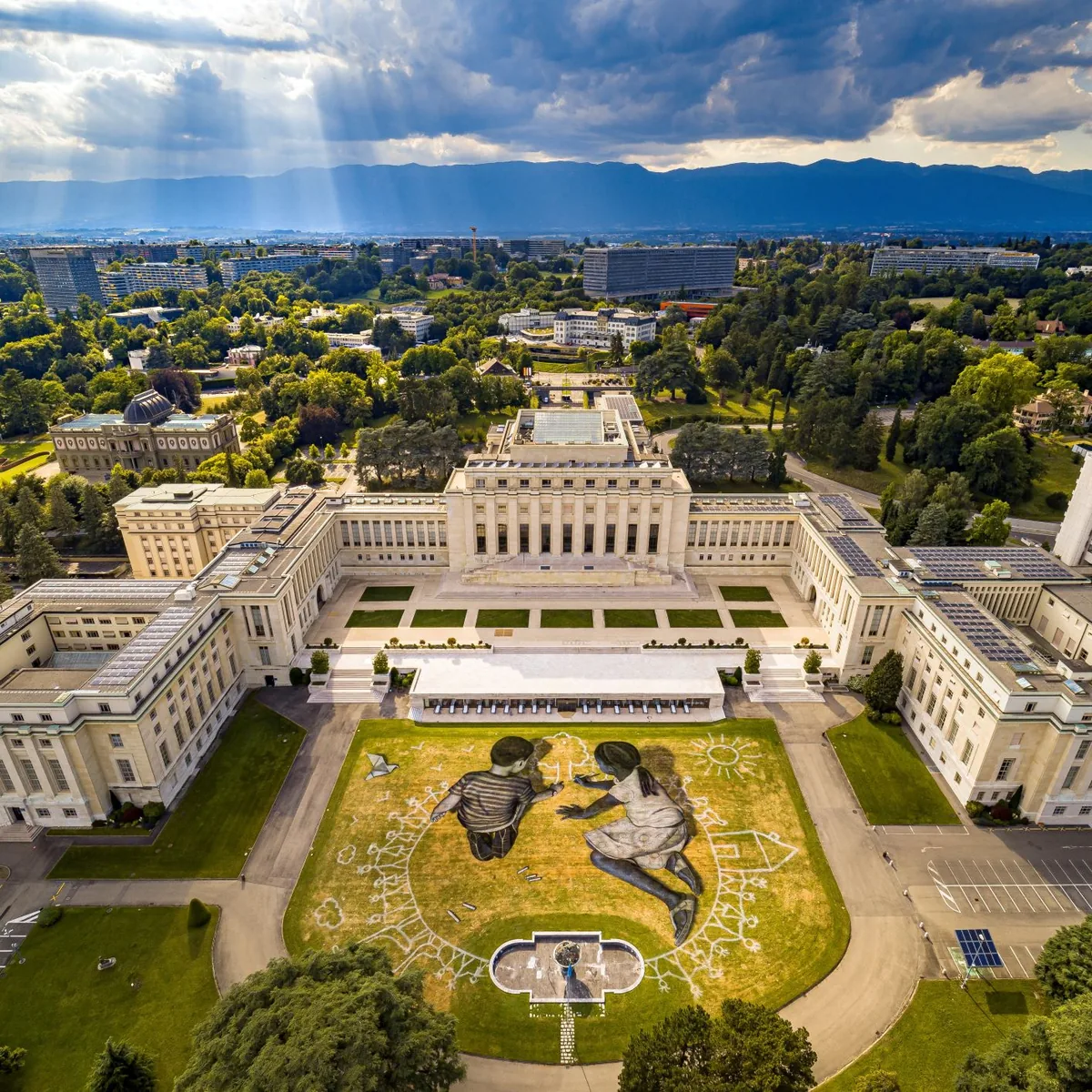
Palais des Nations, Switzerland
The League of Nations was established
The League of Nations was established by the Treaty of Versailles in 1919, Woodrow Wilson's great project for collective security, ratified by European powers but rejected by the United States Senate. Geneva was chosen as its home for its tradition of diplomatic neutrality and its existing infrastructure for international meetings. The Palais was designed between 1929 and 1936 through an international architectural competition eventually resolved by a committee, which produced the characteristic institutional architecture of the period, imposing without being aggressive, formal without warmth. The Hall of Nations, decorated by José Maria Sert with allegorical murals representing the continents, is the most significant interior; its ceiling, depicting the progress of humanity through knowledge and labour, is vast, ambitious, and slightly unnerving. When the League dissolved in 1946, the UN absorbed its premises, its assets, and a significant number of its staff. The continuity between the two organisations is architectural as much as institutional, the same desks, in many cases, the same corridors.
From Geneva's main station, tram line
From Geneva's main station, tram line 15 runs to the Nations stop at the Palais entrance in about fifteen minutes. On foot from the Old Town, the walk takes around twenty-five minutes uphill. Guided tours require advance booking and a valid passport or identity document for security clearance. The park is open to the public without booking during daylight hours.
Visiting Palais des Nations
The guided tours run in multiple languages and cover the Assembly Hall, the Human Rights and Alliance of Civilizations Room, decorated in 2016 by Spanish artist Miquel Barceló with a sculptural ceiling of 35 tonnes of pigmented clay, and the Council Chamber. The Barceló ceiling is the one detail that almost no visitor is prepared for: a cavern of colour, its surface carved into organic forms, the entire room feeling submerged under a reef of paint and plaster. The park itself, free to enter, holds the Broken Chair sculpture, the oversized three-legged chair positioned facing the Palais entrance, installed in 1997 as a symbol of opposition to landmines. At twelve metres high, it is visible from the road outside and functions as both protest and landmark. The view from the park's upper terrace on clear days takes in the entire arc of the lake and Mont Blanc beyond.
The Experience
Most of the Palais is administrative office space and conference rooms, the scale of the bureaucracy required to run global negotiations is not visible on a guided tour, but you feel its weight in the corridor proportions and the number of security passes clipped to every passing official. The moment that tends to recalibrate the visit is entering the Barceló Room. The Hall of Human Rights and Alliance of Civilizations, renovated in 2008 and 2013 and featuring Miquel Barceló's extraordinary ceiling, looks nothing like the rest of the building. The organic, cave-like surface overhead, 35 tonnes of pigmented clay in deep blues, greens, and ochres, transforms the room into something that seems geological rather than institutional. Standing beneath it, looking up, the discussions that take place here feel different than they do from outside.
Why It Matters
The Palais des Nations is the physical centre of the international humanitarian and legal system, not in theory but in practice. The rules that govern the conduct of war, the definition of refugee status, the frameworks for nuclear non-proliferation and chemical weapons prohibition were all negotiated in these rooms. The building's significance is not architectural but functional: it is where the world attempts, with varying success, to manage its worst impulses.
Why Visit
The UN is an abstraction until you stand in the Assembly Hall and see the chairs arranged for 193 member states, each with its nameplate, each delegation equidistant from the podium. The tour makes concrete what the evening news leaves theoretical. The Barceló ceiling alone is worth the booking.
Insider Tips
- 1
Tours require a valid passport or national identity document for security clearance, a driving licence is not accepted.
- 2
Book the English-language guided tour at least a week in advance during spring and autumn; the Barceló Room is not accessible without a tour.
- 3
The Broken Chair sculpture outside the entrance is on public ground and accessible at all hours without entering the Palais complex.
- 4
The park's upper terrace, near the rose garden, gives the clearest view of Mont Blanc across the lake on days when the summit is visible, typically best in early morning before haze builds.
- 5
Geneva's International Museum of the Red Cross and Red Crescent, a 10-minute walk from the Palais, provides context on the humanitarian law framework that the UN here administers.