The largest waterfall in Europe by volume is only 23 metres tall, its power comes entirely from the fact that the entire Rhine river is funnelled through a gap barely 150 metres wide.
About Rhine Falls
The falls are geological rather than historical, they formed 14,000 years ago when glacial meltwater carved a new channel across a shelf of resistant Jurassic limestone, creating a permanent cataract on the river that had previously flowed differently. Human history at the site organised itself around this fact: Castle Laufen was built above the south bank in the ninth century to control the portage point where river cargo had to be unloaded, carried past the falls, and reloaded downstream. The falls became a recognised tourist destination in the late eighteenth century, when Romantic aesthetics valued the sublime, landscapes that impressed through power rather than beauty. Turner visited in 1802 and painted multiple versions, fixing the falls in the popular imagination as a destination worth a significant journey. Ruskin visited; Goethe visited; the falls appeared in dozens of travel accounts that shaped the first generation of organised Alpine tourism. The industrial revolution briefly threatened them: Swiss industrialists proposed in the 1880s to divert part of the Rhine above the falls into a canal to power mills. The proposal was defeated by public opposition, one of the first instances in Switzerland of landscape protection overriding industrial development.
The Rhine Falls near Schaffhausen
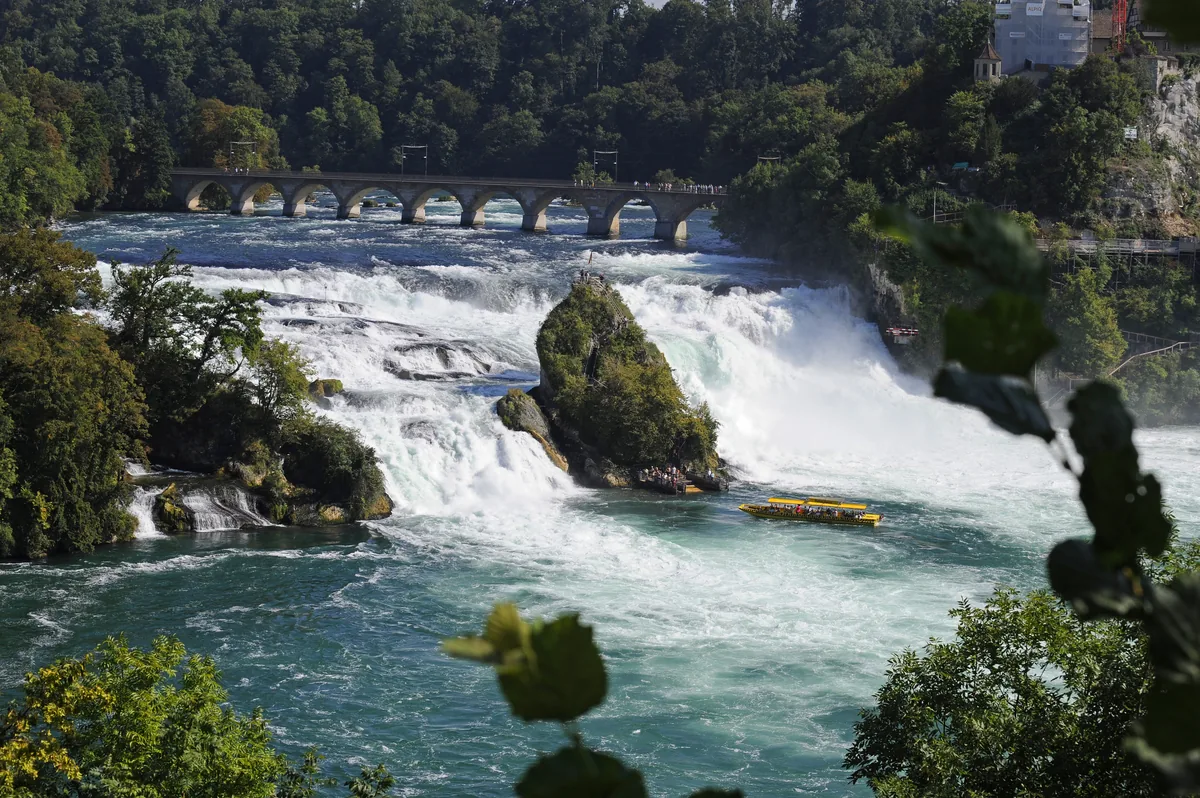
The Rhine Falls near Schaffhausen are the largest waterfall in Europe by volume, 600,000 litres per second at peak flow in June, and the fact that they are only 23 metres high makes them more impressive rather than less. The falls are not a drop so much as a collision: the entire Rhine, already a major river, compresses between limestone cliffs and erupts over a rocky shelf in a churning, permanent thunder that is audible 500 metres away. Two castle ruins frame the scene from either bank, and a central rock outcrop sits in the middle of the falls themselves, reachable by boat and accessible by ladder. The falls are genuinely dramatic and entirely unaffected by the number of visitors who arrive daily to photograph them. The water does not perform. It moves with the indifference of something that has been doing this for twelve thousand years.
The Rhine Falls formed
The Rhine Falls formed at the end of the last ice age, roughly 14,000 to 17,000 years ago, when glacial melting redirected the river across a shelf of hard Jurassic limestone that resisted erosion in a way that the surrounding rock did not. The result is a geological accident, the falls exist because of a specific interaction between post-glacial water volume and local rock hardness, not because of any dramatic topographic feature. Castle Laufen stands on the cliff directly above the southern bank, its foundations dating to the ninth century. The castle controlled the river crossing and extracted tolls from the river traffic that had to portage around the falls. Castle Wörth, smaller and less preserved, occupies the northern bank. Both are now managed as visitor facilities. J.M.W. Turner painted the falls in 1802 and produced several canvases that introduced the Rhine Falls to the Romantic imagination. Turner's version, all spray and dissolution of form, is more atmospheric than accurate, but it established the falls as a subject worth the journey from England, and the tourism infrastructure around Schaffhausen developed accordingly through the nineteenth century.
The proximity is what distinguishes
The proximity is what distinguishes the Rhine Falls from other large waterfalls. The boats that run from the south bank carry passengers to the central rock in the middle of the falls, a platform perhaps 30 metres from the main cascade, where the noise is total and the spray soaks everything within two minutes. A mark of the vibration of the water through the rock under your feet. Standing there, the falls are not scenic, they are physical. From Castle Laufen on the cliff above the south bank, a series of viewing platforms descends to the water level. The lowest platform is at approximately the same height as the falls' crest, and the view from there, across the full width of the falls, the spray catching the light, the central rock visible through the mist, is the one in every photograph. The light is best in morning, when the sun comes from the east and the spray catches it directly.
Schaffhausen is 40 minutes
Schaffhausen is 40 minutes by train from Zürich. The falls are 4 kilometres from Schaffhausen station, reachable by bus (line 6 to Neuhausen Zentrum) or by taxi. The south bank at Castle Laufen is the standard access point; the north bank at Castle Wörth provides a different angle and is connected by ferry during the operating season. Both banks are open year-round.
The Experience
The boat to the central rock takes about three minutes and deposits you on a platform with a railing, a Swiss flag, and a wall of noise and spray that makes conversation impossible. The mass of the cold immediately, the water at this volume displaces enough air to create its own microclimate, several degrees cooler than the bank. Most people spend five minutes on the rock; a few simply stand and let the experience register without trying to photograph it. From the lowest viewing platform at Castle Laufen, the full width of the falls is visible in a single frame. The two largest rocks in the cascade are named, Grosser Stein and Kleiner Stein, and they serve as reference points for understanding the scale. The mist drifts over the platform intermittently; on sunny mornings it carries a partial rainbow that appears and disappears with the wind.
Why It Matters
The Rhine Falls are significant as both a geological formation and a cultural landmark, the site that introduced the concept of the natural sublime to the first generation of British tourists making the Grand Tour. Turner's paintings of the falls, now in the Tate and in Swiss collections, were among the most important landscape images of the early nineteenth century, and the falls' power to overwhelm the human scale was a foundational experience in the development of Romantic aesthetics.
Why Visit
The Rhine Falls are not subtle. They are loud, cold, and persistently wet in a fifty-metre radius. The boat to the central rock is genuinely exciting in a way that most heritage sites are not, and the proximity to the main cascade, close enough to feel the vibration in your sternum, is not replicable from the viewing platforms on the bank. Go for the physical experience, not the photograph.
✦ Photo Gallery
Best Season
🌤 June brings peak flow, snowmelt from the Alps pushes volume to its maximum, and the falls are at their most powerful. The spray radius increases significantly and the noise carries further. Late September through October offers lower water, better visibility into the cascade structure, and smaller crowds. Avoid summer weekends when the boat queue to the central rock can exceed an hour.
Quick Facts
Best time to visit
June brings peak flow, snowmelt from the Alps pushes volume to its maximum, and the falls are at their most powerful. The spray radius increases significantly and the noise carries further. Late September through October offers lower water, better visibility into the cascade structure, and smaller crowds. Avoid summer weekends when the boat queue to the central rock can exceed an hour.
Getting there
In Schaffhausen, Switzerland; reach Schaffhausen first, then continue to the site.
What's nearby
Bahnhofstrasse, Grossmünster and Abbey Library of Saint Gall are also in the area.
Location
Schaffhausen, Switzerland
Type
attraction
Coordinates
47.6772°, 8.6158°
Insider Tips
- 1
The boat to the central rock departs from the south bank; buy the ticket that includes the rock landing rather than just the river cruise, which stays further from the falls.
- 2
Morning light from the east illuminates the spray directly, arrive before 10am for the rainbow effect on the mist from the south bank platforms.
- 3
Waterproof jacket and bag covers are sold at the boat landing; they are not unnecessary precautions, the spray soaks electronics at the central rock.
- 4
Castle Laufen's cliff-side viewing platforms are included in the castle entry fee, which also covers a small historical exhibit about the falls and the portage trade.
- 5
The north bank at Castle Wörth, connected by ferry, has fewer visitors and a different viewing angle, the falls appear wider from that side, the central rock less prominent.