“Three separate hilltop castles were built to guard a single valley, because whoever held this pass held the road between northern Europe and Milan.”
About Three Castles of Bellinzona
The valley at Bellinzona has been fortified since at least the Roman period, but the three-castle system was largely constructed under the Visconti dukes of Milan in the fourteenth and fifteenth centuries. The Visconti understood the pass geometry: a single castle could be bypassed or besieged; three interlinked strongpoints connected by walls made the valley effectively impassable to any force that could not sustain a prolonged campaign. The Swiss Confederation fought for control of Bellinzona through the latter half of the fifteenth century, losing and retaking the town repeatedly before securing it in 1503 under a treaty that divided governance among the three Forest Cantons of Uri, Schwyz, and Nidwalden. The city and its castles remained subject territory of the Confederation for three centuries, important enough to garrison, not important enough to modernise. Restoration of all three castles accelerated after the UNESCO listing in 2000, which brought both funding and tourism. Today Castelgrande and Montebello both contain museums; Sasso Corbaro functions primarily as an events and concert venue, its courtyard used in summer for open-air performances.
Bellinzona sits at the point where the Alps
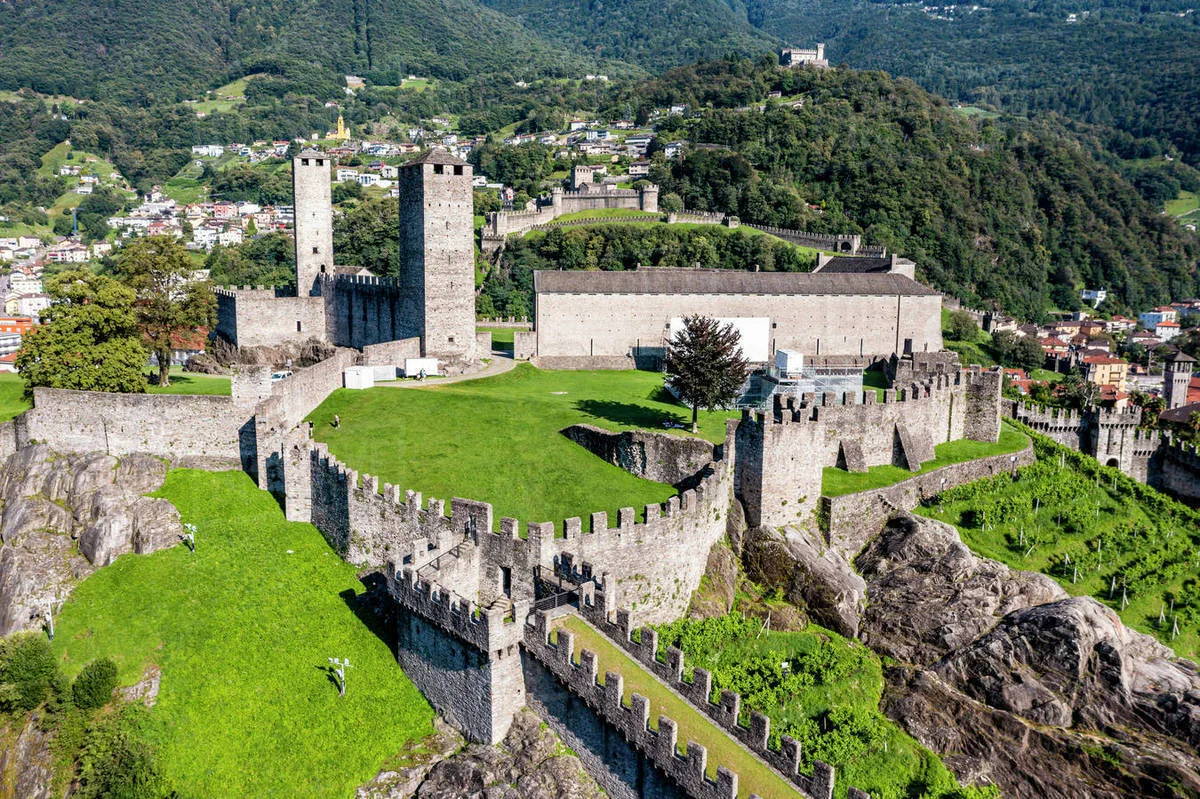
Bellinzona sits at the point where the Alps compress into a single valley before opening onto the Lombard plain, and the three castles that guard this chokepoint were built with precisely that geography in mind. Castelgrande crowns the central rock; Montebello commands the eastern hillside; Sasso Corbaro watches from the highest point to the southeast. Together with the defensive walls connecting them, they constitute the most complete medieval fortification system in the Alps, built by the Visconti and later the Swiss Confederation to control the most strategic transit point between northern Europe and Italy. All three are UNESCO World Heritage sites and all three are accessible on foot from Bellinzona's old town within twenty minutes. The combination of intact medieval architecture, the Ticino light, and the Italian character of the city below makes Bellinzona one of the more undervalued stops on any Swiss itinerary.
Castelgrande crowns the central rock; Montebello commands the eastern hillside; Sasso Corbaro watches from the highest point to the southeast.
Control of Bellinzona was worth fighting
Control of Bellinzona was worth fighting over because whoever held its valley held the key to the Alpine passes, the San Gottardo to the north, the Lucomagno and San Bernardino to the east. The Romans had a garrison here; the Lombards followed; the Visconti of Milan built the first serious stone fortifications in the fourteenth century, expanding Castelgrande and beginning Montebello to create a layered defence that required an attacker to take three separate strongpoints. The Swiss Confederation captured Bellinzona in 1503 after a century of contested control, and the three cantons of Uri, Schwyz, and Nidwalden governed it as a subject territory until the Helvetic Republic dissolved the old relationships in 1798. The city became the capital of the new canton of Ticino in 1803. The castles, no longer militarily relevant, were used variously as prisons, granaries, and administrative buildings before restoration began in the twentieth century.
Castelgrande is the most accessible
Castelgrande is the most accessible and the most dramatic, an elevator cut through the rock connects it to the old town, and the great tower at its summit is visible from every point in the valley. The interior holds a small museum and a restaurant whose terrace gives a direct view along the defensive wall toward Montebello, the middle castle, a fifteen-minute walk along the rampart. Montebello is better preserved internally, with a courtyard and residence that function as a museum of medieval armour and local history. Sasso Corbaro, the highest and most isolated of the three, requires a steeper climb but rewards it with the widest view, the full arc of the valley, both castles below, and the Alps closing the northern horizon with the San Gottardo massif directly visible on clear days.
Bellinzona is the capital of Ticino
Bellinzona is the capital of Ticino and a major railway junction, directly served by trains from Zürich (approximately 2 hours) and Lugano (20 minutes). The castles are all accessible on foot from the station; the walk to Castelgrande takes about 10 minutes, Montebello 20 minutes, and Sasso Corbaro 40 minutes. A combined ticket covering all three sites is available at any of the castle entrances.
Bellinzona is the capital of Ticino and a major railway junction, directly served by trains from Zürich (approximately 2 hours) and Lugano (20 minutes).
The Experience
Walking the rampart wall between Castelgrande and Montebello, about fifteen minutes on a path that follows the original defensive line, gives the clearest sense of the system's logic. You are on the medieval wall, looking down into the city on one side and across the valley toward the Alps on the other, and the sightlines that the medieval engineers calculated are still exactly right. Sasso Corbaro, the highest castle, requires the most effort and receives the fewest visitors. The courtyard at the top is large, quiet, and open to the sky, and the view from its walls encompasses the entire three-castle system simultaneously, Castelgrande below and to the left, Montebello to the right, the valley floor between them with Bellinzona's old town laid out in terracotta and grey.
Why It Matters
The Three Castles of Bellinzona are the best-preserved example of integrated medieval military architecture in the Alpine region, demonstrating how a medieval power understood and exploited mountain geography for strategic defence. The system was not merely defensive, it was also an economic tool, allowing the Visconti and later the Swiss to extract tolls from every merchant crossing the pass. The UNESCO listing recognises both the military and economic significance.
Why Visit
Bellinzona is typically treated as a railway junction rather than a destination, which is a significant error of judgement. The three castles are in better condition than comparable fortifications anywhere in Switzerland, the city below them has an Italian character that distinguishes it from every other Swiss cantonal capital, and the Saturday market in Piazza Nosetto directly below Castelgrande is one of the most authentic in Ticino. Allow a full day.
✦ Insider Tips
- 1
The combined ticket for all three castles is sold at any site and costs less than buying them separately; it is valid for two consecutive days, allowing you to split the visit across a morning and an afternoon.
- 2
The elevator inside the rock at Castelgrande connects the old town directly to the castle courtyard, take the stairs down on the return for the best view of how the rock face is integrated into the fortification.
- 3
Sasso Corbaro hosts open-air concerts in summer; the tourist office has the schedule, and attending an evening event there gives a different quality of experience from the daytime visit.
- 4
Bellinzona's Saturday market, held in Piazza Nosetto, runs from 7am to noon and sells local Ticino produce, Merlot wine, local salumi, polenta, in the shadow of Castelgrande.
- 5
The walk from Montebello to Sasso Corbaro on the marked trail takes about 25 minutes through mixed forest; bring water as there are no facilities between the two castles.