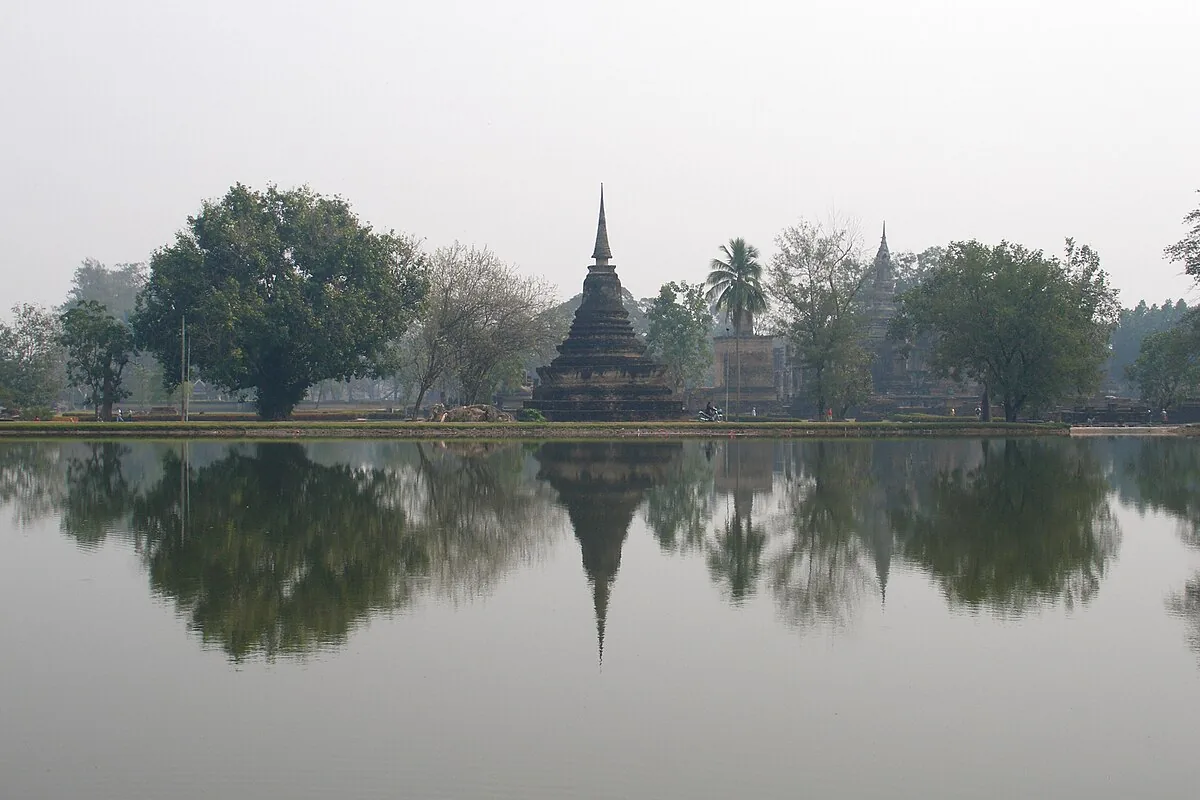
“Ancient Khmer towers that once honored Hindu gods now serve as a multi-story jungle gym for a thousand long-tailed macaques who effectively rule the city center.”
About Phra Prang Sam Yot
Lopburi, known anciently as Lavo, was a major provincial capital for the Khmer Empire. Phra Prang Sam Yot was the architectural centerpiece of this power, demonstrating the empire's ability to move massive amounts of stone across the plains. When the Ayutthaya Kingdom rose to power, they didn't destroy the site but adapted it, adding a large vihara or assembly hall. This adaptation saved the towers from the ruin that befell many other Khmer sites. Today, the monkeys are celebrated annually during the Monkey Buffet Festival, where tons of fruit are laid out on the ancient stones as a thank-you to the primates for drawing visitors.
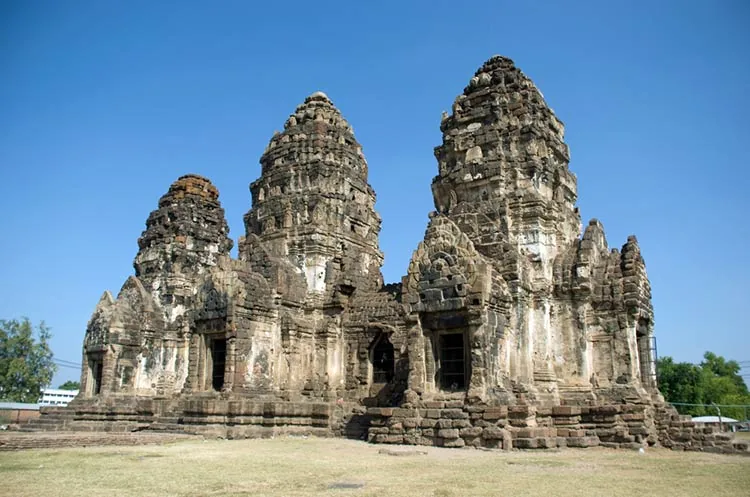
Phra Prang Sam Yot in Thailand
Three weathered towers of dark sandstone and laterite rise from a grassy island surrounded by the chaotic traffic and screeching trains of Lopburi. This 13th-century monument, built during the height of the Khmer Empire’s expansion into central Thailand, was originally dedicated to the Hindu trinity before being converted into a Buddhist shrine. Today, however, the gods are secondary to the site’s most famous inhabitants: hundreds of long-tailed macaques. The monkeys have made the ancient towers their own, swinging from the intricate carvings and sunning themselves on the lintels. It is a surreal sight where the dignity of ancient architecture meets the wild, unpredictable energy of a primate colony.
Three weathered towers of dark sandstone and laterite rise from a grassy island surrounded by the chaotic traffic and screeching trains of Lopburi.
Commissioned by King Jayavarman
Built during the reign of King Jayavarman VII, the site reflects the 'Bayon' style of Khmer architecture, characterized by its heavy stone blocks and towering prangs. It was intended to represent the Hindu deities Brahma, Vishnu, and Shiva, signaling the Khmer presence in the Chao Phraya River basin. In the 17th century, King Narai the Great of the Ayutthaya Kingdom renovated the site, converting it into a Buddhist temple and adding a brick prayer hall. This layering of history, Khmer, Hindu, Siamese, and Buddhist, makes it one of the most complex archaeological sites in the region. The monkeys, once considered servants of the gods, have lived here for generations, their population growing as the city expanded around their stone home.
The air is filled
The air is filled with a distinctive, pungent smell, a mix of old stone, monkey musk, and the fruit offered by tourists. The constant chattering and screeching of the macaques, punctuated by the metallic clang of them jumping onto the nearby fence or the overhead wires. A mark of the rough, cool texture of the laterite blocks, though you must be careful where you step to avoid the remnants of the monkeys' meals. The incredible detail still visible in the stucco carvings, despite the centuries of weathering and the constant climbing of nimble paws. The light at midday is harsh, reflecting off the dark stone, but at sunset, the towers cast long, dramatic shadows over the surrounding modern buildings.
Lopburi is easily reached
Lopburi is easily reached by train from Bangkok’s Krung Thep Aphiwat Central Terminal, a journey of about two hours that drops you off just a few minutes’ walk from the ruins. Most people arrive by rail, as the train tracks run directly alongside the ancient sites, offering a spectacular view of the towers as you pull into the station. Once in town, the site is centrally located and best explored on foot.
Lopburi is easily reached by train from Bangkok’s Krung Thep Aphiwat Central Terminal, a journey of about two hours that drops you off just a few minutes’ walk from the ruins.
The Experience
You feel a constant sense of alert as you walk through the grounds, as the monkeys are far from shy and will happily investigate any loose items on your person. You catch of the city, the hum of motorbikes and the train whistle, blends strangely with the primal noises of the colony. The detail that hits is how the macaques have adapted to the architecture, using the deep niches intended for statues as nursery spots for their young. The most haunting moment is stepping inside the central prang, where the air is still and the walls are blackened by time, offering a brief escape from the chaos of the monkeys outside.
Why It Matters
Phra Prang Sam Yot is the most significant Khmer-era landmark in central Thailand. It serves as a physical reminder of the 'Lavo' period and the cultural exchange between the Khmer and the burgeoning Siamese states. Human-wildlife conflict and coexistence are lived here every day, making it a unique study in urban ecology and heritage preservation.
Why Visit
The spectacle. Nowhere else in the world provides such a direct confrontation between ancient history and wild nature in the middle of a modern city. It is a place that reminds you that nature always reclaims what man builds, even if it does so with a sense of humor and a bit of chaos.
✦ Insider Tips
- 1
Secure all loose items like sunglasses, hats, and earrings before entering the site; the monkeys are expert pickpockets.
- 2
Carry a small stick or a folded umbrella, not to hit the animals, but to act as a deterrent if a particularly bold macaque tries to climb you.
- 3
Visit the interior of the towers to see the bat colonies that share the space with the monkeys, but be prepared for the strong smell.
- 4
Park your car or motorbike away from the immediate vicinity of the temple, as the monkeys are known to tear off windshield wipers and mirrors.
- 5
Buy a bag of sunflower seeds from the local vendors if you want to feed them, but be prepared to be swarmed by dozens of eager recipients.