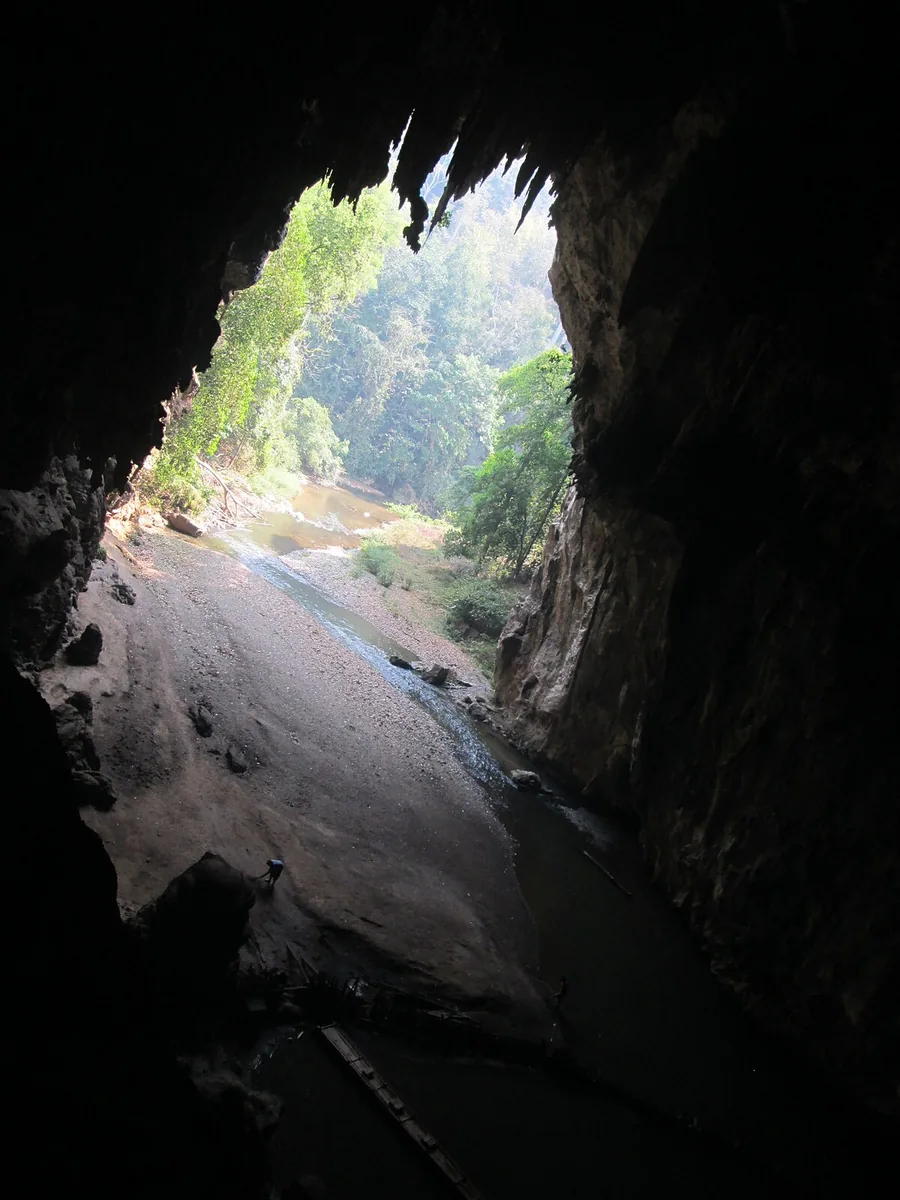
Thousands of swifts and bats trade places in a spectacular sunset aerial dance at the mouth of a cave where 2,000-year-old teak coffins still sit on high stone ledges.
About Tham Lod Cave
Archaeologists first became interested in Tham Lod in the 1960s, discovering that it served as a shelter for hunter-gatherers during the late Pleistocene. The 'Log Coffin' culture remains one of the region's great mysteries, as no one is entirely sure how they hoisted the massive teak trunks onto the precarious ledges. The cave's ecosystem is also unique, supporting a specific species of blind cave fish that lives only in these subterranean waters, thriving in a range of absolute darkness.
Tham Lod Cave in short
A prehistoric river carves a 1,500-meter-long tunnel through a limestone mountain in Mae Hong Son province, creating one of the most dramatic cavern systems in Southeast Asia. Tham Lod is not a static cave; the Lang River still flows through it, allowing visitors to navigate the darkness on bamboo rafts guided by locals with kerosene lamps. The ceiling towers up to fifty meters in height, adorned with massive stalactites and columns that have taken millennia to form. Beyond the geological scale, the cave is a significant archaeological site, housing ancient teak wood coffins believed to have been carved by the Lawa people over two thousand years ago.
History
The cave has been a site of human activity for at least 30,000 years, as evidenced by the stone tools and ceramic shards found deep within its chambers. The most mysterious residents were the 'Log Coffin' culture, who placed their dead in massive, hollowed-out teak trunks on high limestone ledges within the cave. These coffins, some still visible today, suggest a sophisticated understanding of wood preservation and a complex belief system regarding the afterlife. The cave remained largely the domain of local Shan and hill tribe communities until the late 20th century, when it was integrated into the Tham Pla-Namtok Pha Suea National Park, though it continues to be managed by the local villagers.
Visiting Tham Lod Cave
The air is cool and damp, smelling of river water and the heavy musk of thousands of swifts and bats. The rhythmic splash of a bamboo pole in the water and the sudden, high-pitched chirps of the birds as they return to their nests at dusk. The only light comes from the flickering orange flame of your guide's lamp, which casts long, dancing shadows against the limestone curtains and pillars. As you climb the rickety wooden ladders to reach the upper chambers, the smooth, ancient surface of the flowstone. The 'Big Pillar,' a massive column of stone that connects the floor to the ceiling, standing like a sentinel in the dark. Located near the small village of Sop Pong, the cave is about a four-hour drive from Chiang Mai via the famously winding road to Mae Hong Son. The bulk of visitors base themselves in the nearby town of Pai and take a one-hour scenic drive through the mountains. To explore the cave, you must hire a local guide and a raft at the entrance; the guides are mandatory and provide the necessary lighting to navigate the pitch-black interior safely.
The Experience
You pick up a sense of primitive wonder as your bamboo raft drifts into the gaping mouth of the cave, the sunlight slowly fading behind you. The clatter of the river is a constant, low-frequency hum that amplifies the scale of the space. The standout is the flickering lamp light revealing the 'dolls' and 'monsters' in the rock formations, a game of shadows played by your guide. The most incredible moment occurs at the entrance at dusk, when the sky turns purple and a ribbon of black bats exits the cave just as a ribbon of white swifts enters it, a perfect, natural clockwork that has functioned for eons.
Why It Matters
Tham Lod is one of the most important archaeological sites in Northern Thailand, offering a rare look at the burial customs of a vanished prehistoric culture. It is also a prime example of community-based tourism, where the management of the site remains in the hands of the local villagers who have known the cave for generations.
Why Visit
It is a rare chance to explore a massive cave system without the artificial glare of electric lights and paved walkways. The experience of the bamboo raft and the kerosene lamp makes you feel like an early explorer, providing a raw, sensory connection to the earth that modern tourist sites usually strip away.
✦ Photo Gallery
Best Season
🌤 From the dry season beginning November to April is the only time the river level is safe for rafting through the entire length of the cave; during the monsoon, the cave often floods and becomes inaccessible.
Quick Facts
Best time to visit
From the dry season beginning November to April is the only time the river level is safe for rafting through the entire length of the cave; during the monsoon, the cave often floods and becomes inaccessible.
Getting there
In Mae Hong Son, Thailand; reach Mae Hong Son first, then continue to the site.
What's nearby
Wat Phra That Doi Suthep is also close by.
Location
Mae Hong Son, Thailand
Type
attraction
Coordinates
19.5719°, 98.2772°
Insider Tips
- 1
Arrive about an hour before sunset so you can explore the interior and then wait at the mouth of the cave for the spectacular bird-bat exchange.
- 2
Wear shoes with good grip, as the wooden stairs to the upper chambers are often wet and can be very slippery.
- 3
Keep your mouth closed when looking up at the ceiling; the bat guano is plentiful and the inhabitants are active.
- 4
The guides speak limited English but are masters of pointing out the most interesting rock shapes; follow their lead carefully.
- 5
Bring a headlamp if you want to see more of the details, but keep it pointed down to avoid blinding your guide or the wildlife.