A tattooed man whispers a secret into a woman's ear on a crumbling temple wall, capturing a moment of flirtation that has outlasted empires and survived centuries of mountain fog.
About Wat Phumin
Nan was an independent kingdom for centuries, isolated by high mountain ranges that kept the central Siamese influence at bay. This autonomy allowed a unique aesthetic to flourish, blending Lanna traditions with the folk art of the Tai Lue people. In 1867, when the temple underwent its most significant renovation, the murals were painted using natural pigments like powdered stone and bark. They serve as a rare historical ledger, documenting everything from traditional weaving patterns to the curious facial hair of early European explorers who were beginning to infiltrate the northern hills.
What Wat Phumin actually is
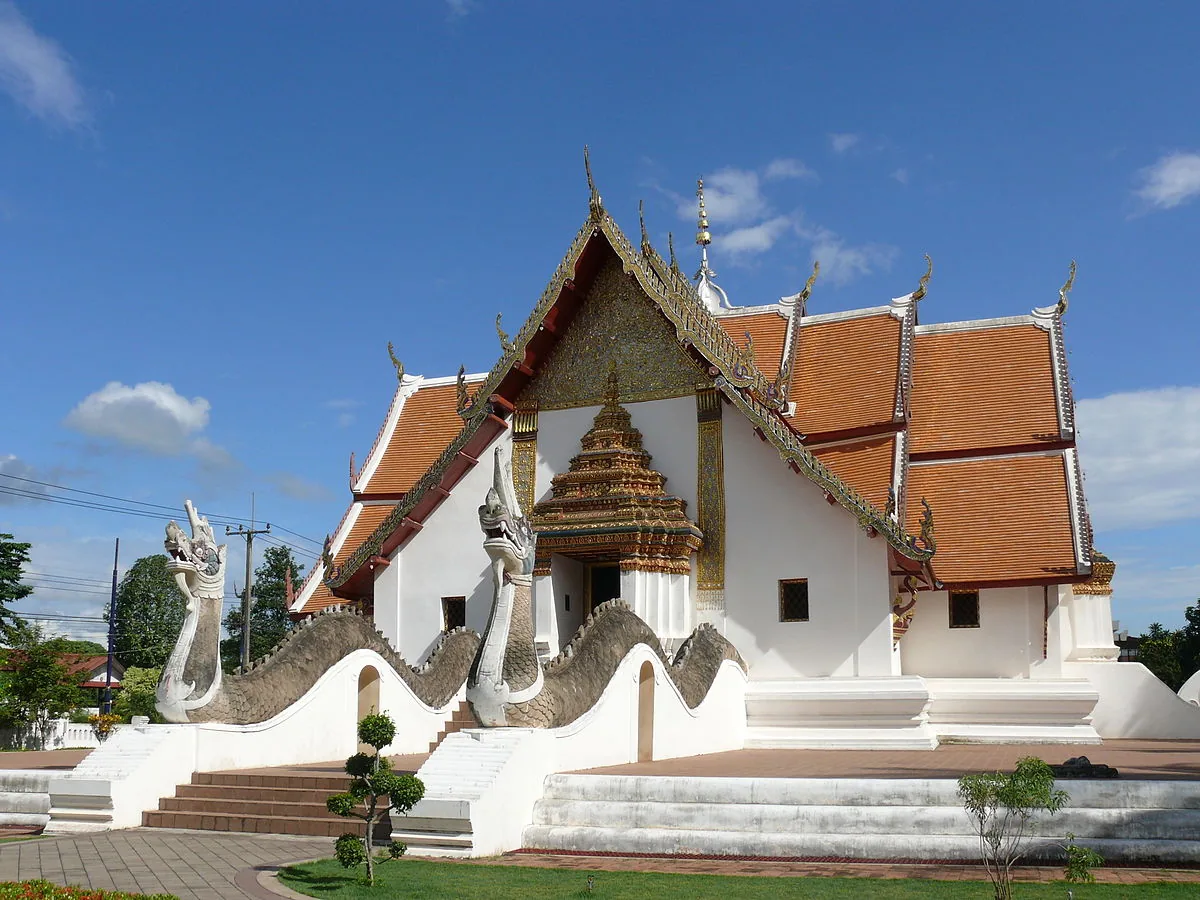
Nan remains a quiet frontier in Northern Thailand, a place where the Lanna pulse beats slower and more deliberately than in the frantic streets of Chiang Mai. At its spiritual center stands a temple that defies the standard geometry of Southeast Asian worship. Instead of a linear hall, this 16th-century cruciform structure faces the cardinal points, anchored by four back-to-back gilded Buddhas that gaze outward into the valley. While the architecture is striking, the true soul of the building lives on its interior walls. Here, nineteenth-century murals depict a vivid, secular world of Tai Lue villagers, star-crossed lovers, and colonial intruders, all painted with a mischievous intimacy that feels more like a shared secret than a religious lesson.
Founded the temple, 1596
Prince Jao Jetabutr Phrommin founded the temple in 1596, but the version that captures the imagination today is the result of a massive restoration in the late 1800s. During this time, a Tai Lue artist named Thit Buaphan was commissioned to decorate the interior. Unlike the stiff, courtly styles found in Bangkok, Buaphan captured the grit and grace of the Nan Valley. He painted local life as it was, including the arrival of the French and the British, subtly weaving geopolitical tensions into the background of village gossip. The most famous image, the Whisperer, depicts a man leaning into a woman’s ear, a scene so evocative it has become the unofficial symbol of the province.
The air inside the temple stays remarkably cool , shielded by thick teak doors and heavy masonry. The scent of old wood and the faint, sweet trail of jasmine incense left by morning devotees. Light enters in narrow, dusty shafts through the small windows, illuminating the intricate floor-to-ceiling murals in fragments. The soft creak of floorboards moving around the central pillar, following the gaze of the four massive Buddhas. The silence is profound, broken only by the occasional flutter of a sparrow in the rafters. The textures of the wall are rough and honest, showing the aging of vegetable dyes and earth pigments that have survived for over a century.
Reaching Nan requires a bit
Reaching Nan requires a bit of dedication, usually involving a long bus journey from Chiang Mai or a short domestic flight from Bangkok. The temple sits in the middle of the old town, a short walk from the provincial museum. Most visitors explore the area by bicycle, as the streets are flat and traffic is blissfully sparse compared to the rest of the country.
The Experience
Something strange sense of voyeurism as you walk through the dim interior, as if you have stumbled into a private conversation rather than a place of worship. The murals don't just depict the life of Buddha; they show people smoking pipes, children playing in the dirt, and the subtle lean of a body in love. First, the way the light catches the gold leaf on the central statues, creating a halo effect that contrasts with the earthy, matte finish of the surrounding stories. The most striking thing is the lack of barriers; you are close enough to see the individual brushstrokes of an artist who died long before electricity reached this valley.
Why It Matters
Wat Phumin acts as a cultural bridge between the sacred and the profane. It is widely considered the finest example of Northern Thai folk art, preserving the dialect, dress, and daily rituals of a vanished era. It challenges the notion that religious sites must be austere, proving that the divine can be found in the mundane details of human life.
Why Visit
The intimacy. While Bangkok’s temples offer grandeur and gold, Wat Phumin offers a human connection. It is one of the few places in Thailand where you can look at art from the 1800s and see a reflection of yourself, your desires, your humor, and your curiosity, staring back from the plaster.
✦ Photo Gallery
Best Season
🌤 November through February provides the crisp, cool mornings that define Northern Thailand, ensuring the light is soft and the mountain air is clear of the smoke that occasionally drifts in during the later planting season.
Quick Facts
Best time to visit
November through February provides the crisp, cool mornings that define Northern Thailand, ensuring the light is soft and the mountain air is clear of the smoke that occasionally drifts in during the later planting season.
Getting there
In Nan, Thailand; reach Nan first, then continue to the site.
Location
Nan, Thailand
Type
attraction
Coordinates
18.7747°, 100.7716°
Insider Tips
- 1
Visit just after sunrise when the local monks are finishing their chants and the light hits the 'Whisperer' mural at a perfect, raking angle.
- 2
Look for the depictions of the 'westerners' in the murals; their exaggerated features offer a hilarious glimpse into how the Tai Lue perceived early explorers.
- 3
Hire a local student guide who can point out the specific Tai Lue idioms and dirty jokes hidden within the smaller scenes of the paintings.
- 4
Take time to notice the serpent balustrades outside; the tails of the nagas enter through the back of the building and the heads emerge at the front.